







By Bianca Mahere
Introduction: What the Marriages Act changed
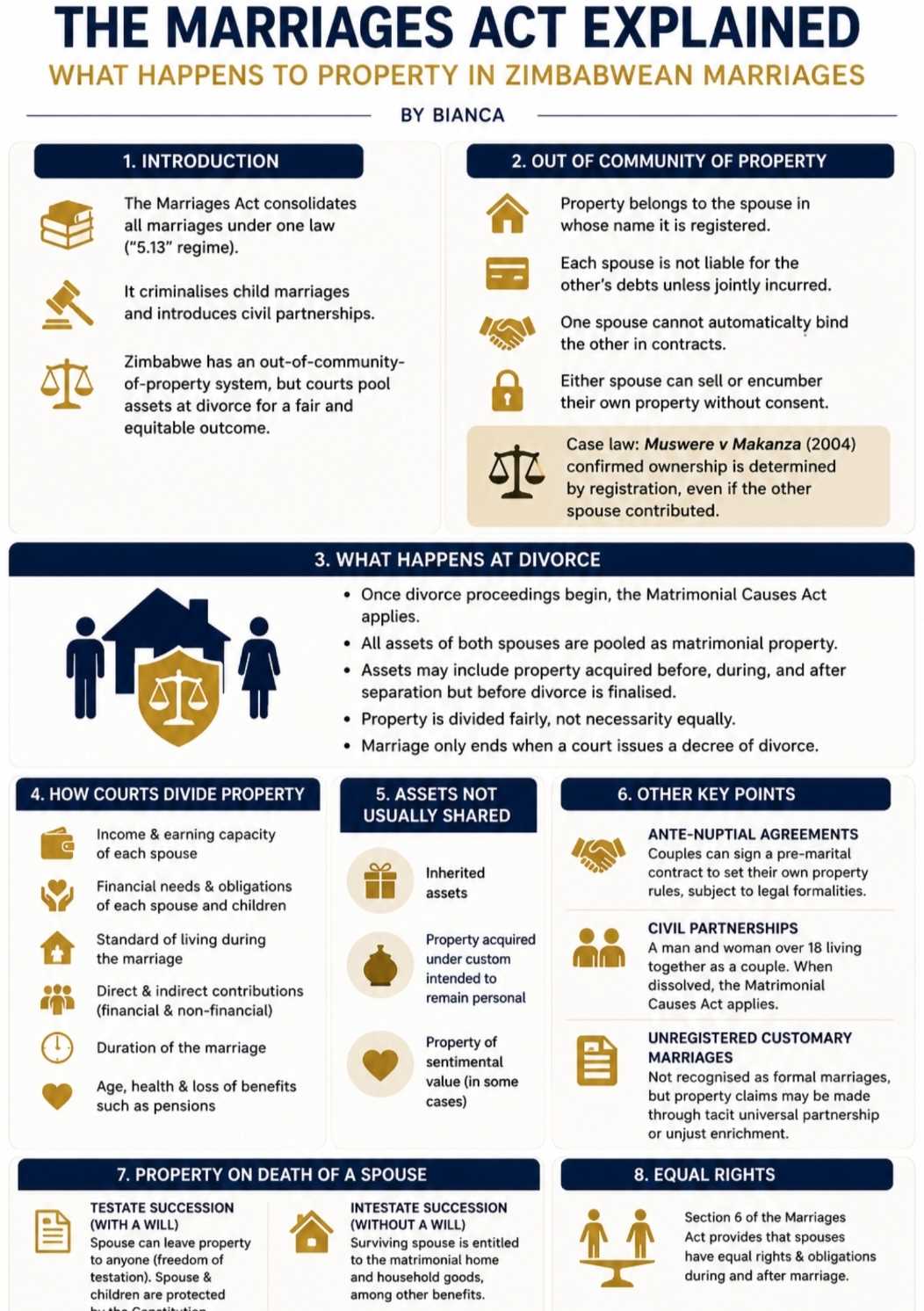
The main purpose of the Marriages Act is to consolidate the law relating to marriages. The distinction between a “5.11 marriage” (former Chapter 37) and a “5.07 marriage” (former registered customary marriage) no longer exists. All marriages now fall under the “5.13” regime.
The Act introduces key reforms, including the criminalisation of child marriages and the introduction of civil partnerships. A civil partnership is not a marriage, but it can still create property consequences when it is dissolved.
Although Zimbabwe maintains an out-of-community-of-property system, this separation becomes less clear at divorce, where courts often pool assets to achieve a just and equitable distribution.
Marriage: Out of Community of Property
All marriages in Zimbabwe are out of community of property unless spouses sign an antenuptial contract before marriage.
This means:
Property belongs to the spouse in whose name it is registered
Each spouse is not liable for the other’s debts unless jointly incurred
One spouse cannot automatically bind the other in contracts
Either spouse may deal with property registered in their name without consent
A key case, Muswere v Makanza (2004), confirmed that even where a spouse contributes to property, ownership is determined by registration. The court held that a wife could not stop her husband from selling property registered in his name, even if she contributed directly or indirectly.
In simple terms, during marriage, each spouse legally controls their own property.
What changes at divorce
The legal position shifts once divorce proceedings begin under the Matrimonial Causes Act [Chapter 5:13].
At this stage, all assets of both spouses may be considered together and treated as a matrimonial property pool.
This means:
Property is no longer viewed separately
Assets may include property acquired before marriage, during marriage, and even after separation but before divorce is finalised
Division is based on fairness, not ownership alone
Marriage only ends when a court grants a decree of divorce.
How courts divide property
Courts do not apply a strict 50/50 rule. Instead, they aim for fairness based on several factors, including:
-Income and earning capacity of each spouse
-Financial needs and obligations of each spouse and children
-Standard of living during the marriage
-Age and physical or mental condition
-Direct and indirect contributions to the family
-Duration of the marriage
-Loss of benefits such as pensions or gratuities
The court’s aim is to place spouses and children, as far as possible, in the position they would have been in if the marriage had continued.
The Contribution Principle
A central factor in property distribution is contribution.
Courts recognise both:
-Direct contributions (financial input, receipts, bank transfers)
-Indirect contributions (childcare, domestic work, emotional support, career sacrifice)
This means a spouse who did not earn income may still receive a share if they contributed to the household or supported the other spouse’s success.
Assets that may be excluded
Not all property is automatically shared. Some assets may be excluded from distribution, including:
-Property acquired through inheritance
-Property held under custom intended to remain personal
-Property with strong sentimental value
-Assets acquired after separation
-Assets acquired after separation but before divorce are still considered matrimonial property.
This is because, in law, a marriage only ends when the court issues a decree of divorce.
Related Stories
Ante-Nuptial Agreements
Spouses may enter into an Ante-Nuptial Agreement before marriage to set their own property rules.
These agreements:
-Must meet legal formalities, including registration
-Allow parties to depart from default rules
-Can define how property will be shared on divorce
In Zimbabwe, such agreements may either reinforce separation or set agreed distribution rules between spouses, sometimes including a 50/50 arrangement instead of court-based fairness.
Civil Partnerships
A civil partnership is a relationship where a man and woman (18+) live together as a couple without being married.
Courts assess factors such as:
-Duration of the relationship
-Shared residence
-Financial dependence or interdependence
-Property use and ownership
-Commitment and public presentation
A civil partnership is not a marriage, but when it ends, the Matrimonial Causes Act applies with necessary adjustments, meaning property may still be divided.
Unregistered customary marriages
Unregistered customary unions are not recognised as formal marriages under the Act.
To claim property, a person must prove:
-That a customary union existed (often through lobola)
-That it has been terminated
-That general law applies instead of customary law
A legal basis for the claim
Common legal grounds include:
-Tacit universal partnership
-Unjust enrichment
Zimbabwe law recognises freedom of testation, meaning a person may leave property to anyone, even disinheriting a spouse.
However, constitutional protection under section 26(d) requires the State to ensure protection of spouses and children after dissolution of marriage.
This may include allowing continued occupation of the matrimonial home in certain cases.
Intestate succession (no will)
Where a spouse dies without a will, the Deceased Estates Succession Act applies.
A surviving spouse is entitled to:
-The matrimonial home
-Household goods and effects
-These rights apply only after death, not during marriage.
Disputes may be handled under the Administration of Estates Act.
Recognised marriages in Zimbabwe
Section 5 of the Marriages Act recognises:
Civil marriages (monogamous)
Customary marriages (potentially polygamous)
A lobola ceremony alone is not a marriage. However, unregistered customary unions should be registered within three months, though failure to register does not invalidate children’s rights.
Equal rights in marriage
Section 6 provides that spouses have equal rights and obligations during and after marriage.
The application of this principle in customary and polygamous contexts remains a developing legal question.
Conclusion
Zimbabwe’s marriage law is based on separation of property during marriage, but fairness-based redistribution at divorce.
Courts consider both financial and non-financial contributions to ensure equitable outcomes.
At death, succession is governed by wills or intestate law, supported by constitutional protections for spouses and children.
Understanding these rules is key to navigating marriage, divorce, and inheritance in Zimbabwe.






Leave Comments