





The government is currently trying to change Zimbabwe’s Constitution through a piece of legislation known as Constitution Amendment No. 3 Bill (CAB 3). Because the Constitution is the country’s supreme law, changing it isn't like passing a normal law—it requires a long, strict process in Parliament.
Here is a simplified, jargon-free breakdown of exactly where the Bill stands right now, and the hurdles it must clear to become law.
1. Where is the Bill right now?
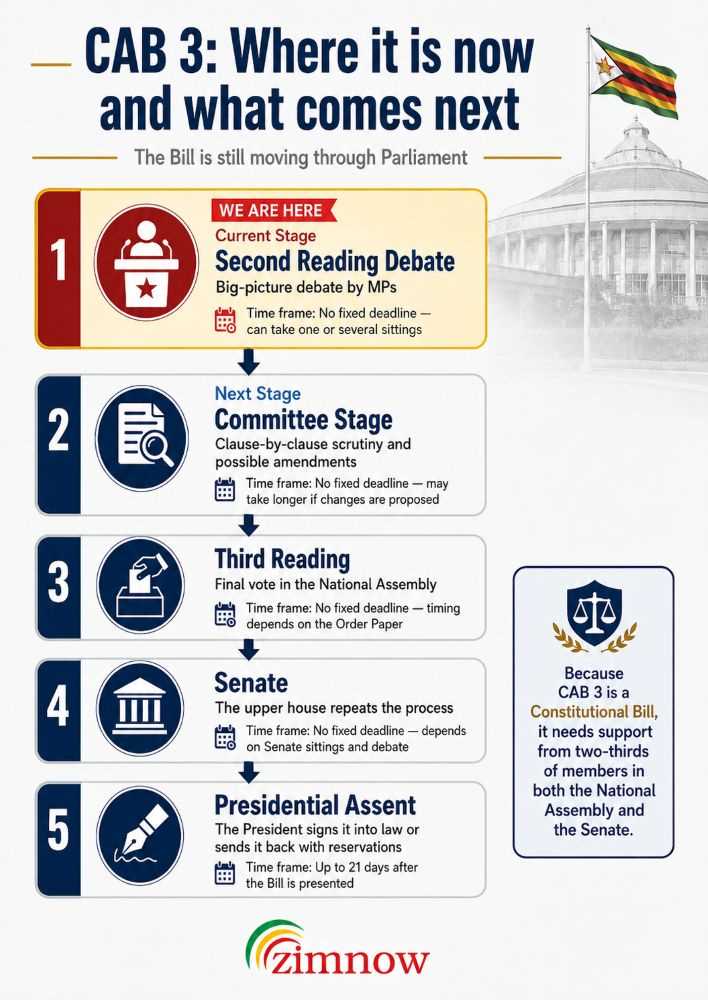
Right now, the Bill is in the National Assembly (the lower house of Parliament) at a stage called the Second Reading.
What that means: Members of Parliament (MPs) are currently arguing over the big picture. They are debating whether the basic ideas and goals of this amendment are good or bad for the country.
The Status: Parliament stopped mid-debate last week, so they restarted the discussion right back up on Tuesday.
2. The Multi-Step Journey: What happens next?
| Stage | What happens |
|---|---|
| Second Reading Debate | Can take one sitting or several sittings, depending on debate. |
| Committee Stage | Can be quick if there are few amendments, but may take longer because MPs examine the Bill clause by clause. |
| Third Reading | Usually follows after Committee Stage and any required reports, but timing depends on the Order Paper. |
| Senate process | The Senate must also pass the Bill. For a Constitutional Bill, the final vote in each House requires support from two-thirds of the membership. |
| Presidential Assent | The President must sign it within 21 days or refer it back to Parliament with reservations. |
| Gazetting / coming into force | After assent, publication in the Gazette follows. An Act comes into operation on publication day unless another date is specified. |
If the Bill survives the current debate, it has a long ladder to climb before it actually becomes law. Here is the exact order of events:
[Current Stage] Second Reading Debate (Big picture discussion) ↓ [Next Stage] Committee Stage (Looking at the fine print, line by line) ↓ Third Reading (The final vote in the National Assembly) ↓ The Senate (The upper house of Parliament must repeat the whole process) ↓ Presidential Assent (The President signs it into law)
The Fine-Print Check (Committee Stage): If MPs vote "yes" on the big picture, they immediately move to the Committee Stage. Here, they look at the Bill line-by-line, word-by-word. If they don't like a specific sentence, they can change or delete it.
Related Stories
The Final Lower-House Vote (Third Reading): Once the wording is finalized, the National Assembly votes one last time to officially pass it out of their hands.
3. The "Two-Thirds" Rule (Why this is a tough test)
Passing a regular law is easy—you just need more people in the room to vote "yes" than "no." But changing the Constitution is much harder.
To pass, CAB 3 needs a supermajority of two-thirds of all members.
The catch: This doesn't mean two-thirds of the MPs who show up to vote that day. It means two-thirds of every single seat in Parliament. If MPs stay home orare absent, it counts against the Bill. If they can't hit this high number, the Bill dies instantly.
4. It's not over even if the National Assembly says "Yes"
Even if the National Assembly passes the Bill, it still faces three major hurdles:
The Senate: The Bill travels to the upper house of Parliament (the Senate). Senators have to debate it and vote on it all over again. They also must hit that strict two-thirds majority rule.
The President's Pen: If the Senate also passes it, the Bill goes to the President. It only becomes official law once the President signs it (called "assent") and it is published in the government's official record book (the Gazette).
The Courts: Even after it is signed, people who oppose the law can sue the government. They might argue to the judges that Parliament skipped a legal step, or that the change is so massive it required a nationwide public vote (a referendum) first.
What to watch for:
Keep your eyes on the vote counts. The ultimate fate of CAB 3 depends entirely on whether its supporters can get enough politicians into their seats to clear that strict two-thirds voting hurdle in both the National Assembly and the Senate.









Leave Comments