





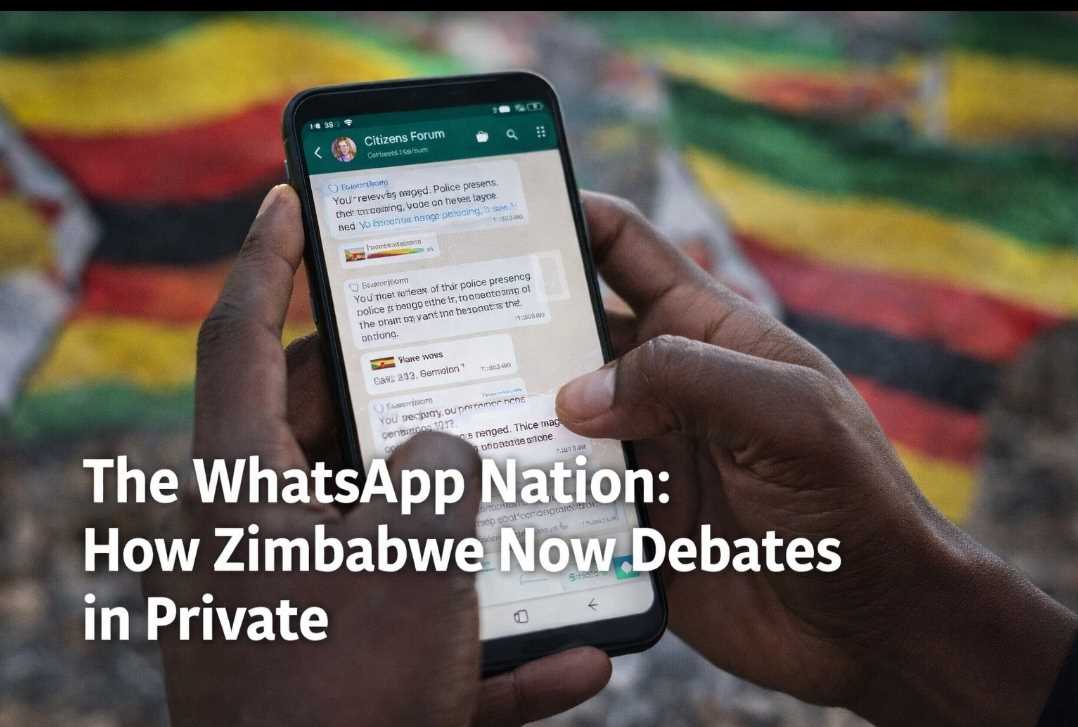
Simbarashe Namusi
Zimbabwe is no longer a loud country.
It is a connected one.
Across cities, towns and growth points, the national conversation has not disappeared — it has simply migrated. Quietly, efficiently and almost invisibly.
Welcome to Zimbabwe’s new public square: WhatsApp.
There was no national announcement, no policy shift and no formal reform. Yet a profound transformation has taken place. Today, some of the country’s most honest political discussions are no longer happening in Parliament, on radio talk shows or at public meetings. They unfold instead inside WhatsApp groups — family chats, church forums, burial societies, residents’ associations and alumni networks.
Within these digital rooms, Zimbabweans analyse policies, criticise leadership decisions and debate national issues with striking openness. But they do so away from public visibility and, crucially, away from potential consequences.
The migration of debate is less about technology than it is about political adaptation. Over time, public spaces have become increasingly difficult to navigate for citizens holding dissenting views. Public meetings have grown tense, alternative voices are sometimes dismissed, and individuals expressing unpopular opinions risk social isolation or political labelling.
The lesson has been absorbed quietly: not every opinion feels safe in public.
Zimbabweans have therefore not fallen silent; they have simply moved their conversations elsewhere.
On the surface, the country appears calmer. Public events proceed with limited confrontation, official narratives face little visible resistance, and the national mood can seem subdued. Yet this calm masks a nation engaged in constant discussion — debate that now exists largely beyond public view.
This invisibility creates a growing disconnect between citizens and leadership. Governments respond to what they can see, measure and hear publicly. When disagreement retreats into private digital spaces, leaders may mistake silence for consensus.
Related Stories
Zimbabwe has consequently become a nation of forwarded messages. Information circulates rapidly through closed networks, often faster than verification can keep pace. Opinions reinforce one another within familiar circles, while correction and accountability remain inconsistent.
The result is a population that is highly engaged but unevenly informed.
WhatsApp offers a powerful sense of participation. Citizens comment, react, share voice notes and debate passionately. Yet governance does not respond to forwarded messages. It responds to visible, collective pressure — the kind historically expressed through organised civic engagement, public dialogue and institutional participation.
As debate moves inward, citizens unintentionally weaken their public influence.
For those in authority, this shift carries advantages. Discontent still exists, but it is fragmented across thousands of private conversations. Without visible unity or sustained public pressure, governance proceeds with fewer challenges and less scrutiny — not because agreement exists, but because disagreement has been decentralised into silence.
WhatsApp has achieved something remarkable: it has ensured Zimbabwe continues talking. But it has also introduced a paradox. A nation that debates primarily in private risks becoming easier to ignore in public decision-making spaces.
Policies are not changed in group chats. Systems are not reformed through broadcasts. Accountability cannot be enforced through emojis or disappearing messages.
At some point, conversation must leave the inbox.
The challenge is not to abandon private digital spaces but to reconnect them with public life — to transform opinion into participation and discussion into engagement. Democratic societies depend on spaces where disagreement is visible, tolerated and expected.
A country where everyone speaks only in private is not necessarily stable.
It may simply be suppressed.
And a nation that can only whisper its truths risks eventually losing the courage to speak them aloud at all.
Simbarashe Namusi is a peace, leadership and governance scholar and media expert writing in his personal capacity.






Leave Comments