




After a decade-long pause, the India-Africa Forum Summit (IAFS-IV) returns to New Delhi from May 28 to 31, bringing together leaders from across the African continent, the African Union Commission, and regional organisations to map the future of a partnership that has quietly grown into a US$100 billion trade relationship.
With Indian investments already embedded in the Zimbabwe’s energy sector, defence cooperation, and education system, the outcomes in New Delhi could shape Harare's development trajectory for years to come.
The Summit at a Glance
India's External Affairs Minister Dr. S. Jaishankar unveiled the summit's logo, theme and official website on April 23, describing the upcoming gathering as one that will "shape the next phase of our partnership—one that is more ambitious, more inclusive, and more future-oriented."
The theme, "IA SPIRIT: India Africa Strategic Partnership for Innovation, Resilience, and Inclusive Transformation," is a deliberate acronym. "SPIRIT" captures what Indian officials describe as a relationship that goes beyond transactions, one marked by shared values, mutual respect, and solidarity.
A series of preparatory meetings will lead up to the main event: the Senior Officials Meeting on May 28, followed by the India-Africa Foreign Ministers' Meeting on May 29, culminating in the Leaders' Summit on May 31.
What's at Stake for Zimbabwe?
1. Energy: The Jindal Hwane Deal
The most immediate Zimbabwean interest lies in the power sector. Indian conglomerate Jindal Africa has already received approval from the Mutapa Investment Fund to refurbish Hwange Power Station's Units 1 through 6. The estimated US$350 million project is expected to add between 400MW and 840MW to the national grid, a critical intervention for a country needing more energy to meet current and upcoming demands.
While the deal received Cabinet approval in September 2025, the summit provides a high-level platform for both sides to reaffirm commitment and potentially announce a timeline for full implementation.
2. Education and Skills: The ITEC Pipeline
Since 2015, India has provided more than 70,000 scholarships and professional training opportunities to Africans under its Indian Technical and Economic Cooperation (ITEC) programme. The programme, which has run since 1964, offers around 12,000 scholarships annually to developing countries across Asia, Africa, and the Pacific.
For Zimbabwean professionals and students, ITEC remains one of the most accessible pathways to technical training in fields ranging from information technology to parliamentary practices, renewable energy to entrepreneurship.
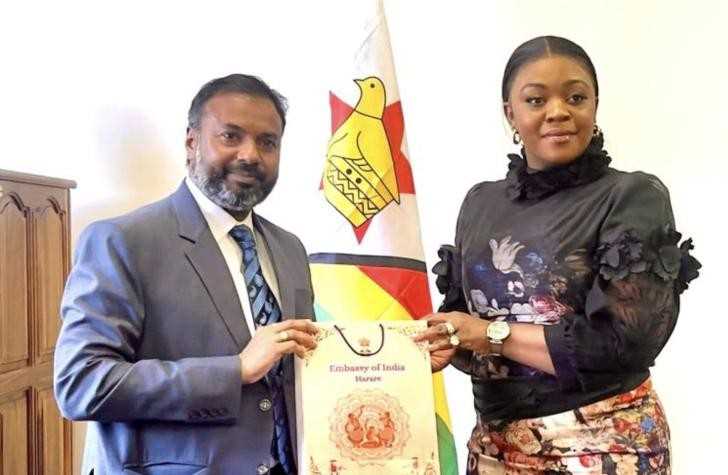
Indian Ambassador to Zimbabwe, Shri Bramha Kumar, recently noted that these capacity-building initiatives represent a "demand-driven" approach where African priorities guide India's engagement—a principle that has defined New Delhi's Africa policy since Prime Minister Narendra Modi articulated it before the Ugandan Parliament in 2018.
3. Global Governance: Zimbabwe's UN Moment
Less visible but arguably more significant is the diplomatic alignment between Harare and New Delhi on United Nations Security Council reform. India has explicitly backed the "African model" of UNSC reform, which calls for expansion in both permanent and non-permanent categories, with new permanent members enjoying the same veto privileges as existing ones.
In an April 20 statement delivered at the UN, India's Secretary (West) Sibi George said: "India whole-heartedly welcomes the presentation of the African model... The Global South needs to have a more active role and larger representation in the Security Council during discussions, particularly pertaining to issues that directly affect them."
Zimbabwe is campaigning for a non-permanent UNSC seat in 2027-28, while India seeks permanent membership. The two countries have maintained a reciprocal vote-swap understanding that could be further cemented in New Delhi.
The Numbers Behind the Partnership
The scale of India-Africa engagement is substantial by any measure:
Related Stories
Trade: Nearly US$100 billion in bilateral trade annually
Investment: Estimated US$80 billion in Indian investments across Africa between 1996 and 2025
Development assistance: More than 190 Lines of Credit worth over US$10 billion, financing projects in electricity generation, transport, water supply, and digital connectivity across 41 African countries
Pharmaceuticals: Indian firms now supply nearly half of Africa's generic medicines
Diplomatic footprint: India has opened 17 new missions in Africa in recent years, bringing its total to 46
India's External Affairs Minister has made more than 20 visits to African countries, a statistic Jaishankar cites as evidence of sustained engagement.
The Bigger Picture: Global South Solidarity
While other global powers, China, the European Union, the US, Japan, South Korea, have all intensified their Africa engagement in recent years, India is positioning its approach as fundamentally different. The narrative is about what Indian officials call "demand-driven development" shaped by African priorities.
"India did not see Africa as a partner in development only, but also in shaping the global order," said Bharath Kumar Kuthati, India's High Commissioner to Botswana, during a pre-summit briefing.
This sentiment was reinforced by Jaishankar at the logo launch: "Together, India and Africa are not just partners in development, we are partners in shaping a better world."
The most concrete evidence of this shift came during India's G20 presidency in 2023, when New Delhi successfully pushed for the African Union's permanent inclusion in the grouping. India also backed the inclusion of Egypt and Ethiopia into BRICS during the 2023 Johannesburg summit.
Challenges and Questions
Not all analysts are unreservedly optimistic. Writing in The Indian Express ahead of the summit, former ambassador to Ethiopia and the AU, Anil Sooklal, pointed to a persistent weakness: the gap between commitment and delivery.
"The five-year summit cycle remains useful at the leadership level, but in the absence of a robust inter-summit mechanism, engagement defaults to bilateral interactions," Sooklal wrote. "Without consistent engagement, India risks being seen as an episodic rather than a strategic partner."
The COVID-19 pandemic delayed IAFS-IV from its original 2020 schedule, creating a 11-year gap since the last summit in 2015. In that time, Africa's global partnerships have "deepened and diversified," Sooklal noted, making the resumption more urgent but also more challenging.
Thus the question is whether the summit's outcomes will translate into tangible, bankable projects, or remain at the level of declarations and memoranda of understanding.
What to Watch in New Delhi
Zim Now will be following three specific outcomes from the summit:
1. Energy announcements: Any update on the Jindal Hwange deal, including financing timelines and implementation schedules.
2. Scholarship expansion: Whether India announces an increase in ITEC slots specifically for Zimbabwe or Southern Africa.
3. UNSC language: The final summit declaration's wording on UN reforms and whether it explicitly references Zimbabwe's 2027-28 candidacy.
The 4th India-Africa Forum Summit arrives at a moment of global realignment. The post-pandemic world order remains unsettled. Traditional Western dominance of multilateral institutions is increasingly contested. And for countries like Zimbabwe, the emergence of multiple development partners, India, China, the EU, and others, offers both opportunity and complexity.
Zim Now will provide live coverage from New Delhi from May 28-31.









Leave Comments