








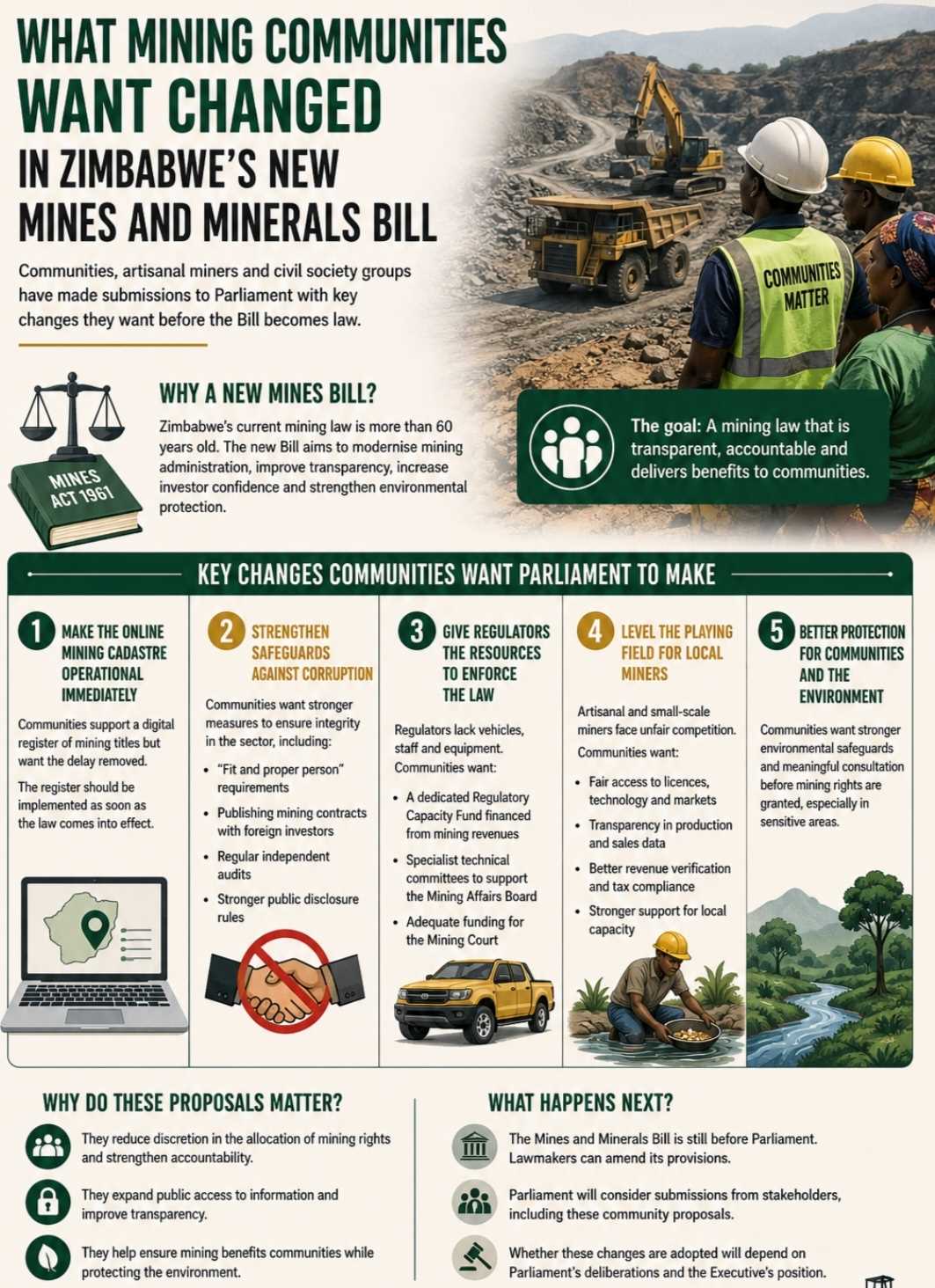
The Mines and Minerals Bill, 2025, promises the most significant overhaul of Zimbabwe's mining laws in more than six decades.
While the proposed legislation has been welcomed as a major step towards modernising the sector, mining communities say several key issues still need to be addressed before it becomes law.
Those concerns have now been compiled into a submission by Transparency International Zimbabwe following stakeholder policy dialogues held in Mutare and Gweru that brought together government officials, civil society organisations, artisanal and small-scale miners and representatives from mining communities including Chiadzwa, Chimanimani, Penhalonga, Odzi, Mutare, Kwekwe, Zvishavane and Shurugwi.
Rather than opposing the Bill, the submission supports many of its reforms while proposing amendments that participants believe would improve transparency, accountability, environmental protection and community participation.
Why is a new Mines Bill needed?
Zimbabwe's current Mines and Minerals Act dates back to 1961 and has long been criticised for failing to keep pace with developments in the mining sector.
The proposed Bill seeks to modernise mining administration by introducing an Online Mining Cadastre Register, restructuring the Mining Affairs Board, establishing a Mining Court within the High Court, creating an environmental restoration fund and improving public access to mining information. TIZ says these provisions have the potential to reduce disputes over mining claims, strengthen governance and increase investor confidence.
What are mining communities asking Parliament to change?
Make the Online Mining Cadastre operational immediately
Participants welcomed the introduction of a digital mining cadastre, saying it could reduce corruption and ownership disputes by creating a transparent record of mining titles.
However, they objected to a provision allowing implementation to be delayed until the President declares the system operational. The submission recommends removing that delay so the register comes into effect as soon as the law is implemented.
Strengthen safeguards against corruption
One of the recurring concerns raised during the consultations was that corruption continues to undermine oversight of the mining sector. Participants alleged that environmental complaints are sometimes ignored after inspections and expressed concern about political interference, selective enforcement and illicit financial flows.
To address those concerns, the submission recommends introducing "fit and proper person" requirements before mining rights are granted, publishing mining contracts with foreign investors, conducting regular independent audits of mining rights administration and strengthening public disclosure requirements.
Related Stories
Give regulators the resources to enforce the law
Mining community representatives argued that enforcement agencies often lack vehicles, personnel and technical expertise to monitor mining activities effectively.
The submission proposes establishing a dedicated Regulatory Capacity Fund financed through mining revenues to support inspections, investigations and enforcement. It also recommends creating specialist technical committees to support the Mining Affairs Board and adequately funding the proposed Mining Court.
Level the playing field for local miners
Participants, particularly artisanal and small-scale miners, said they face unequal competition from large foreign companies and politically connected businesses. They complained of limited access to licences, technology and markets, as well as unfair pricing practices.
The submission recommends stronger disclosure of production and sales data, improved revenue verification systems linked to ZIMRA, tighter controls on tax incentives and measures to strengthen technical capacity within government and mining communities.
Better protection for communities and the environment
Communities also raised concerns about environmental degradation, destruction of tourist attractions, damage to public infrastructure, deforestation and pollution of water sources.
While acknowledging that the Bill introduces an environmental restoration fund and protects certain categories of land, the submission argues that it should go further by requiring consultation with the Ministry of Tourism and Hospitality Industry, the Environmental Management Agency and the Ministry responsible for cultural heritage before mining rights are granted in environmentally or culturally sensitive areas.
Why do these proposals matter?
Many of the recommendations seek to make government decisions more transparent and legally accountable. If adopted, they would reduce discretion in the allocation of mining rights, expand public access to information and strengthen oversight of the extractive sector.
The proposals also reflect concerns from communities that mining should deliver economic benefits without undermining environmental protection, public participation and accountability.
What happens next?
The Mines and Minerals Bill is still before Parliament, meaning legislators can amend its provisions after considering submissions from stakeholders.
Whether the recommendations emerging from the mining community consultations are incorporated into the final legislation will depend on Parliament's deliberations and the position taken by the Executive.
For communities living alongside mining operations, however, the submission argues that the Bill presents a rare opportunity to ensure Zimbabwe's new mining law is not only modern, but also transparent, accountable and responsive to the realities on the ground.





Leave Comments