






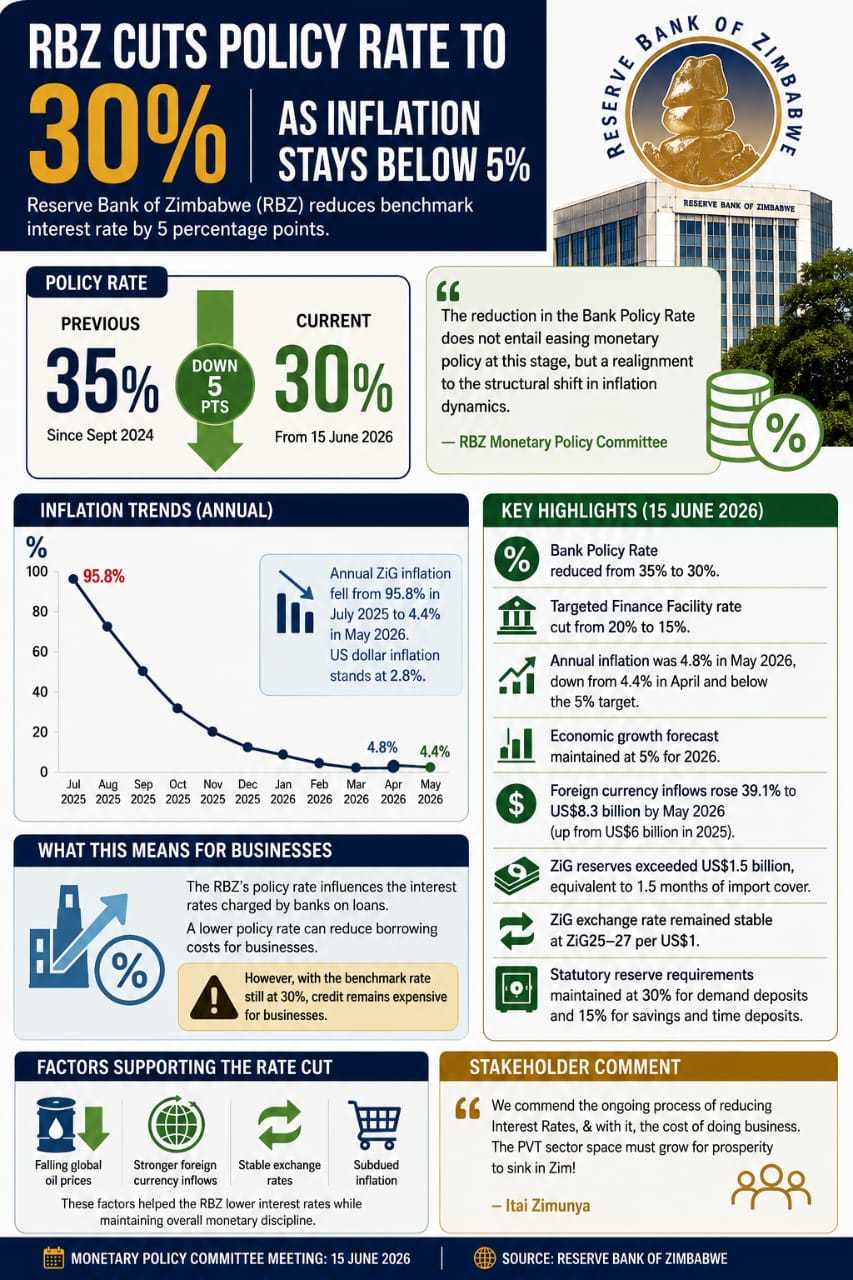
The Reserve Bank of Zimbabwe has cut its benchmark policy interest rate by five percentage points to 30%, marking its first reduction since the introduction of the Zimbabwe Gold currency.
However, the smaller-than-expected adjustment leaves borrowing costs among the highest in the region, with business groups likely to continue pushing for further monetary easing.
The decision, announced following the Monetary Policy Committee meeting held on 15 June, comes after the central bank maintained the policy rate at 35% for nine months following an aggressive increase from 20% to 35% in September 2024. The move was intended to stabilise the ZiG after its sharp depreciation.
Despite the rate cut, the MPC stressed that the decision "does not entail easing monetary policy at this stage, but a realignment of the Policy Rate to the structural shift in inflation dynamics."
The committee said inflation has undergone a significant turnaround, falling from a peak of 95.8% in July 2025 to sustained single-digit levels since January this year.
"The Monetary Policy Committee commended the Reserve Bank for continued implementation of prudent monetary policy that has culminated in the observed structural shift in inflation dynamics, from peak levels of 95.8% in July 2025 to sustained single-digit levels below 5% realised since January 2026," the RBZ said.
Annual inflation stood at 4.4% in May, down from 4.8% in April, while month-on-month inflation eased to 0.5% after temporarily rising to 1.1% in April following global oil price shocks.
The central bank attributed the improved inflation outlook to tight monetary policy, declining international oil prices, the Government's reduction of selected fuel taxes and levies, and businesses exercising restraint in passing higher costs on to consumers.
The MPC also cited stronger external sector performance as justification for the rate adjustment.
Foreign currency inflows increased by 39.1% to US$8.3 billion during the first five months of 2026, compared to US$6 billion over the same period last year, while foreign currency reserves backing the ZiG exceeded US$1.5 billion, equivalent to 1.5 months of import cover.
The RBZ said the stronger reserve position had helped support exchange rate stability.
Related Stories
"The ZiG/US$ exchange rate remained stable at between ZiG25 and ZiG27 per US dollar, with subdued parallel market activity," the MPC said.
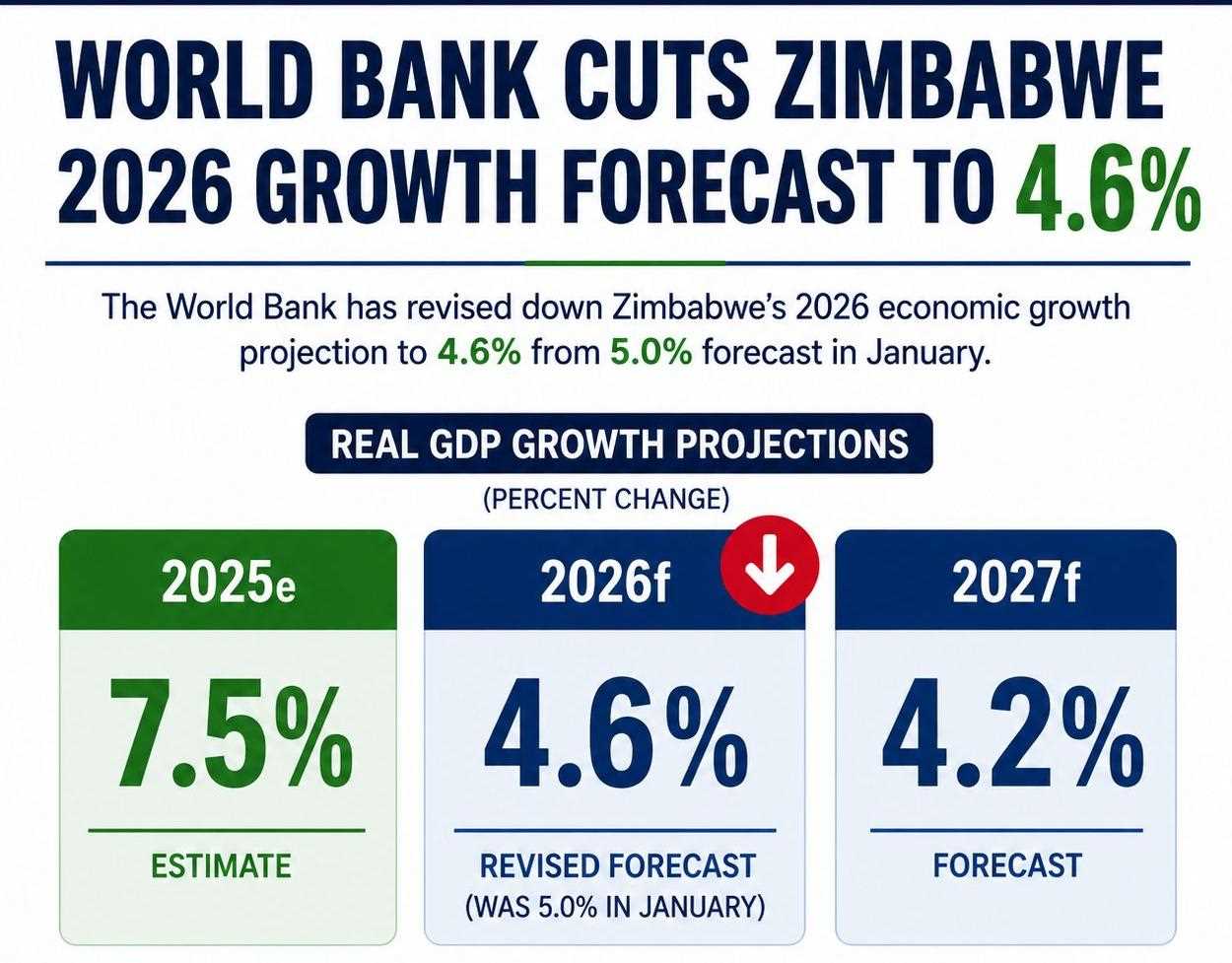
Economic growth is projected to remain at 5% in 2026, following an estimated 8.2% expansion in 2025, despite global supply chain disruptions linked to tensions in the Middle East.
Alongside the policy rate reduction, the MPC lowered the Targeted Finance Facility lending rate from 20% to 15%, while capping banks' lending rates to productive sectors at an all-inclusive 25%.
However, the central bank left statutory reserve requirements unchanged at 30% for demand deposits and 15% for savings and time deposits, signalling that liquidity conditions will remain relatively tight.
The cautious approach contrasts with calls from business organisations, which have argued that high interest rates continue to constrain investment and industrial expansion despite the sharp decline in inflation.
The Confederation of Zimbabwe Industries has repeatedly identified the cost of finance as one of the principal obstacles to manufacturing growth, with many firms relying on expensive short-term borrowing to fund operations. In its 2025 Manufacturing Sector Survey, CZI reported that capacity utilisation improved to 56%, although investment remained constrained by high financing costs and other structural challenges.
Economist Itai Zimunya welcomed the decision but suggested that further reductions would be necessary to stimulate private sector activity.
"We commend the ongoing process of reducing interest rates and, with it, the cost of doing business. The private sector space must grow for prosperity to take root in Zimbabwe," he said.
The decision also comes as Zimbabwe implements an IMF Staff-Monitored Programme under which authorities have committed to maintaining disciplined monetary and fiscal policies as part of broader economic reform efforts.
The MPC acknowledged the ongoing IMF review mission and urged the Reserve Bank to adhere to agreed quantitative and structural benchmarks to ensure the programme's success.
Analysts say the central bank's statement reflects a delicate balancing act between supporting economic growth and preserving confidence in the ZiG.
Although inflation has fallen dramatically, the RBZ repeatedly emphasised that it remains "vigilant to emerging risks" and will continue calibrating monetary policy "on a meeting-by-meeting basis, guided by the evolution of macroeconomic fundamentals."




Leave Comments