






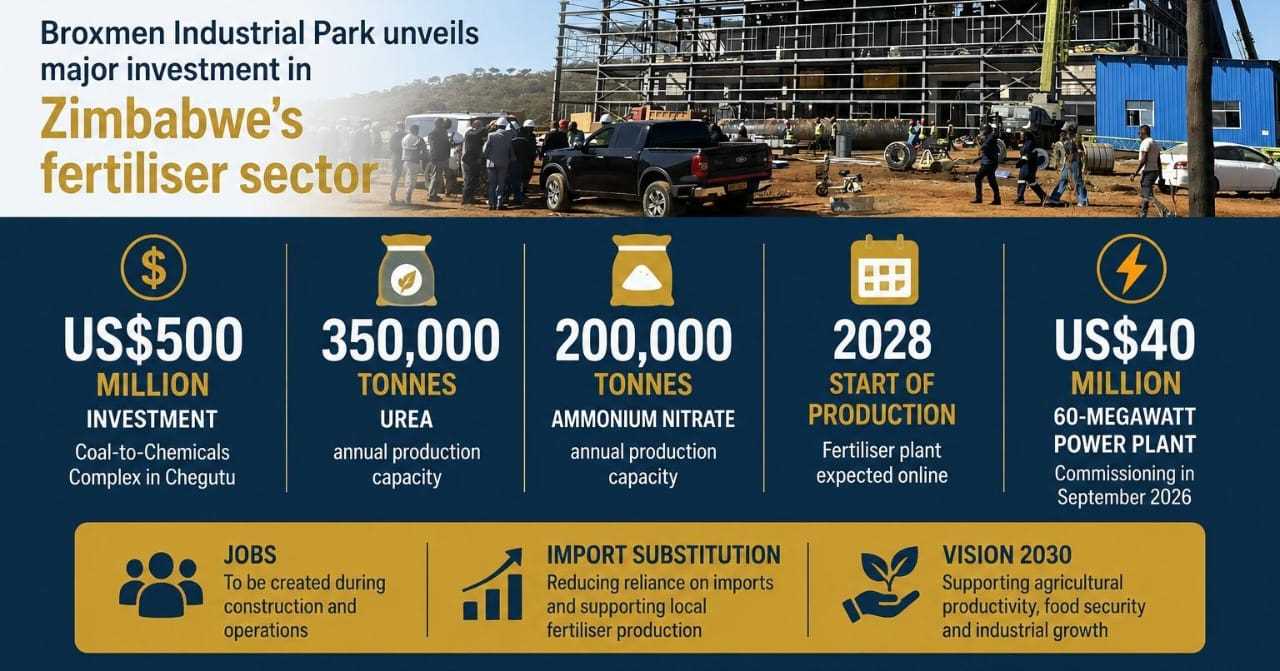
Zimbabwe's drive to industrialise its agricultural value chain has received a major boost after Chinese investor Broxmen Industrial Park committed US$500 million towards the construction of a Coal-to-Chemicals Complex in Chegutu, a project expected to produce 350,000 tonnes of urea and 200,000 tonnes of ammonium nitrate annually from 2028.
The investment, alongside a US$40 million 60MW captive power plant scheduled for commissioning in September 2026, comes as Zimbabwe intensifies efforts to reduce its dependence on imported fertiliser, which has exposed farmers to global price shocks and foreign currency shortages.
If completed on schedule, the project will significantly expand domestic fertiliser production at a time when the country is seeking to raise agricultural productivity while strengthening local manufacturing capacity.
The announcement also adds momentum to a broader pipeline of coal-to-fertiliser investments exceeding US$1 billion, which the government believes could make Zimbabwe self-sufficient in nitrogen-based fertiliser production by 2030.
Zimbabwe requires approximately 780,000 tonnes of fertiliser annually, yet domestic manufacturers have struggled to meet demand.
During a recent tour of local producers, the Parliamentary Portfolio Committee on Industry and Commerce revealed that Windmill Private Limited, one of the country's major manufacturers, has been operating at only about 10% of its installed capacity, leaving Zimbabwe heavily reliant on imports.
According to trade data, Zimbabwe imported about US$331 million worth of fertilisers in 2024, including urea and ammonium nitrate largely sourced from Russia, potash from Belarus and other raw materials from the Gulf region, making local agriculture vulnerable to geopolitical disruptions and volatile international prices.
Separate United Nations COMTRADE data shows that Zimbabwe imported fertilisers worth more than US$101 million from South Africa alone in 2024, underlining the country's continued dependence on regional suppliers.
The Chegutu project is expected to strengthen domestic supplies of two strategic fertilisers. Urea, which contains about 46% nitrogen, is widely used in maize, wheat, tobacco and horticulture production, while ammonium nitrate, containing about 34% nitrogen, remains Zimbabwe's dominant top-dressing fertiliser for maize cultivation.
Related Stories
Beyond agriculture, ammonium nitrate is also an important industrial input for Zimbabwe's mining sector, giving the project significance beyond food production.
Government officials argue that increased local production will help stabilise prices while conserving scarce foreign currency.
Speaking on Zimbabwe's broader fertiliser industrialisation programme earlier this year, Industry and Commerce Permanent Secretary Thomas Utete Wushe said:
"This investment will enable Zimbabwe to become self-sufficient in fertiliser production by 2030, producing over 300,000 tonnes of urea annually."
Finance, Economic Development and Investment Promotion Minister Mthuli Ncube has also linked the fertiliser investment drive to rising production costs faced by farmers.
"Fertiliser... we've seen that 30–40% increase easily on fertiliser. The way we respond to it... is to really push hard in incentivising new investors into the fertiliser sector," Ncube said while outlining the government's strategy of attracting large-scale coal-to-fertiliser investments.
Economic analysts say the significance of the Chegutu project lies not only in replacing imports but also in moving Zimbabwe further up the industrial value chain by converting its abundant coal resources into higher-value chemical products.
Research by Equity Axis estimates that replacing imported nitrogen fertilisers through domestic production could save Zimbabwe between US$180 million and US$220 million annually in foreign currency outflows, materially improving the country's trade balance while creating opportunities to export surplus fertiliser to regional markets such as Zambia, Malawi, Mozambique and the Democratic Republic of Congo.
The investment also aligns with Zimbabwe's industrialisation strategy, which seeks to leverage the country's mineral and energy resources to develop downstream manufacturing industries rather than exporting raw commodities.
If successfully implemented, the Chegutu project could become one of Zimbabwe's most significant import-substitution investments, reducing external dependence, supporting agricultural productivity and strengthening the country's broader industrial base.









Leave Comments