






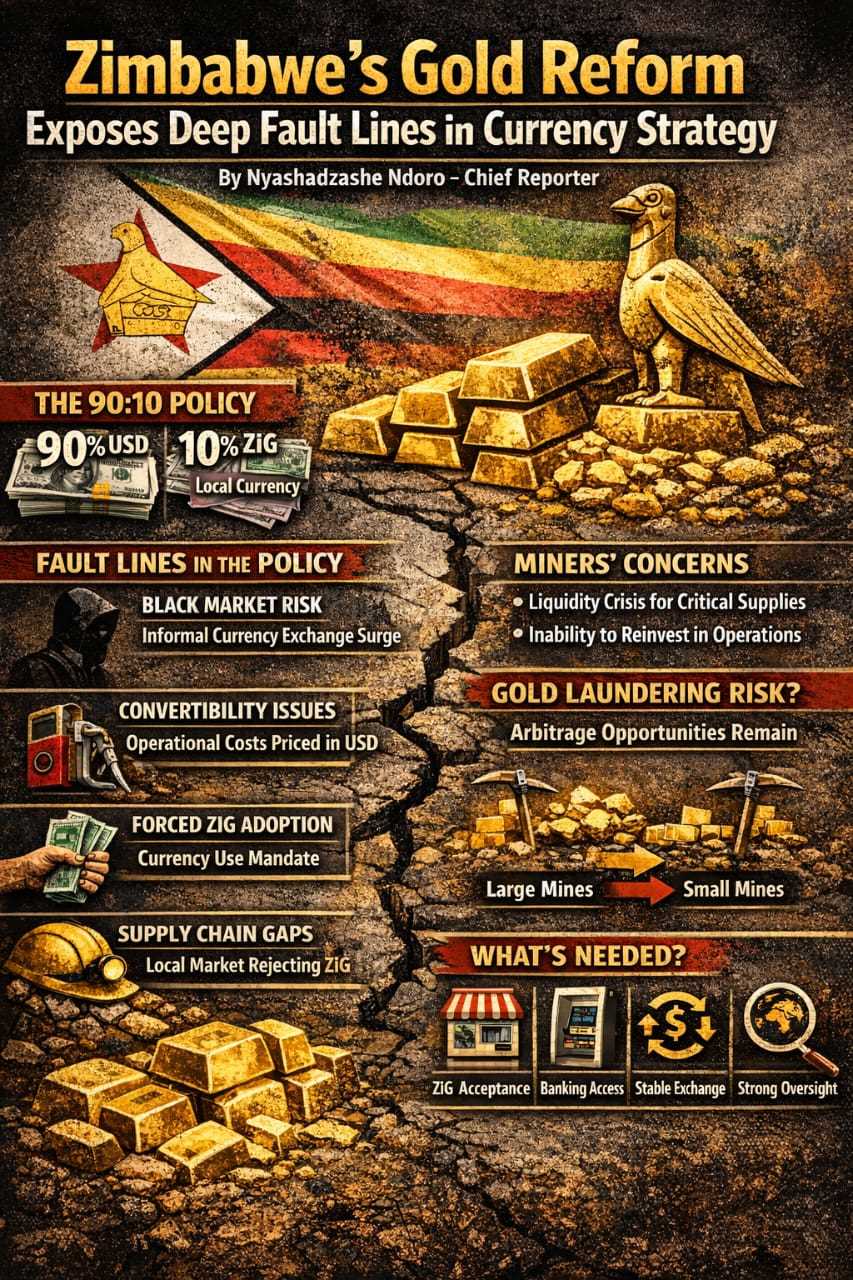
Zimbabwe’s decision to introduce a 90:10 payment structure for small-scale gold miners, where 90 percent of payments are made in US dollars and 10 percent in the local currency ZiG, is emerging as one of the most consequential policy shifts in the country’s gold sector in recent years.
Announced by the Reserve Bank of Zimbabwe in its 2026 Monetary Policy Statement and implemented through Fidelity Gold Refinery, the reform aims to strengthen the Zimbabwe Gold, reduce regulatory arbitrage in the mining industry, and improve transparency in gold transactions.
However, analysts and miners warn that the measure may also expose deeper structural weaknesses in Zimbabwe’s currency strategy and the operational realities of the country’s dominant artisanal mining sector.
At the centre of the reform is the Reserve Bank of Zimbabwe, which announced the change through governor John Mushayavanhu. Under the new framework, small-scale miners will receive a portion of their gold payments in ZiG, ending the previous system where they were paid entirely in US dollars.
Authorities say the reform is designed to address several challenges in the gold sector. Policymakers argue the new structure will reduce arbitrage opportunities that have allegedly allowed large-scale miners to bypass foreign currency surrender requirements.
Large producers must currently surrender 30 percent of their export earnings to the central bank in exchange for local currency, while small-scale miners had previously been exempt.
The government believes some large mining firms were channelling gold through artisanal miners to avoid these surrender obligations.
Officials also say the policy will help increase the circulation of ZiG as Zimbabwe works toward a long-term transition to a mono-currency system by 2030. At the same time, authorities believe the reform will improve transparency and data visibility in the gold trade, allowing regulators to better track financial flows in a sector that contributes significantly to national exports and foreign reserves.
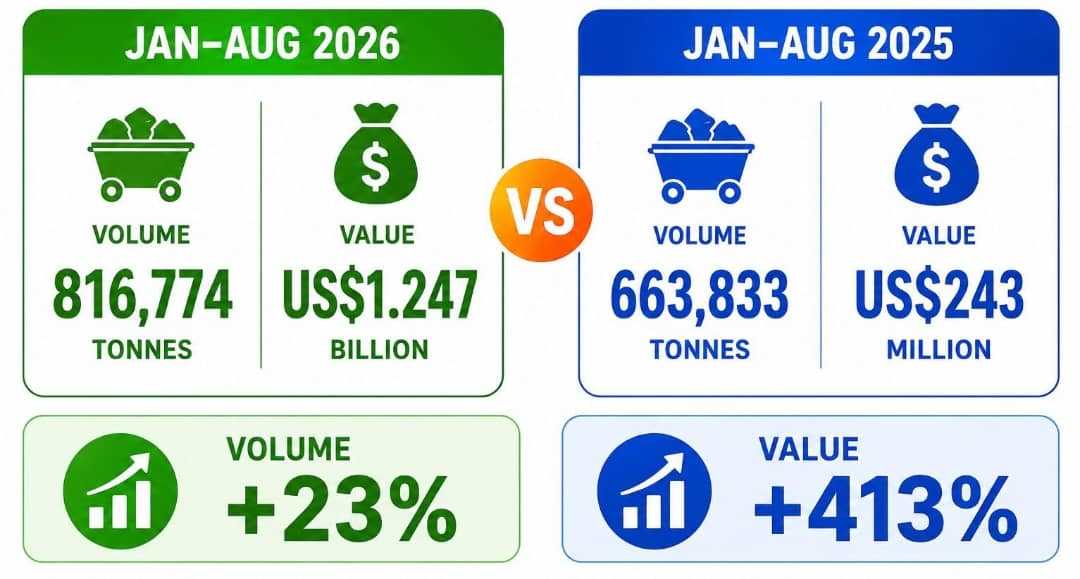
Gold remains one of Zimbabwe’s most important economic pillars. In 2025 the country produced a record 44.7 tonnes of gold valued at approximately US$4.8 billion, accounting for nearly half of national export earnings. Artisanal and small-scale miners contributed roughly 75 percent of the output, making them the dominant force in the sector.
Despite these objectives, analysts say the 90:10 framework exposes several structural vulnerabilities within Zimbabwe’s mining and monetary systems.
One of the most immediate concerns relates to the convertibility of ZiG. Many mining inputs, including fuel, explosives, spare parts, chemicals and heavy equipment, are priced exclusively in US dollars. For artisanal miners operating on tight margins and rapid production cycles, even a 10 percent payment in local currency may create liquidity constraints.
If suppliers refuse to accept ZiG, miners may be forced to convert their earnings through informal markets, effectively recreating the parallel currency system authorities have been trying to eliminate.
Business consultant Clive Masarakufa warns that this dynamic could unintentionally push parts of the gold economy underground.
“The black market risk is real,” Masarakufa said. “When miners receive ZiG that cannot easily be used for operational expenses, they will naturally seek conversion, and that inevitably means informal markets.”
Another criticism is that the policy may be driven more by monetary objectives than mining sector reform.
Zimbabwe introduced the ZiG currency in 2024 as part of efforts to stabilise the economy after years of currency volatility. However, adoption has been uneven, with many businesses continuing to prefer US dollars for transactions.
Related Stories
Some analysts argue that the mining sector may now be serving as a captive demand base for the currency, effectively forcing ZiG into circulation through gold payments.
Economists caution that such strategies rarely succeed without strong market confidence.
For any currency to function effectively, it must operate as a store of value, a unit of account and a reliable medium of exchange. Critics say ZiG still struggles to fulfil these roles in many rural mining economies.
Operational realities in remote mining areas further complicate the policy’s implementation.
According to Nyasha Magadhi, one of the biggest challenges is the limited circulation of ZiG within rural supply chains.
In regions such as Matabeleland and Manicaland, many suppliers of critical mining inputs do not accept ZiG, effectively rendering the currency unusable for reinvestment into mining operations.
“In our mining communities the ZiG is currently failing the test of being a medium of exchange,” Magadhi said. “It becomes dead capital because the suppliers who sell us diesel, spare parts or machinery do not accept it.”
As a result, some miners may spend their ZiG portion mainly on groceries or retail goods rather than reinvesting it into production, weakening the policy’s intended economic impact.
The government’s argument that the reform will also curb gold laundering between large and small producers has raised further questions among analysts.
While experts acknowledge that arbitrage opportunities existed under the previous system, some believe the new rule addresses symptoms rather than underlying structural issues.
Weak traceability systems, limited oversight of gold buying agents and the existence of informal trading networks have long complicated regulation in Zimbabwe’s gold sector. Without stronger monitoring mechanisms, critics say the new payment structure could simply shift arbitrage to different channels rather than eliminating it.
Economists also warn that policies affecting artisanal miners must be handled carefully because the sector supports hundreds of thousands of livelihoods across the country.
Small-scale mining operations are largely cash-based and operate with minimal financial buffers. Even small disruptions to cash flow can reduce production or push miners toward informal gold buyers who offer more favourable payment terms.
If miners begin bypassing official buyers such as Fidelity Gold Refinery, the government could face a difficult paradox. A policy designed to increase formal gold deliveries might ultimately reduce them.
Analysts say the success of the 90:10 rule will depend less on the payment structure itself and more on whether authorities address the broader economic ecosystem surrounding the currency.
Key measures that experts say could improve the policy include expanding ZiG acceptance among rural suppliers and service providers, improving banking infrastructure and digital payment systems in mining areas, ensuring stable exchange mechanisms to prevent large conversion losses and strengthening traceability systems in gold trading.
Without these complementary reforms, economists warn the new rule risks becoming another top-down policy that struggles against the operational realities of Zimbabwe’s largely informal mining economy.









Leave Comments