






Zimbabwe's banking sector extended approximately ZiG85 billion in loans and advances by the end of June 2026, with nearly three-quarters of lending supporting productive sectors of the economy, underscoring the financial sector's growing role in economic activity despite a sharp decline in bank profitability.
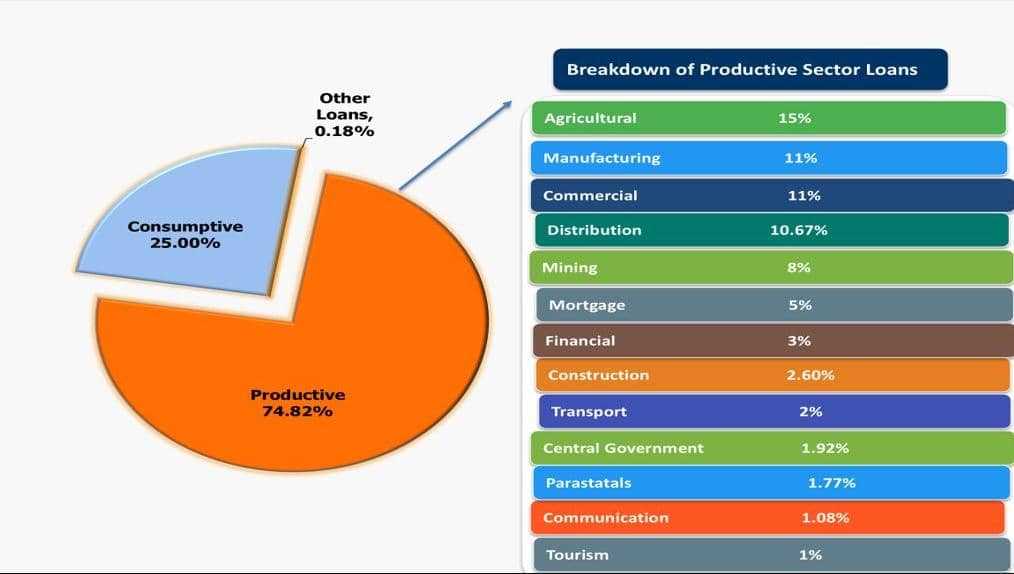
The latest figures contained in the 2026 Mid-Term Budget and Economic Review show that 74.8% of total loans were directed towards productive sectors such as agriculture, mining, manufacturing and distribution, while foreign currency-denominated loans accounted for 90% of total lending, reflecting continued preference for hard currency borrowing.
The data suggests that while banks remain willing to finance economic production, confidence in the local currency has yet to translate into a comparable shift in lending patterns despite relative exchange rate stability over the past year.
Presenting the Mid-Term Budget and Economic Review, Minister of Finance, Economic Development and Investment Promotion Mthuli Ncube said the banking sector continued to support economic production.
"The banking sector continues to support the productive sectors of the economy, with 74.8% of total loans channelled towards the productive sector as of end June 2026."
The increase in lending comes as Government continues to position private sector credit as an important driver of economic growth.
Treasury said the banking sector's liquidity position remained satisfactory, enabling financial institutions to continue extending credit to productive industries.
The sector also maintained a strong funding base, with aggregate deposits rising to ZiG148.1 billion by the end of June 2026. However, the composition of those deposits mirrors the lending market, with foreign currency deposits accounting for 80% of total deposits.
The dominance of foreign currency in both deposits and lending indicates that while macroeconomic stability has improved, businesses and households continue to favour holding and borrowing in foreign currency, reflecting persistent confidence considerations in Zimbabwe's dual-currency financial system.
Despite robust lending activity, banks earned significantly less than they did a year earlier.
The sector recorded an aggregate profit of ZiG1.5 billion for the quarter ended March 31, 2026, down from ZiG2.6 billion during the corresponding period in 2025.
Treasury attributed the decline primarily to lower foreign exchange revaluation gains rather than weaker core banking operations.
"The decline in aggregate net income for the banking sector is mainly attributed to reduced revaluation gains on foreign exchange and investment properties previously arising from foreign exchange fluctuations. On aggregate, the quality of earnings, however, improved as a result of stability in the exchange rate over the past year."
Related Stories
The figures suggest that the lower profits may reflect a more stable operating environment rather than deteriorating banking performance. In previous years, exchange rate volatility generated substantial accounting gains for banks through foreign currency assets and property revaluations. As exchange rate movements moderated, those exceptional gains diminished, leaving earnings increasingly dependent on traditional banking activities.
This shift is reflected in the composition of bank income.
According to Treasury, fees and commission income contributed 47.5% of total earnings during the period under review, while interest income from loans and advances accounted for 40.9%.
The figures indicate that banks still rely heavily on non-interest income, although lending activity is becoming a more significant contributor to profitability.
Asset quality also remained resilient.
The non-performing loan ratio stood at 3.6% as at March 31, 2026, comfortably below the internationally accepted prudential benchmark of 5%, suggesting that most borrowers continued servicing their obligations despite broader economic pressures.
Meanwhile, the sector remained well capitalised.
Average capital adequacy and Tier 1 capital ratios stood at 29.1% and 23.2%, respectively, well above the minimum regulatory requirements of 12% and 8%, providing banks with substantial buffers against potential financial shocks.
The strong capital position enhances the sector's capacity to absorb losses and continue extending credit during periods of economic stress.
The Mid-Term Budget Review also comes against the backdrop of policy measures aimed at reducing the cost of banking services.
Responding to concerns from businesses and consumers over high transaction charges, the Reserve Bank of Zimbabwe introduced a revised bank charges framework effective 31 March 2026.
Under the new framework, cash withdrawal and ZIPIT charges are capped at 2%, while Point-of-Sale, Bank-to-Wallet, Wallet-to-Bank and Send Money charges are capped at 1.5%, subject to a maximum of US$20 or its ZiG equivalent.
In addition, cash deposits and balance enquiries are now free, bank card charges are restricted to cost recovery, accounts holding less than US$100 are exempt from maintenance fees, and Point-of-Sale transactions below US$5 attract no charges.
The reforms could gradually reshape banks' income structures. Given that fees and commissions remain the sector's largest source of revenue, lower transaction charges may reduce non-interest income over time unless offset by stronger lending growth, increased transaction volumes or broader financial inclusion.










Leave Comments