









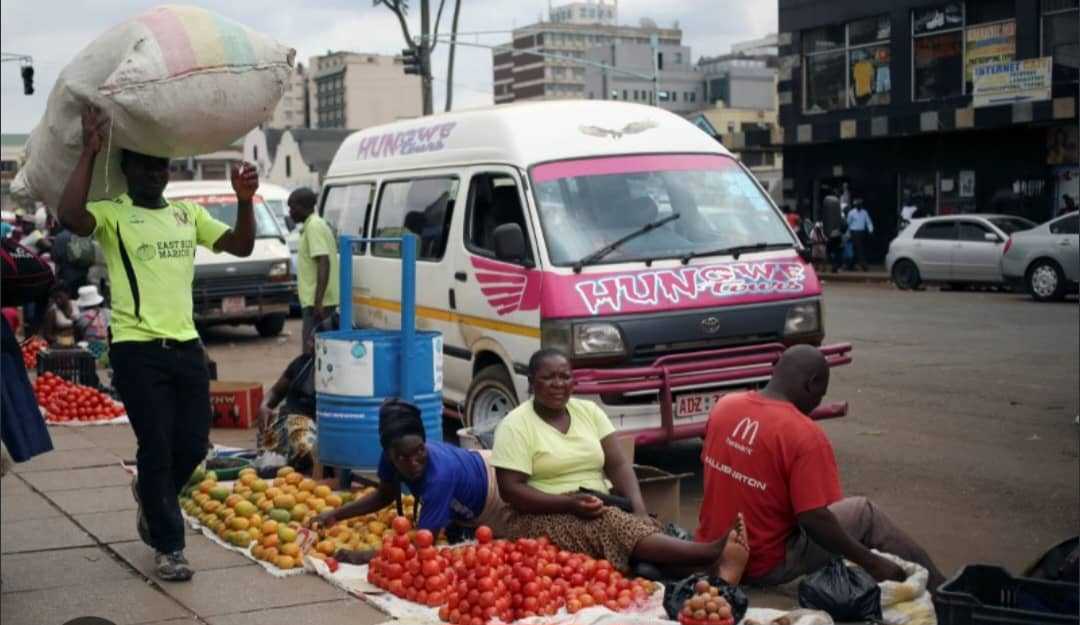
Thousands of informal traders operating from undesignated spaces in Harare face eviction from the streets next week after the Government issued a September 9 deadline for vendors to relocate to approved markets, warning that a “zero-tolerance” clean-up will begin immediately afterwards and later spread nationwide.
Local Government and Public Works Minister Daniel Garwe said the crackdown would target illegal vending structures, stalls and trading sites in Harare’s Central Business District and the wider Harare Metropolitan Province.
"All vendors engaging in illegal street and night trading have until Wednesday, September 9, 2026, to immediately vacate these unauthorised sites and relocate to lawful, designated vending markets provided by the local authority,” Garwe said.
He said the proliferation of informal trading in undesignated areas had compromised sanitation, blocked public pathways, disrupted formal businesses and created congestion.
"The current state of disorderliness on the streets is not tolerable,” the minister said.
From September 9, Garwe said the Ministry, working with other Government ministries, departments and agencies, would launch a “comprehensive, zero-tolerance clean-up operation”, with municipal police remaining deployed after the clearances to prevent vendors from returning.
The operation is subsequently expected to move beyond Harare to other cities, towns and urban settlements.
But the scale of Zimbabwe's informal economy makes the crackdown more complicated than a straightforward enforcement exercise.
ZIMSTAT's Economic Census found 204,798 operational establishments nationally, of which 76.1% were informal, while 87.9% were micro-enterprises. Wholesale and retail trade accounted for the largest share of informal establishments.
Labour-market data tells a similar story. ZIMSTAT's 2024 first-quarter figures recorded about 1.36 million people in informal non-agricultural employment, representing 41.3% of total employment, while formal non-agricultural employment accounted for 30%.
Related Stories
Harare's street economy is particularly concentrated around areas with high pedestrian traffic. A recent academic study estimates that more than 20,000 street traders operate in the CBD, although researchers caution that the number is difficult to establish because street trading is poorly captured in official statistics.
This creates the central policy dilemma confronting the Government: clearing pavements may restore order, but removing traders without making designated markets commercially viable risks simply moving, rather than solving, the problem.
The issue of inadequate trading infrastructure has already been raised by informal-sector organisations.
In June, the Vendors Initiative for Social and Economic Transformation welcomed Harare City Council's decision to ring-fence 25% of revenue collected from trading markets for market and vending-site infrastructure, arguing that informal traders are a significant component of the city's economy.
Traders have also previously complained that designated spaces can be too far from customers, one reason why some continue operating in the CBD despite restrictions. Research into Harare's informal economy found that vendors viewed central locations as commercially attractive because of the concentration of potential customers.
The enforcement question is therefore tied directly to the economics of the informal sector.
A 2025 StreetNet survey of Harare and Chitungwiza found that 45.4% of respondents operated in informal fixed markets, while 37% worked on the street, showing the importance of physical trading space to livelihoods. Women accounted for 41.5% of street-based respondents, compared with 31.9% of men.
Government, however, insists that it is not seeking to eliminate informal trading altogether.
"Whilst the Government of the Republic of Zimbabwe acknowledges the existence of informal trading as a recognised avenue of livelihood, this, however, should be within the bounds of municipal by-laws and at legally designated marketplaces,” Garwe said.
That distinction is crucial. The stated target is illegal or undesignated trading, rather than informal trading as an economic activity.
Garwe has instructed local authorities to facilitate the immediate registration and orderly placement of compliant traders into designated structures, giving councils a parallel responsibility: enforcement on one side and providing workable trading spaces on the other.








Leave Comments