







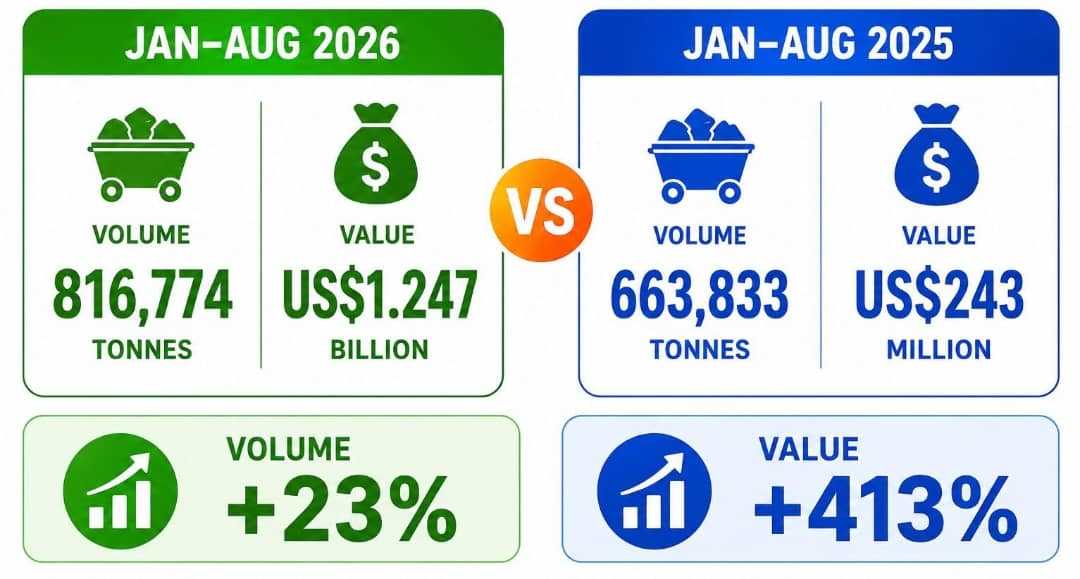
Zimbabwe’s lithium industry has generated US$1.247 billion from 816,774 tonnes of concentrate in the first eight months of 2026, with export value surging more than fourfold from the same period last year as recovering international prices dramatically improved the economics of the country’s fast-growing battery-mineral sector.
Figures from the Minerals Marketing Corporation of Zimbabwe show that lithium concentrate sales between January and August 2026 rose from 663,833 tonnes worth US$243 million in the corresponding period of 2025.
That represents a 23% increase in volumes but a staggering 413% increase in value.
The disparity between the two growth rates is the most important feature of the figures: Zimbabwe did not sell four times as much lithium. Rather, the value of each tonne sold increased sharply.
Average revenue per tonne rose from roughly US$366 in 2025 to US$1,527 in 2026, an increase of about 317%.
MMCZ general manager Nomusa Jane Moyo attributed the surge primarily to the recovery in international lithium prices.
"Zimbabwe is benefiting from the recovery in lithium prices, as reflected in MMCZ’s 2026 sales performance,” Moyo said.
She said the increase demonstrated that the improvement was being reflected in current transactions rather than simply being a consequence of higher export volumes.
"The substantial growth in value indicates that improved international lithium prices are being captured in current sales and are not merely the result of volumes carried over from the lower-priced market conditions of 2025."
The figures nevertheless expose Zimbabwe's continued vulnerability to the international lithium price cycle.
In 2025, Zimbabwe's spodumene concentrate exports reached about 1.128 million tonnes, up 11% from 1.014 million tonnes in 2024, but export revenue was only about US$513.8 million. The increase in physical production therefore failed to produce a comparable increase in earnings because prices had fallen sharply.
The 2026 numbers show the opposite effect: a relatively modest increase in tonnes has produced an enormous increase in export earnings because prices have recovered.
Government is preparing to end exports of lithium concentrate from January 1, 2027, forcing producers to move further up the processing chain.
The policy is already contained in the country's National Development Strategy 2, which states that Government will phase out lithium concentrate exports by January 2027 and support the production and export of lithium salts. It further sets an ambition of moving from lithium sulphate into lithium carbonate and lithium hydroxide, both important inputs in battery manufacturing.
Prospect Lithium Zimbabwe, owned by Zhejiang Huayou Cobalt, has commissioned a US$400 million lithium sulphate plant at Arcadia, while Sinomine has been developing a US$500 million processing facility at Bikita.
Zimbabwe's lithium producers warned in June that only one of the country's seven major producers had completed a lithium sulphate plant, prompting calls for more time before the January deadline. The Lithium Producers Association said the industry had committed about US$1.45 billion to beneficiation projects.
Related Stories
Government has so far rejected the request for an extension.
Mines Minister Polite Kambamura said in July:
"For now, we are not talking about the waiver. We are still sticking to the 1st of January."
The minister argued that producers had been given adequate notice to prepare for the deadline.
"The producers were given a notice in June 2025. This is an 18-month period to January 2027."
The policy challenge is becoming more complicated because the country is currently enjoying unusually strong lithium export earnings at precisely the point when it is preparing to restrict the export of the product generating those earnings.
There is therefore a potentially significant trade-off between short-term export revenue and long-term value capture.
Selling 816,774 tonnes of concentrate has generated US$1.247 billion so far this year, but Government wants future earnings to come increasingly from processed lithium rather than the concentrate itself.
The logic behind this is that instead of Zimbabwe capturing revenue primarily from mining and concentrating the ore, more of the chemical-processing stage, and eventually battery-material production, would take place domestically.
Reports in July indicated that Zimbabwe's only operational lithium sulphate plant was unable to process material from third-party producers, meaning miners without their own processing facilities could face difficulties complying with the January 2027 requirement.
Government has pointed to tolling arrangements, under which producers without their own conversion plants could have their concentrate processed by operators with available facilities, as one way of bridging the gap.
The February 2026 suspension of lithium concentrate and raw-mineral exports also demonstrated the Government's willingness to intervene aggressively in the sector. The Ministry of Mines said the move was intended to strengthen in-country value addition, accountability and protection of national mineral resources.
The stakes are considerable because lithium has rapidly become one of Zimbabwe's most important mineral exports, following billions of dollars of investment into mines and processing infrastructure, much of it from Chinese companies.
But the latest sales figures also provide a warning against measuring the sector's success purely through export receipts.
US$1.247 billion is a major foreign-exchange inflow, but roughly four-fifths of the increase in export earnings relative to 2025 is explained by the value obtained per tonne rather than physical production growth.
If international lithium prices weaken again, concentrate exports could once more generate substantially less revenue even if Zimbabwe continues producing at high volumes.
Hence, beneficiation is being positioned as the mechanism through which Zimbabwe can capture more value from each tonne of lithium, regardless of where the global price cycle moves.










Leave Comments