








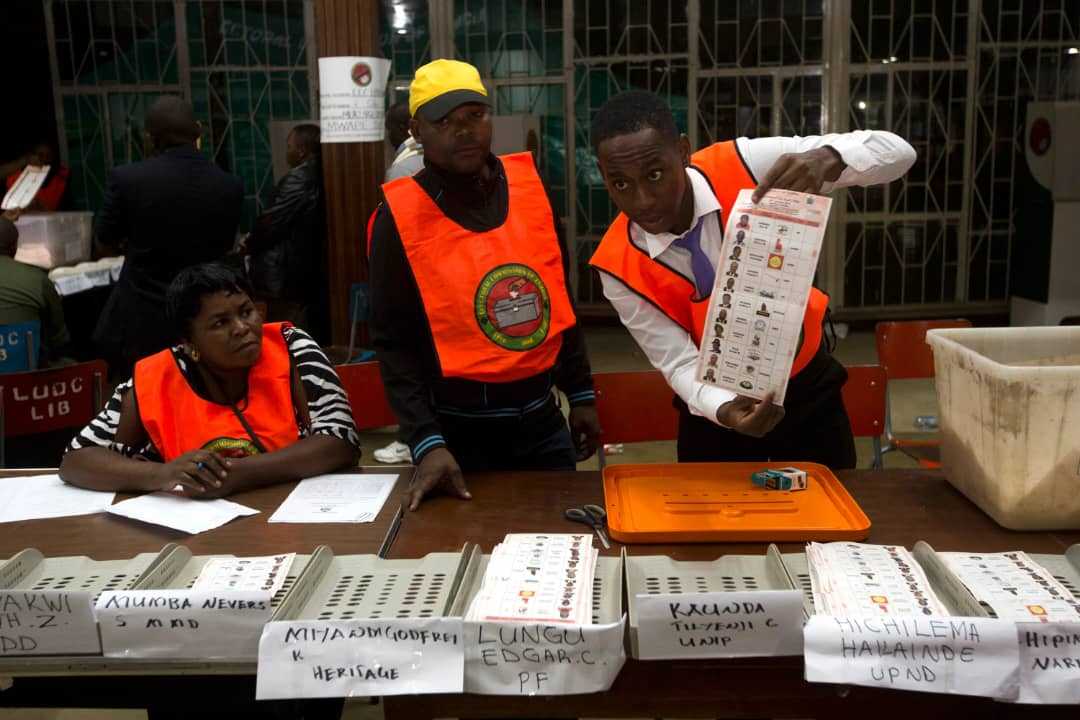
The European Union Election Observation Mission has raised fresh concerns over Zambia’s 2026 election results management, reporting a significant deterioration in the transparency and conduct of vote tabulation after the Electoral Commission of Zambia suspended the process following violent incidents.
The EU observers said tabulation had initially been conducted relatively well across the 226 constituency-level tallying centres, but the process became increasingly problematic after the suspension was lifted late on August 14.
“The overall conduct of tabulation deteriorated significantly,” the EU EOM said, reporting that transparency was assessed as “bad” or “very bad” in 12% of the tallying centres it observed.
Before the suspension, results tabulation was assessed as “very good” in 43% of observations. However, after counting resumed, observers found that tallying-centre staff frequently failed to record results on tally sheets immediately after they were announced by returning officers, as required by electoral regulations.
The mission also reported a decline in cases where figures entered into the digital results management system corresponded with those recorded on tally sheets. This fell to 81% of observations after the suspension, compared with 100% before it.
The deterioration followed the ECZ’s decision on August 14 to suspend the counting and announcement of results from midday until 18:00 after violent incidents targeting polling staff and allegations of ballot-box theft.
The EU EOM had observers stationed in 64 tallying centres, allowing it to directly monitor a significant portion of the national tabulation process.
One of the most significant concerns was the prolonged delays that emerged after counting resumed. Observers reported extended breaks during tabulation in almost half of their observations, with returning officers apparently waiting for instructions from ECZ headquarters before announcing results.
The development raises questions about the degree of operational independence at constituency level and whether uncertainty within the electoral administration contributed to delays in releasing results.
Related Stories
The mission also reported a heavy military presence at tallying centres following the suspension, which it said was perceived as intimidating by most of its interlocutors. The number of party agents and citizen observers present at tallying centres subsequently declined.
Security concerns were not limited to delays.
In Lusaka, the EU mission reported that an armed group attacked the tallying centre in Makeni and took almost all polling-station result forms covering August 15.
In Central Province, observers also received credible reports that alleged supporters of the United Party for National Development removed polling materials from two of three tallying centres in Kabwe on August 16, disrupting the tabulation process.
These incidents have complicated an already contested election environment, particularly because the credibility of an election depends not only on voting but also on the transparent aggregation and publication of results.
The EU EOM also criticised the ECZ’s approach to publishing results, saying the commission did not publish partial results on the results website it launched before election day.
The commission also confirmed that it would not publish disaggregated polling-station results, despite their importance in allowing political parties, observers and citizens to compare nationally announced results with the original figures recorded at individual polling stations.
The mission reiterated its call for maximum transparency, arguing that publishing results broken down by polling station would provide an important confidence-building mechanism.
This is particularly significant given the delays and disputes surrounding the counting process.
Polling-station results provide the most basic audit trail in an election. Where those figures are publicly available, political parties and observers can independently compare them with constituency and national totals.
Where they are withheld, confidence in the aggregation process becomes more dependent on trust in the electoral commission.








Leave Comments