







ZimNow News Desk
Zimbabwe’s manufacturing sector recorded positive growth in 2025, with output, turnover and employment all improving, according to the Confederation of Zimbabwe Industries Annual Manufacturing Sector Survey launched in Harare on Thursday.
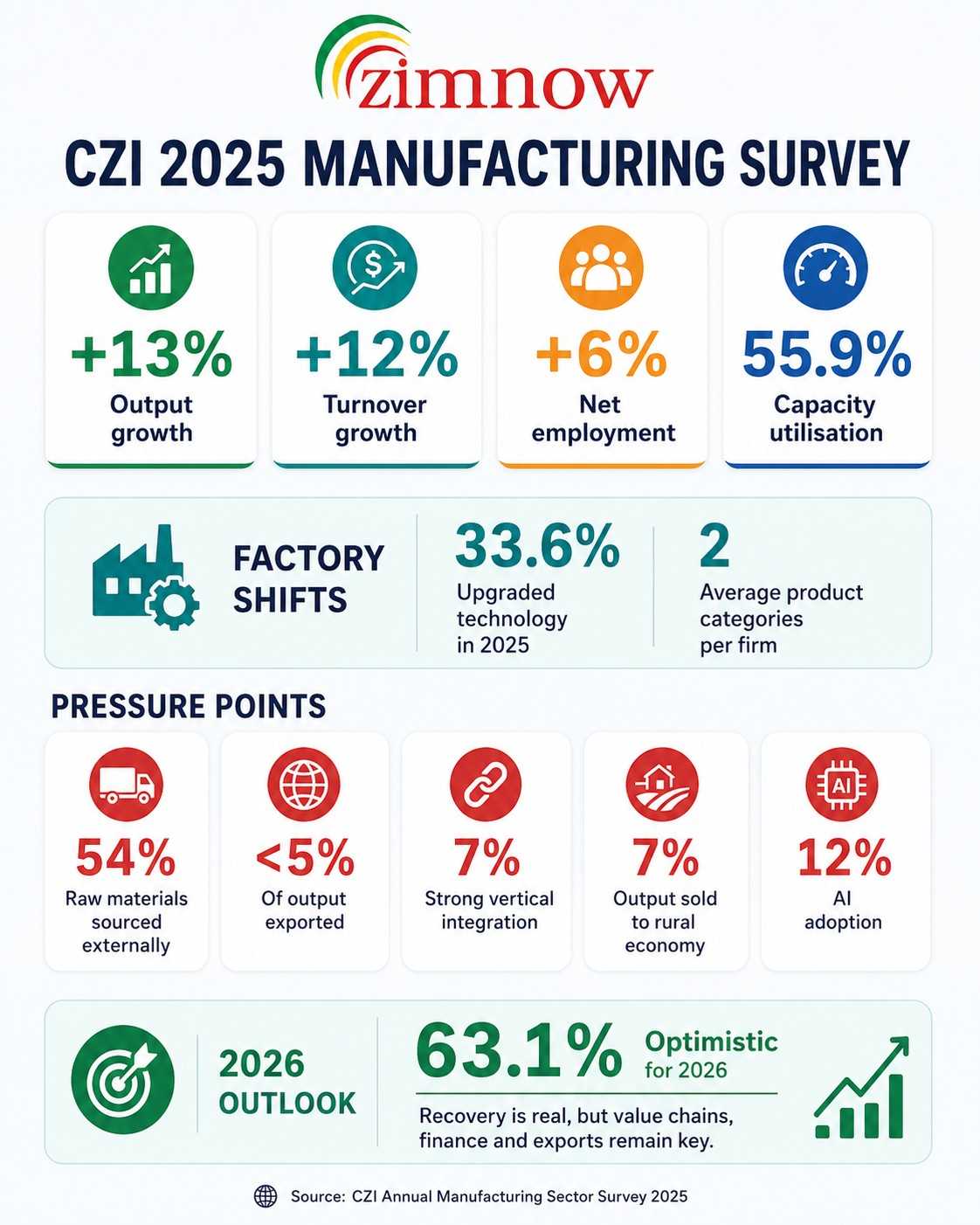
The survey, presented during the Manufacturing Sector Review and launch of the CZI Annual Manufacturing Sector Survey 2025 at Hyatt Regency Harare, The Meikles, shows that manufacturing output grew by 13%, turnover increased by 12% and net employment rose by 6%.
On average, firms created five new jobs each during the period under review.
The survey covered 388 firms with at least 10 employees across all provinces and manufacturing subsectors, giving a broad picture of the state of industry in Zimbabwe.
Capacity utilisation improved to 55.9%, making 2025 the fourth-highest level since 2009. This points to a sector that is recovering after years of pressure, but the data also shows that growth remains uneven and exposed to structural weaknesses.
The survey says medium-sized firms recorded the highest growth in output and turnover, while large firms had the strongest employment growth. Small firms remained the weakest performers, largely because of capital constraints and limited market access.
Product diversification is emerging as one of the coping strategies for manufacturers, with firms now producing an average of two product categories. About 40% of firms produce one product, while 30% produce two products and 19% produce three.
Technology upgrading also appears to be paying off. The survey says 33.6% of firms upgraded technology in 2025. Firms that upgraded recorded average turnover growth of 18.38%, compared to 8.43% among those that did not upgrade. Output growth was also higher among firms that upgraded technology, at 19.9% compared to 9.22%.
However, the recovery sits on a fragile base.
Related Stories
Zimbabwean manufacturers remain heavily dependent on imported raw materials, with 54% of inputs sourced externally in 2025, up from 52% in 2023. The main reason given was unavailability and shortages in the local market, followed by cheaper imports and better quality imported inputs.
This exposes local industry to foreign currency pressures, supply chain shocks and higher production costs.
Export performance also remains weak. The survey shows that less than 5% of manufacturing output is exported. The main barriers include high production and operating costs, market competition, logistics and transport costs, financial constraints, regulatory hurdles, standards requirements and currency retention policies.
The data also shows limited value-chain integration. Only 7% of firms report strong vertical integration with suppliers or customers, suggesting that many manufacturers still operate in thin and fragmented supply chains.
Rural markets remain underdeveloped. Only 7% of total manufacturing output is sold to the rural economy, although food processing performs better, with 34% of food output reaching rural markets.
CZI chief executive officer Sekai Kuvarika noted that although power costs remain a major hurdle for manufacturers, power supply has improved.
The survey records broad optimism for 2026, with 63.1% of manufacturers optimistic about the sector and 54.7% optimistic about the broader economy.
But the outlook depends heavily on policy reforms, infrastructure investment and macroeconomic stability.
Industry and Commerce Minister Nqobizitha Mangaliso Ndlovu said Zimbabwe may need to better understand the economy that is now emerging, including the growing role of smaller enterprises in production, distribution and services.
He said Government was now looking more closely at the structure of the economy, including what has traditionally been described as the informal sector.
The survey suggests that Zimbabwe’s manufacturing sector is no longer simply in survival mode. It is producing more, hiring more and investing in capacity. But the next test is whether that recovery can be converted into deeper local supply chains, stronger exports, better finance and wider market reach.







Leave Comments