








Zim Now News Desk
Zimbabwean manufacturers say the country’s next industrial growth phase will depend on moving beyond fragmented policy responses towards practical, sector-specific solutions that support production, agriculture, finance and market expansion.
The message emerged during the Manufacturing Sector Review and launch of the CZI Annual Manufacturing Sector Survey 2025 in Harare, where business leaders said firms are already innovating under difficult conditions, but policy and finance must now catch up.
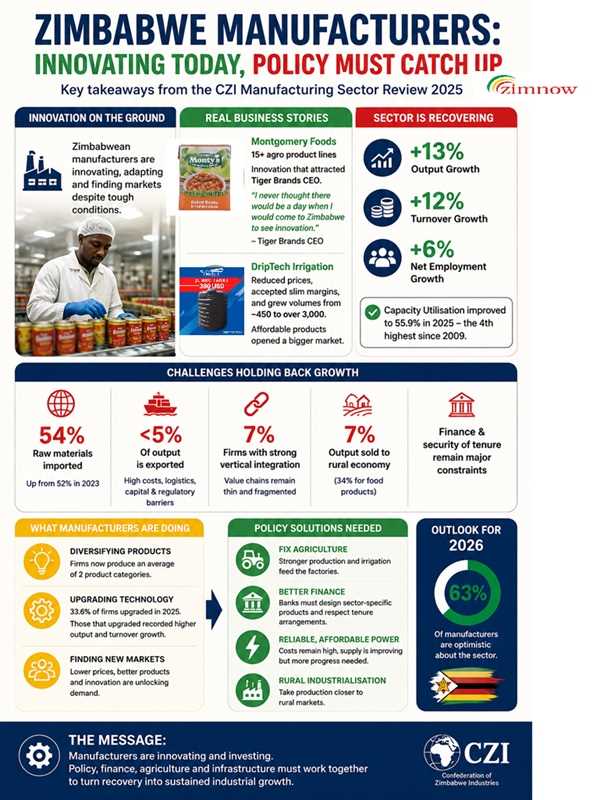
The CZI survey confirms that the sector is recovering, with output up 13%, turnover up 12% and net employment up 6% in 2025. Capacity utilisation also improved to 55.9%.
Liam Philp, chief executive officer of Montgomery Foods, said the era of fragmented solutions should be over.
Montgomery Foods has built a food manufacturing model around agro-processing, with product lines including baked beans, tomato sauce, tomato puree, chopped tomatoes, tomato and onion mix, and canned sweet corn.
Philp said the company’s experience showed that Zimbabwe could build competitive food manufacturing if agriculture, technology, markets and policy are treated as one connected system.
He told delegates that the company’s innovation had attracted high-level regional interest, including from Tiger Brands.
“I never thought there would be a day when I would come to Zimbabwe to see innovation,” he quoted the Tiger Brands chief executive as saying after visiting the business.
The message from manufacturers was that Zimbabwe is not short of ideas or enterprise. The weakness is that many businesses are still forced to solve power, finance, inputs, market access, technology and logistics problems separately.
The CZI survey shows that manufacturers are already adapting through product diversification and technology upgrading. Firms now produce an average of two product categories, while 33.6% upgraded technology in 2025. Those that upgraded technology recorded stronger turnover and output growth than those that did not.
Related Stories
Bob Henson, chief executive officer of DripTech Irrigation, said agriculture must be fixed because manufacturing depends on it.
This backs Indigenous Grain Millers Association of Zimbabwe chairman Tinashe Prosper Chiname’s recent assertion that Zimbabwe should not continue to lose in excess of US$4 billion annually through unnecessary imports.
Henson said irrigation, input supply and agricultural productivity directly affect manufacturing because factories need reliable raw materials and viable demand from producers.
He said DripTech had managed to reinvent itself by reducing prices, accepting slimmer margins and growing volumes. According to him, sales volumes rose from about 450 to more than 3,000 after the company reduced prices and reached a wider market segment.
Henson also raised the issue of security of tenure, saying policies must ensure security in whatever form that banks and investors can trust.
Industry and Commerce Minister Nqobizitha Mangaliso Ndlovu said the banking industry needs to find ways of attracting deposits and designing financial products that respond to specific sectors.
He said at cabinet level, the government has questioned whether it fully understands the structure of its current economy, including the growth of smaller producers and businesses that are often described as informal.
The Minister said this was why there is a shift towards recognising the “small sector” rather than simply calling it informal.
He said some businesses have grown sharply in the past decade, pointing to beverage sector growth where Varun has reportedly grown eight times while Delta has doubled. For the Minister, such examples suggest that a different Zimbabwean business story is emerging, but it may take time for everyone to fully understand it.
But manufacturers still face binding constraints. According to the survey results, raw material import dependence remains high, with 54% of inputs sourced externally. Less than 5% of manufacturing output is exported, with high production costs, logistics, capital constraints and regulatory issues among the main barriers.
CZI chief executive officer Sekai Kuvarika said it is good to note gaps, but also to acknowledge progress. She said although power costs remain a significant hurdle, power supply has improved.
The message from the indaba was that manufacturers are not waiting for perfect conditions. They are changing products, cutting prices, upgrading technology, finding markets and building new models.
The policy challenge is to turn these individual survival stories into a national manufacturing system.






Leave Comments