








By Simbarashe Namusi
There is something increasingly fascinating about the Second Republic's relationship with records.
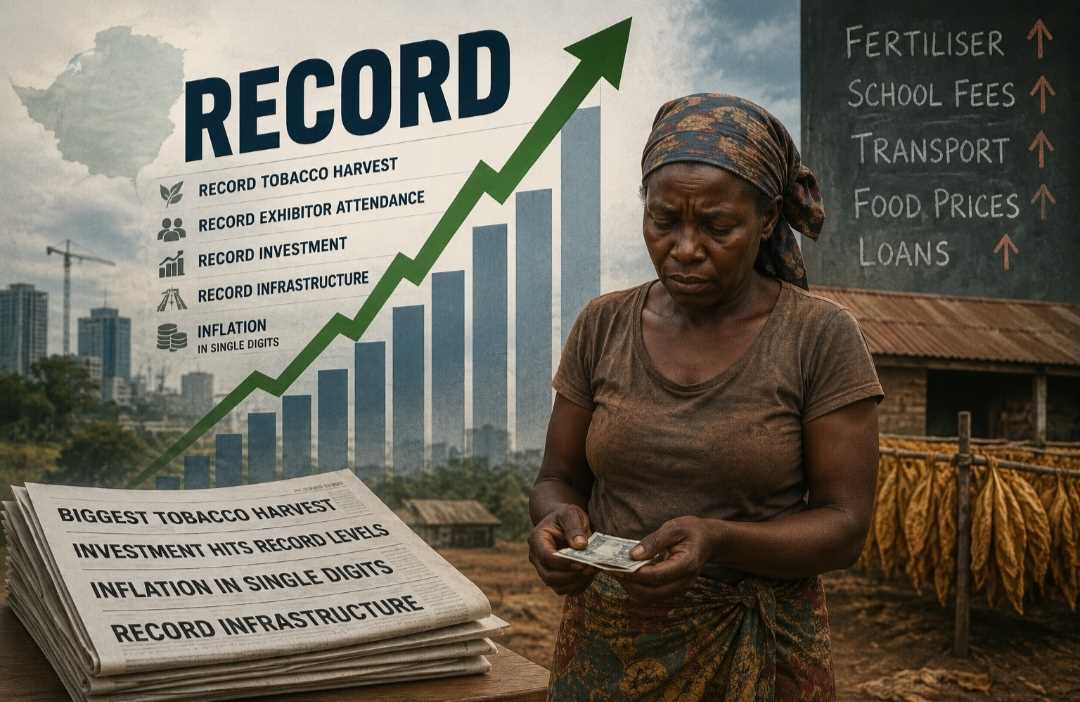
Zimbabwe has been presented with records in tobacco production, exhibition attendance, investment, infrastructure development and a range of other indicators. Even inflation has become part of the narrative, with single-digit figures presented as evidence of economic stabilisation.
Individually, these figures may well be accurate. But somewhere along the way, the record has become a measure of governance itself.
This is not an argument against statistics. Governments need them to measure progress and assess whether policies are working. The issue is what happens when selected statistics become the principal language of performance.
A record is irresistible public relations material. It is simple. It is memorable. It fits neatly into a headline. It requires little explanation.
"Zimbabwe records its biggest tobacco harvest." "Record exhibitor attendance at the Zimbabwe Agricultural Show." "Inflation falls to single digits." "Investment reaches record levels."
Each statement carries an implicit message: things are working. That is the politics of the record.
The sophistication here is that the statistic need not be false to be useful propaganda. A government can communicate a perfectly accurate number while leaving the more complicated story outside the frame.
Tendai grows tobacco on four hectares outside Karoi. Her name is composite, drawn from farmers across the growing belt, but her arithmetic is real. This season's harvest was, by the numbers, one of the best the country has recorded.
Related Stories
Her own return was not. Fertiliser cost more. The loan against next season's crop cost more. What reached her hand after the contractor, transporter and grading floor took their share was, in real terms, roughly what it was two seasons ago.
A record harvest is unquestionably good news for the sector. But production is an output. It says nothing about input costs, producer prices, financing or the share of the final value that actually reaches the farmer. Tendai's harvest and Zimbabwe's harvest can both be records, and only one of them changes her life.
Exhibition attendance works the same way, only the gap shows up later. A record number of exhibitors is a genuine achievement for an organiser, but attendance is an activity indicator, not an outcome. What matters is what happened afterwards: the investment deals concluded, the jobs created and the local businesses that secured contracts, rather than just a photograph and a handshake.
Inflation is the trickiest of the three because it sounds like the good news is arithmetic rather than framing. When inflation falls from a high level to single digits, the rate at which prices are increasing has slowed. That is not the same as prices returning to where they were, and it does not, by itself, mean household purchasing power has recovered.
Tendai does not experience the inflation rate as a percentage. She experiences it as the price of fertiliser, school fees and the bus fare into town.
Governments everywhere select favourable indicators; political communication is selective by nature. The danger comes when the metric becomes the achievement, when a record crop becomes evidence of agricultural transformation and lower inflation becomes evidence that the economy is thriving. Sometimes that conclusion is justified. Sometimes it needs considerably more evidence than the headline offers.
The real test of governance cannot simply be whether Zimbabwe has produced another record. It must be whether that record reaches Tendai. Whether it increases her income, whether it makes input costs more bearable, and whether it changes what is actually left over once the season closes.
Repeated often enough, statistics stop describing reality and start constructing a narrative about it. A country can produce a record tobacco crop and still have a farmer who is worse off than she was two seasons ago. These are not contradictions. They simply show that national performance has many dimensions, and that citizens do not live inside spreadsheets. They live inside economies.
The most meaningful record is not the one that looks best in a government communiqué. It is the one Tendai can actually feel.
Simbarashe Namusi is a media expert writing in his personal capacity.





Leave Comments