






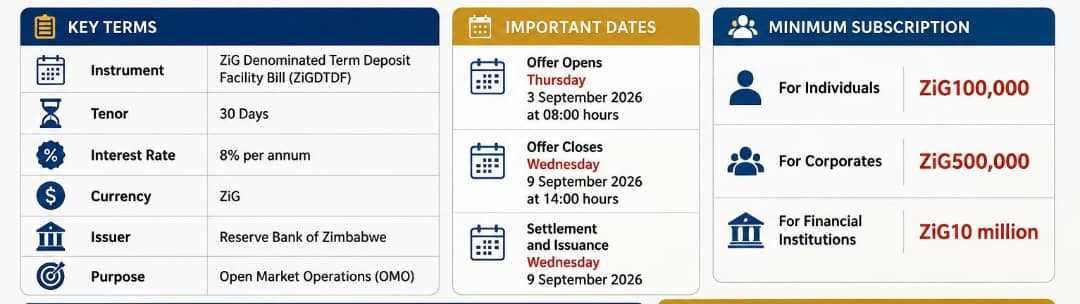
The Reserve Bank of Zimbabwe has opened a fresh 30-day ZiG-denominated investment window offering an annual interest rate of 8%, as the central bank steps up the use of market-based instruments to mop up excess liquidity while encouraging savings in the local currency.
The latest ZiG Denominated Term Deposit Facility Bill offer opened at 08:00 today, September 3, 2026, and closes at 14:00 on September 9. Settlement and issuance are scheduled for the same day.
Unlike conventional Treasury borrowing, the ZiGDTDF is an open-market operations instrument through which the central bank takes ZiG liquidity out of the financial system for a defined period before returning it with interest.
The facility is open to banks, building societies, deposit-taking microfinance institutions, POSB, corporates and individuals.
Minimum subscriptions are set at ZiG10 million for financial institutions, ZiG500,000 for corporates and ZiG100,000 for individuals.
The RBZ says the instrument is designed to provide “positive real returns to investors” while supporting reserve-money management, exchange-rate stability and a savings culture.
The offer comes as Zimbabwe's inflation environment has shifted significantly from the conditions that prevailed when the ZiG was introduced.
RBZ data shows annual ZiG inflation stood at 2.89% in August 2026, while monthly inflation was 0.10%. Annual US-dollar inflation was 3.13%.
At an 8% annual interest rate, a 30-day investment would generate approximately 0.66% in interest before applicable charges or taxes. For an individual investing the minimum ZiG100,000, the return would be about ZiG658 over 30 days.
The return would therefore be above August's monthly ZiG inflation rate, provided the current inflation environment remains broadly stable.
However, the bigger purpose of the instrument is monetary policy rather than investment alone.
The RBZ introduced the ZiGDTDF under its 2026 Monetary Policy framework as a tool for sterilising liquidity — effectively removing excess ZiG from circulation and reducing the amount of local currency available to chase foreign currency and goods.
Related Stories
The central bank's June Monetary Policy Committee said the inaugural 90-day bill attracted ZiG367.2 million, while the 30-day instrument raised another ZiG110 million. The two instruments carried yields of 11% and 8%, respectively.
The MPC said the interest rates were expected to help establish a benchmark for savings instruments.
“In the near to medium-term, the ZiGDTDF interest rates [are expected] to guide the minimum savings interest rates that ensure positive real returns, support a domestic savings and investment culture, and provide impetus to ongoing efforts to develop the capital and money markets.”
The latest operation is part of the RBZ's broader effort to shift monetary policy towards market-based instruments, reserve-money discipline and exchange-rate stability.
For years, Zimbabwe's monetary authorities have faced challenges including excess liquidity, currency substitution and weak confidence in local-currency savings.
Offering a positive return on ZiG deposits is intended to give banks, companies and individuals an incentive to retain surplus local-currency balances instead of immediately converting them into foreign currency or other stores of value.
The 8% rate is significantly above the current annual ZiG inflation rate of 2.89%. However, investors also face exchange-rate risk because the ultimate value of a ZiG return depends on the currency's performance against the US dollar.
As of September 2, the RBZ's indicative interbank rate put the US dollar at an average of ZiG26.72, with a bid rate of ZiG26.05 and an offer rate of ZiG27.38.
The RBZ's June MPC statement said the ZiG had traded within roughly ZiG25 and ZiG27 per US dollar, supported by increased foreign-currency reserves and central-bank interventions.
The bill also carries features aimed at increasing its attractiveness to institutional investors. It qualifies for prescribed-asset and liquid-asset status, can be used as collateral for RBZ accommodation, is redeemable at maturity and is tradable.
Its tradability could also support the development of a domestic ZiG yield curve by creating a financial asset that can be bought and sold before maturity.
The RBZ's June offer provided 30-, 60- and 90-day maturities at 8%, 9% and 11%, respectively, indicating an effort to establish reference rates across different periods.
The latest offer, however, is focused solely on the 30-day tenor at 8%, giving investors a shorter-term avenue to earn a return on ZiG while allowing the central bank to temporarily withdraw liquidity from the financial system.




Leave Comments