





By Tanatsiwa Dambuza
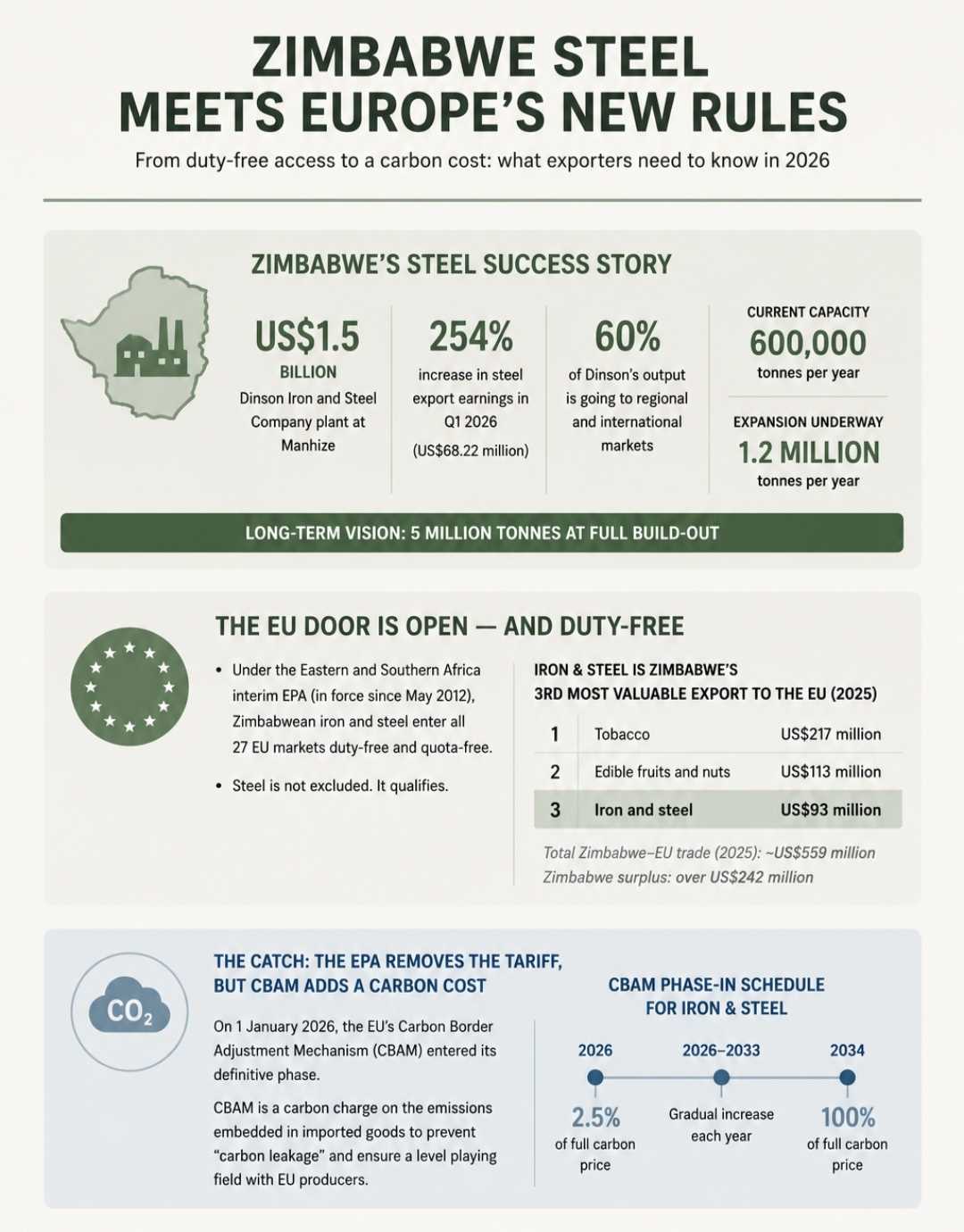
For the first time in a generation, Zimbabwe is a steel exporter. The Dinson Iron and Steel Company's US$1.5 billion Manhize plant, the largest integrated steel mill in Africa, has transformed the country from spending roughly US$500 million annually importing steel to exporting it.
In the first quarter of 2026 alone, steel export earnings jumped 254% to US$68.22 million, with around 60% of Dinson's output destined for regional and international markets.
Phase One currently produces 600,000 tonnes of steel annually, while an additional US$800 million investment by parent company Tsingshan Holding is expected to double capacity to 1.2 million tonnes as part of a long-term target of five million tonnes.
As Zimbabwe's steel industry expands beyond regional markets, Europe presents a major opportunity—but one that comes with new rules.
First, the Good News: The EU Door Is Open and Duty-Free
Zimbabwe exports to the European Union under the Eastern and Southern Africa Interim Economic Partnership Agreement, which has been in force since 2012.
The agreement gives Zimbabwean products, including iron and steel, duty-free and quota-free access to all 27 EU member states.
This is particularly significant after South Africa introduced steel import duties of between 10% and 30% in May 2026, making the European market an attractive alternative for Zimbabwean producers.
Trade figures already show growing demand. Iron and steel became Zimbabwe's third-largest export to the EU in 2025, worth an estimated US$93 million, behind only tobacco (US$217 million) and edible fruits and nuts (US$113 million). Overall trade between Zimbabwe and the EU reached approximately US$559 million, with Zimbabwe recording a trade surplus of more than US$242 million.
The Catch: Duty-Free Access, But a Carbon Cost
While the EPA removes customs duties, it does not exempt Zimbabwean steel from the European Union's Carbon Border Adjustment Mechanism.
The new system entered its definitive phase on January 1, 2026, applying to imports of iron and steel, cement, aluminium, fertilisers, electricity and hydrogen.
CBAM requires importers to pay a carbon charge equivalent to that paid by European manufacturers under the EU's emissions trading system. The mechanism is designed to prevent "carbon leakage" by ensuring imported products face the same carbon costs as those produced within Europe.
The carbon charge will be phased in gradually—from 2.5% of the full carbon price in 2026 to 100% by 2034.
In other words, Zimbabwean steel can enter Europe without paying customs duty but may still face significant carbon-related costs.
Why This Matters for Manhize
Related Stories
The challenge lies in how Zimbabwe currently produces steel.
The Manhize plant relies primarily on coal- and coke-based blast furnace technology powered largely by thermal energy—one of the world's most carbon-intensive methods of steel production.
A second major investment, the US$3.6 billion Palm River Energy Metallurgical Special Economic Zone in Beitbridge, is also centred on coal mining, coke production and coal-fired power generation, although it will include some electric arc furnace capacity, which produces lower emissions.
There are encouraging developments. Dinson's expansion includes a 50-megawatt solar power plant and a 200-megawatt waste-gas recovery system, while Zimbabwe has committed under the Paris Agreement to reduce per-capita greenhouse gas emissions by 40% by 2035.
The Cost of Not Measuring Emissions
Experts say one of the biggest risks is failing to provide verified emissions data.
Under CBAM, exporters that cannot submit independently verified, installation-level carbon emissions data will automatically be assigned default EU emissions values, which are deliberately set high.
That means Zimbabwean steel producers could pay significantly higher carbon charges than necessary simply because they cannot prove their actual emissions.
With EU carbon prices recently ranging between €65 and €80 per tonne of carbon dioxide, and penalties of €100 for every undeclared tonne of emissions, the financial implications could be substantial for exporters shipping hundreds of thousands of tonnes of steel annually.
What Needs to Be Done
Industry experts say the immediate priority is establishing robust systems to measure, report and independently verify emissions.
Doing so would allow Zimbabwean producers to avoid punitive default values and pay carbon costs based only on their actual emissions.
Over the longer term, expanding renewable energy, improving energy efficiency and adopting lower-carbon steelmaking technologies will become increasingly important. Manhize's solar investment, waste-gas recovery system and Palm River's planned electric arc furnace capacity provide a starting point, but experts say further progress will be needed.
At policy level, Zimbabwe also faces a strategic decision on carbon pricing. Because CBAM recognises carbon prices already paid in the exporting country, introducing a domestic carbon pricing system would allow some of that revenue to remain in Zimbabwe instead of being collected by the EU, while supporting the country's climate commitments.
The Bigger Picture
Zimbabwe's steel boom and Europe's new carbon rules have arrived at the same time.
The EPA gives Zimbabwe something many steel exporters would envy: duty-free, quota-free access to one of the world's largest markets.
CBAM, however, adds a new condition—steel must not only be competitively priced, but its carbon footprint must also be measured, verified and, over time, reduced.
For an industry targeting five million tonnes of annual production, carbon transparency is no longer simply an environmental issue. It is becoming a key requirement for competing in global markets.





Leave Comments