





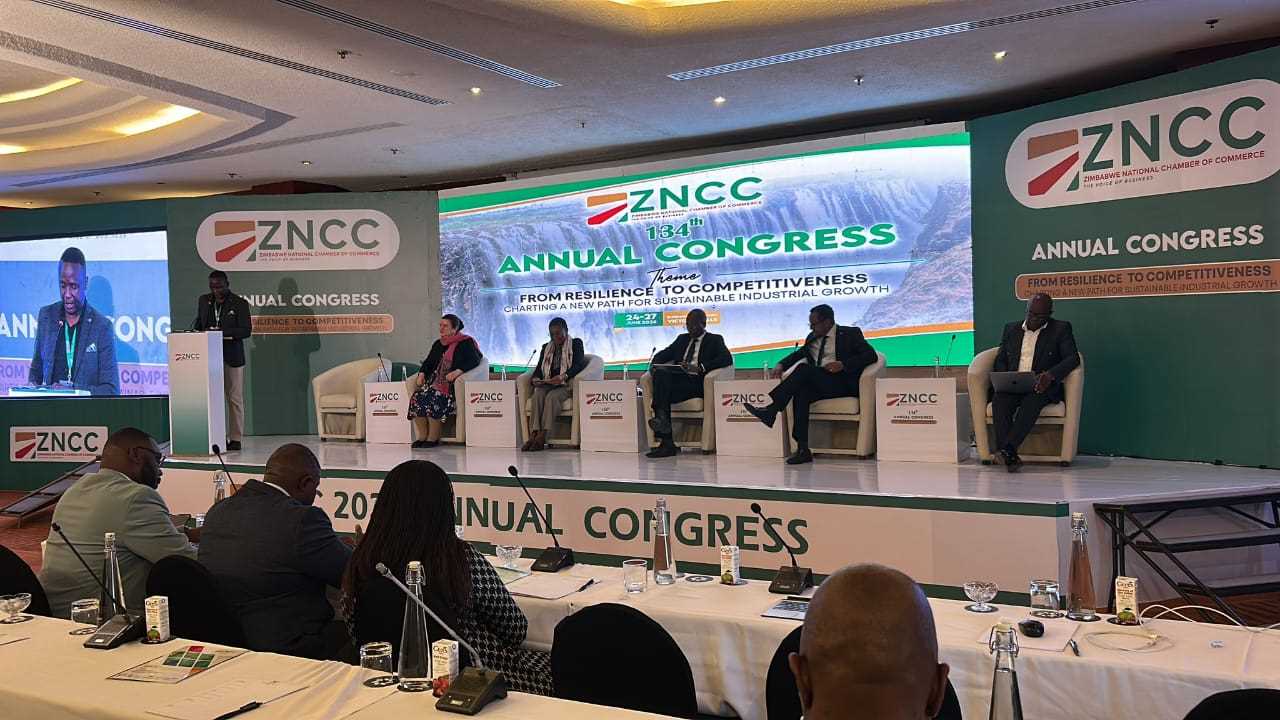
Zimbabwe risks missing out on emerging trade opportunities under the African Continental Free Trade Area unless it addresses long-standing competitiveness challenges that continue to limit exports, business leaders, policymakers and development experts heard at the Zimbabwe National Chamber of Commerce Annual Congress.
Discussions at the congress centred on a growing reality facing African economies: while global trade is becoming increasingly fragmented through preferential trade agreements and geopolitical competition, Africa is pushing ahead with the creation of a single continental market through the African Continental Free Trade Area.
Participants argued that market access alone will not guarantee success for Zimbabwean businesses.
Speaking during the discussions, Ministry of Foreign Affairs and International Trade official Rudo Faranisi said Zimbabwe must focus on building competitive industries capable of succeeding in regional and global markets.
"A country that doesn't trade cannot prosper. We have to develop our own technologies that suit our needs. Education 5.0 is starting to entrench change and advance towards competitiveness. We need to know what is required to make our products internationally competitive. Competitiveness is our goal."
The comments come as Zimbabwe seeks to increase exports beyond its traditional dependence on minerals and primary commodities.
According to United Nations Trade and Development data, Zimbabwe exported goods worth approximately US$7.4 billion in 2024, but the country continues to run a merchandise trade deficit, importing significantly more than it exports.
One statistic presented at the congress captured the scale of the challenge. Manufactured goods account for only about five percent of Zimbabwe's total merchandise exports, meaning the overwhelming majority of export earnings still come from raw or semi-processed commodities.
World Bank data similarly shows manufactured exports accounted for just 6.7 percent of Zimbabwe's merchandise exports in 2024.
For economists, that figure matters because countries that export manufactured products generally create more jobs, earn higher export revenues and are less vulnerable to commodity price shocks than those dependent on raw material exports.
The issue is not unique to Zimbabwe. Across Africa, primary commodities accounted for 76.8 percent of merchandise exports in 2024, highlighting the continent's broader struggle to industrialise and move up global value chains.
Several speakers argued that the African Continental Free Trade Area should be viewed as an industrialisation opportunity rather than simply a trade agreement.
The agreement, which aims to create a market of more than 1.4 billion people, has been ratified by most African countries and is gradually moving from negotiation to implementation. Yet businesses continue to face practical obstacles that make cross-border trade difficult.
President of the Limpopo Chamber of Commerce and Industry, Albert Jeleni, said businesses needed to become more active participants in the integration process.
Related Stories
"The private sector has been sleeping on duty," he said while discussing cross-border value chains and investment opportunities between Zimbabwe and South Africa's Limpopo Province.
His remarks echoed concerns raised during the congress that business organisations across the continent have not been sufficiently involved in shaping implementation of the trade agreement.
Delegates argued that governments can negotiate trade deals, but businesses ultimately determine whether trade actually takes place.
"The Voice of Business should be represented and at the end of the day, it's business that trade - should have a seat at the table. Government's is to create a regime that allows businesses to fully maximize the available opportunities," participants noted.
The discussion also highlighted opportunities arising from preferential trade arrangements outside Africa.
Speakers pointed to China's recent zero-tariff initiative for a number of African countries and Zimbabwe's preferential access to the European Union market under the Economic Partnership Agreement framework.
Despite those opportunities, delegates noted that many Zimbabwean companies have struggled to fully utilise available export markets.
The European Union was cited as one example where stronger performance has been recorded in horticulture exports, while significant opportunities remain untapped in other sectors.
Deputy Resident Representative of the United Nations Development Programme in Zimbabwe, Challa Getachew, focused attention on micro, small and medium enterprises, which account for the majority of businesses in Zimbabwe but often face the greatest barriers to entering export markets.
This concern reflects a wider trend across Africa, where trade participation remains concentrated among larger firms with greater access to finance, logistics networks and market information.
Research on African trade competitiveness increasingly points to infrastructure and logistics as major obstacles. A recent study on trade competitiveness in Africa found that high transport costs, multiple border inspections, inadequate infrastructure and unreliable power supplies remain among the biggest barriers to export growth.
The same concerns surfaced repeatedly during the congress.
Participants identified logistics bottlenecks, regulatory burdens, compliance costs and infrastructure deficits as key constraints on Zimbabwe's competitiveness.
Those challenges are becoming more important as implementation of the African Continental Free Trade Area accelerates.
The World Bank has estimated that the agreement could increase intra-African exports by more than 80 percent if countries address trade barriers and improve infrastructure. However, analysts warn that countries with weak productive capacity risk becoming consumers rather than beneficiaries of continental trade.
Oxford Economics analyst Raheema Parker recently warned that implementation challenges remain significant across the continent.
"These barriers are especially pronounced in smaller sub-Saharan economies, which are more vulnerable to external shocks and often lack the administrative and financial capacity," she said.








Leave Comments