








Zim Now News Desk
Zimbabwe’s human rights challenges are impacting ordinary people through dry taps, unsafe toilets, crowded settlements, joblessness and the daily struggle to live with dignity.
New data from the Human Rights Measurement Initiative’s Rights Tracker shows that Zimbabwe is underperforming on several basic rights that should be achievable at the country’s current income level.
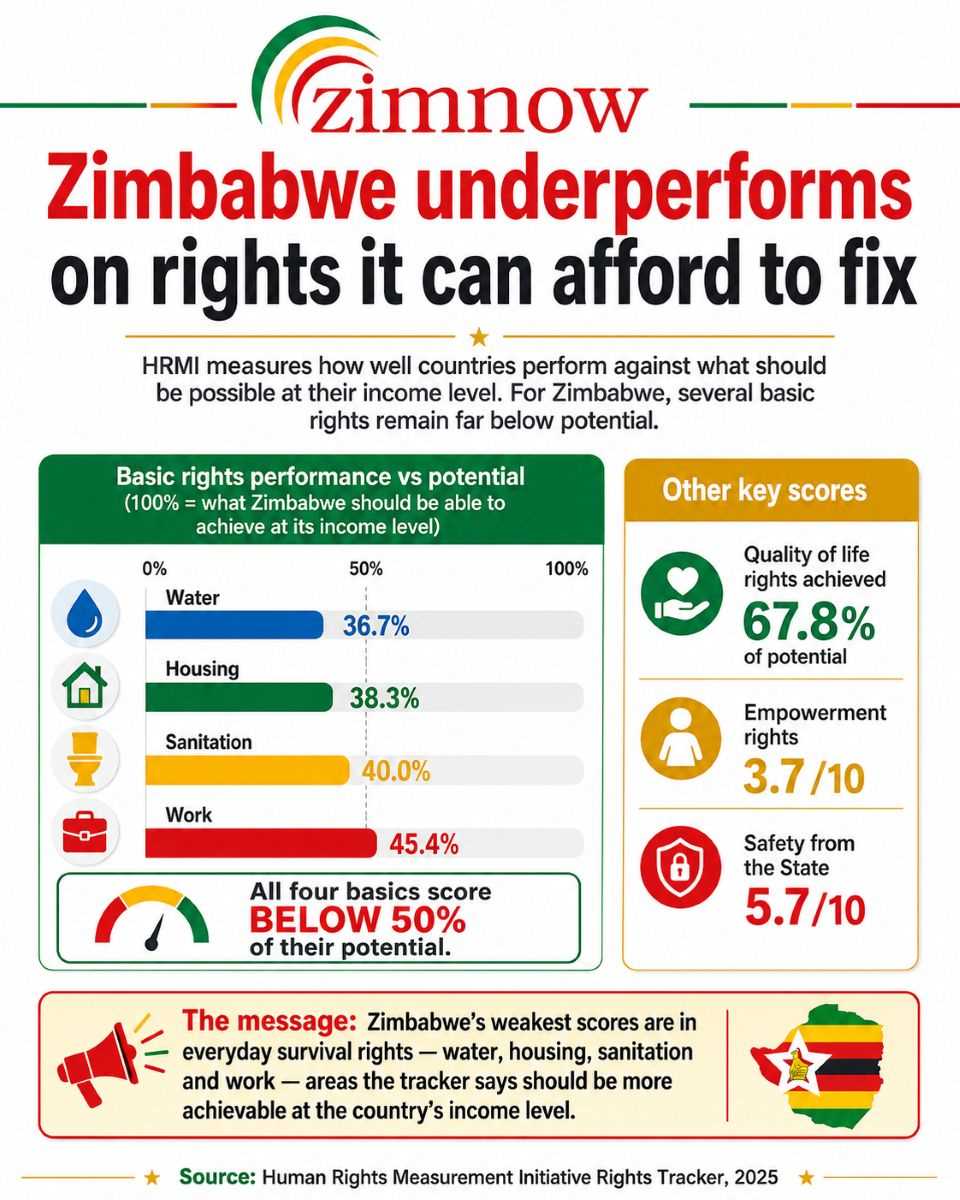
According to the 2025 HRMI Rights Tracker, Zimbabwe’s weakest economic and social rights include water, sanitation, housing and work.
The tracker rates Zimbabwe’s fulfilment of the right to water at 36.7%, sanitation at 40%, housing at 38.3% and work at 45.4%.
The Rights Tracker is particularly significant because it does not simply compare Zimbabwe with wealthy countries. For economic and social rights, HRMI measures how well a country is doing against what should be possible at its level of income.
The numbers suggest that Zimbabwe is not only constrained by poverty, sanctions, drought, debt or global economic shocks. It is also falling short in areas where better planning, stronger public finance management, improved local authority capacity and less leakage could produce visible gains.
Zimbabwe’s Constitution recognises several of these rights. Section 77 gives every person the right to safe, clean and potable water, as well as sufficient food. The same Constitution also places obligations on the State to take reasonable measures, within available resources, to progressively realise social and economic rights.
The gap between constitutional promise and household reality remains wide. UNICEF says access to basic drinking water in Zimbabwe has stagnated at 64% since 2020, while access to basic sanitation stands at 36%. Hygiene coverage is also low at 42%, with major disparities between urban and rural communities.
This means the HRMI figures mirror the lived experience of communities where residents queue at boreholes, buy water from private suppliers, use unsafe sources or rely on poorly maintained sanitation systems.
Poor water and sanitation increase disease risk, place a heavier burden on women and girls who often collect water, disrupt schooling, reduce household productivity and weaken public health systems already under pressure.
Related Stories
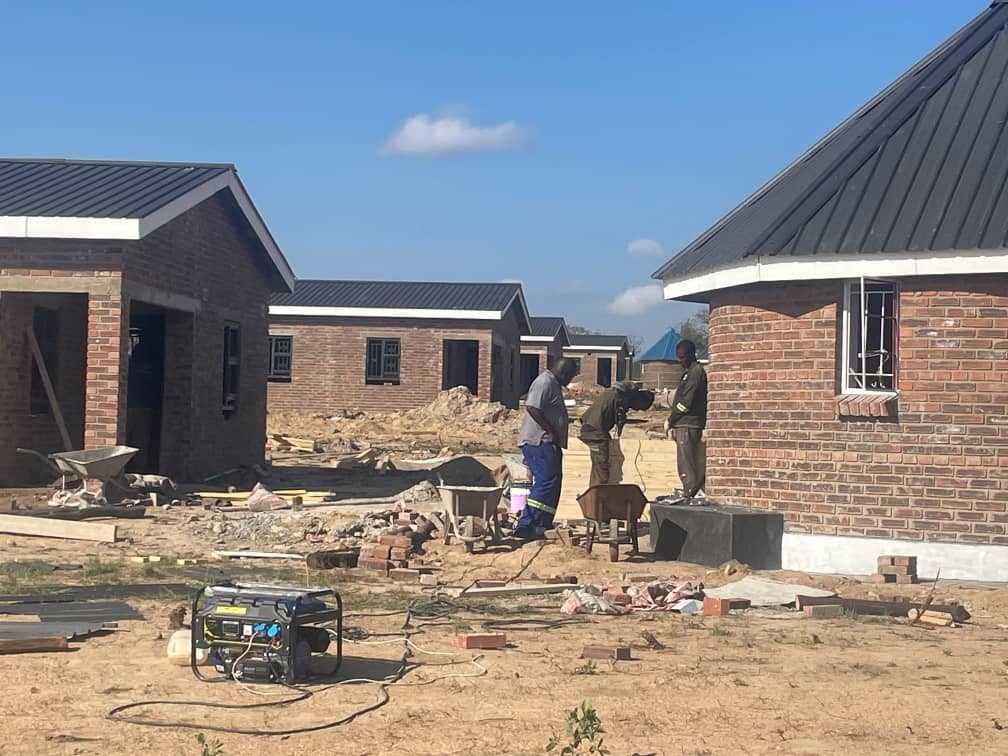
Housing presents another fault line. Zimbabwe’s rapid urbanisation has not been matched by affordable serviced land, low-cost housing delivery, secure tenure and infrastructure investment. In many urban and peri-urban areas, families have built homes ahead of roads, sewer lines, clinics, schools and water systems. In some cases, desperate home seekers have been exposed to land barons and irregular settlements, only to later face demolitions or service exclusion. The result is a rights crisis hidden inside the housing crisis.
The right to work is also central to the picture. A low score on work does not only mean unemployment. It points to the wider struggle for decent livelihoods in an economy where many people survive through informal trading, short-term hustles, unstable earnings and unpaid family labour.
The tracker also records weak civil and political rights. Zimbabwe’s empowerment score, which covers freedoms such as expression, assembly and political participation, stands at 3.7 out of 10. Safety from the State is scored at 5.7 out of 10.
The strong warning from the data is that civil rights and survival rights are now feeding into each other.
A citizen without water, work or secure housing is less able to participate freely in public life. A community dependent on political gatekeepers for land, food aid, vending space or borehole access is less able to speak without fear. A young person without work is more vulnerable to patronage, exploitation and social collapse.
That is why the Rights Tracker should not be read only as a human rights report. It is also a service delivery, governance and development scorecard.
For Government, the challenge is to show that NDS2 and Vision 2030 will not only produce roads, mines, malls and headline investments, but measurable improvements in the rights people experience at household level.
For local authorities, it raises questions about water treatment, sewer maintenance, land allocation, housing regularisation, refuse collection and transparent use of ratepayer funds.
For Parliament, it points to the need for stronger budget oversight: how much is being allocated to rights-critical services, how much is actually disbursed, and how much reaches the intended communities?
For citizens, the data offers a different way to ask for accountability. A broken sewer line is not only a council failure. A dry tap is not only an inconvenience. An unsafe settlement is not only a planning issue. These are rights questions.
The tragic story is not that Zimbabwe is failing because it is poor. It is that Zimbabwe is underperforming on rights it can afford to fix.





Leave Comments