







Zimbabwe's foreign currency inflows surged to US$8.3 billion during the first five months of 2026, up 39.1 percent from US$6 billion recorded during the same period last year, according to the Reserve Bank of Zimbabwe's Monetary Policy Committee.
During the same period, foreign currency inflows exceeded outflows of US$5.9 billion, strengthening the country's external position and reflecting stronger export earnings.
The figures show Zimbabwe received an additional US$2.3 billion in foreign currency between January and May compared with the same period in 2025. However, beneath the encouraging headline lies a more important economic story. The country's foreign currency boom is increasingly being powered by one commodity—gold.
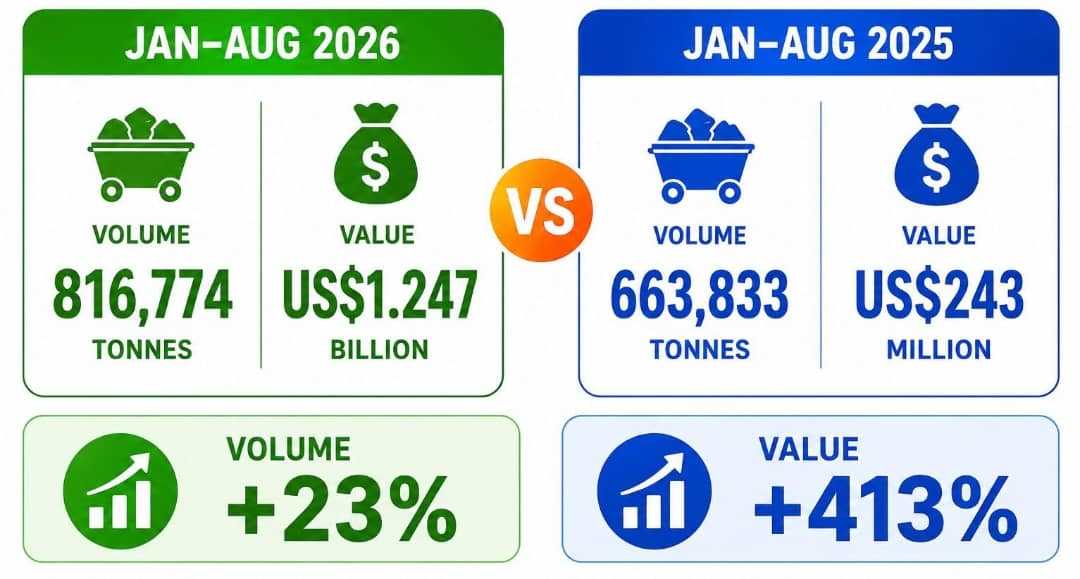
Gold export earnings reached US$1.2 billion during the first four months of 2026, more than double the US$579 million earned during the corresponding period last year. Yet gold production increased by only 3.1 percent, rising from 16 tonnes to 16.5 tonnes over the same period.
The figures suggest Zimbabwe's foreign currency windfall is being driven far more by record international gold prices than by a significant expansion in mining production.
That raises a critical economic question: if gold is responsible for much of Zimbabwe's foreign exchange boom, how are the country's other export sectors performing, and can the current momentum be sustained if global bullion prices retreat?
Mining, tobacco, platinum, diaspora remittances, manufacturing exports and tourism have traditionally underpinned Zimbabwe's foreign currency earnings. Yet the latest figures indicate that gold has emerged as the dominant contributor to recent growth, exposing the economy to the risks associated with commodity price cycles.
Internationally, gold prices have climbed to historic highs as investors seek safe-haven assets amid geopolitical uncertainty, central bank buying and global economic volatility. Zimbabwe has benefited enormously from that rally, but analysts caution that commodity booms rarely last forever.
That concern is already being echoed within Zimbabwe's mining industry.
Speaking at the Chamber of Mines of Zimbabwe Annual Conference, Gold Producers Association of Zimbabwe president Qubeka Nkomo warned that while Zimbabwe's miners are enjoying record prices today, the industry remains vulnerable if those prices decline.
Nkomo said miners continue to face high operating costs, limited access to affordable capital and delays in payments from Fidelity Gold Refinery for gold deliveries.
These challenges, he said, are preventing mining companies from investing in expansion projects while prices remain favourable. Without new investment, miners will struggle to increase production, improve productivity and build resilience for the day international gold prices inevitably soften.
His warning highlights one of the biggest contradictions within Zimbabwe's mining industry.
Despite record export earnings, production growth remains subdued.
Official statistics show gold production reached 16.5 tonnes by May compared with 16 tonnes during the same period in 2025, an increase of only 3.1 percent. Export earnings, meanwhile, more than doubled because of higher international prices rather than substantially higher output.
Economist Gift Mugano says Zimbabwe's long-term economic stability depends on expanding production rather than relying on favourable international commodity prices.
"The challenge in Zimbabwe is not currency.
Related Stories
The challenge in Zimbabwe is production. We need to address production and anchor the currency with production so that we substitute imports," Mugano said during the Buy Zimbabwe Summit.
He argues that commodity booms should finance productive investment capable of sustaining growth long after prices normalise.
"We are importing because we don't have enough items that we are producing. We need to be producing locally," Mugano said.
Mugano has also pointed to structural challenges that continue to constrain both mining and manufacturing.
"Some of the factors making Zimbabwean products very expensive are liquidity challenges, poor infrastructure, outdated equipment and management inertia," he said.
"Zimbabwe is a cash-trapped economy... resulting in high cost of financing that goes into industry."
Those financing constraints are particularly significant for gold mining, where expanding production requires substantial investment in exploration, underground development, processing plants and modern equipment.
The latest RBZ figures also raise questions about the contribution of Zimbabwe's other foreign currency earning sectors.
Manufacturing continues to operate at only 56 percent capacity utilisation, according to the Confederation of Zimbabwe Industries Manufacturing Sector Survey 2025, limiting its export potential despite significant installed capacity. Tobacco remains one of Zimbabwe's largest export earners but is vulnerable to weather patterns and international market prices, while tourism continues its gradual recovery following the COVID-19 pandemic.
Diaspora remittances remain an important source of foreign exchange, but economists say remittance-led growth cannot substitute for a diversified export economy built on production.
The concentration of recent forex growth in gold therefore raises questions about the pace of export diversification envisioned under Zimbabwe's industrialisation strategy.
Zimbabwe produced a record 46.7 tonnes of gold in 2025 and has set a target of 50 tonnes this year. Achieving that goal will require significantly stronger production during the second half of 2026.
Recent reforms, including Fidelity Gold Refinery's adoption of international spot pricing and improvements to payment arrangements, have strengthened confidence among producers. However, miners argue that affordable long-term financing, timely payments and investment-friendly policies remain essential if production is to keep pace with favourable market conditions.
International analysts caution that while gold prices remain elevated, they are unlikely to stay at current levels indefinitely.
Should prices retreat, countries whose export earnings depend heavily on bullion could experience slower foreign currency inflows, weaker trade balances and increased pressure on exchange rates.
For Zimbabwe, the lesson from the latest RBZ figures extends beyond celebrating a US$2.3 billion increase in foreign currency inflows.
The data demonstrate the strength of the country's mining sector during a favourable commodity cycle, but they also expose an economy becoming increasingly reliant on one commodity to sustain export growth.






Leave Comments