







Zimbabwe's cotton export earnings more than tripled during the first four months of 2026, but industry stakeholders say the figures also expose how much value the country continues to leave on the table by exporting relatively low-value products instead of finished garments.
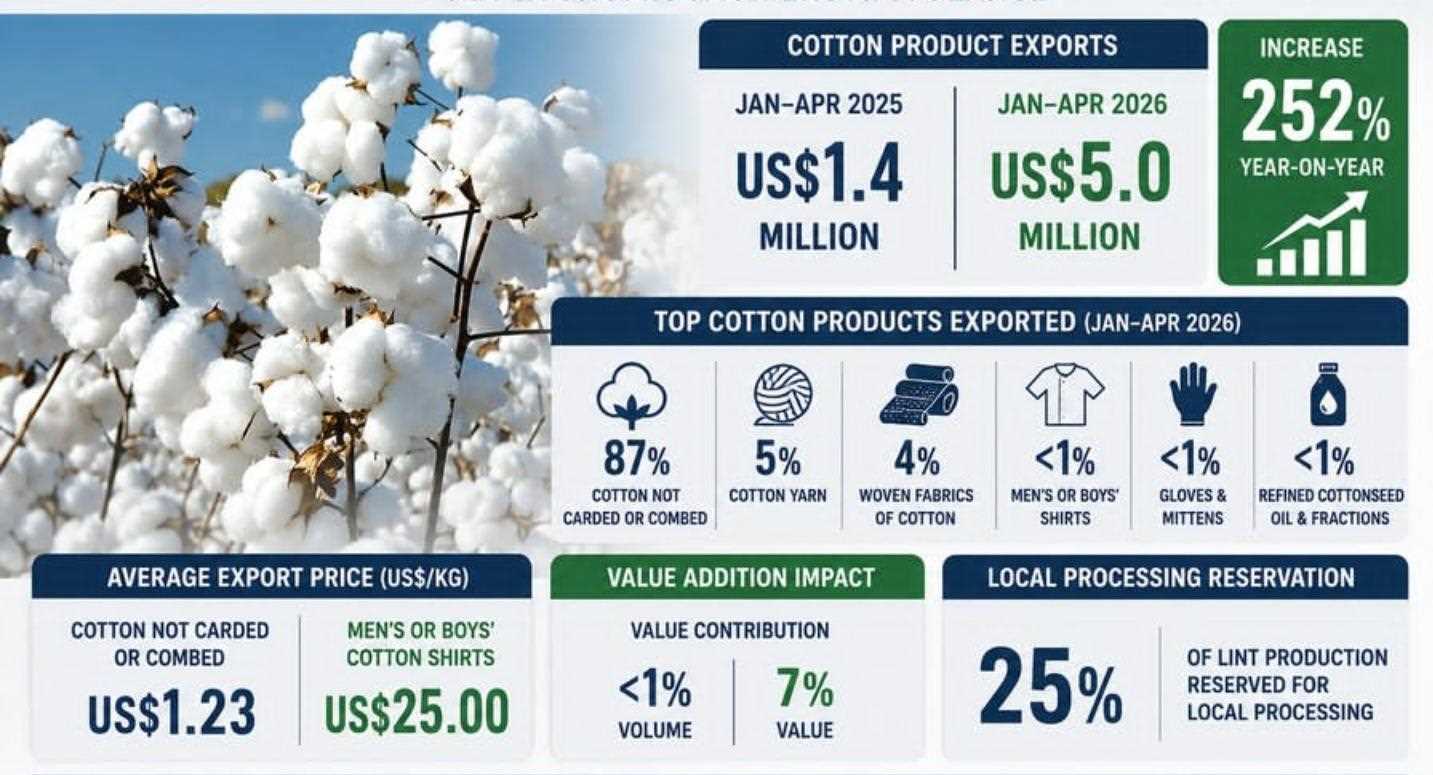
Cotton product exports rose 252% to US$5 million between January and April 2026, up from US$1.4 million during the same period last year. The growth was driven by higher exports of cotton lint, yarn, fabrics, garments, industrial gloves and refined cottonseed oil.
The increase comes as Zimbabwe pushes to diversify exports through value addition and beneficiation under the National Development Strategy 2, which seeks to raise the share of value-added exports from 5.5% in 2025 to 18.4% by 2030.
While the latest figures point to renewed activity across the cotton value chain, analysts say the sector remains far below the levels achieved when Zimbabwe's textile industry employed tens of thousands of workers and supplied both regional and international markets.
At the centre of the debate is the difference between exporting raw cotton and exporting finished clothing.
Trade promotion agency ZimTrade argues that the country's future export earnings lie in processing more of its cotton locally before shipment.
Speaking at the 2026 ZimTrade Annual Exporters' Conference, ZimTrade Chief Executive Officer Allan Majuru said:
"The increase reflected Zimbabwe's steady movement towards industrialisation through value addition and beneficiation."
He added that rising exports of manufactured products demonstrate that Zimbabwe is gradually moving away from dependence on raw commodity exports.
The latest cotton export performance mirrors that broader trend. Rather than relying solely on lint exports, Zimbabwe is increasingly shipping higher-value products such as yarn, fabrics and garments, which generate significantly greater foreign currency earnings and support more employment along the value chain.
Government policy also places considerable emphasis on rebuilding the textile industry.
Related Stories
Under NDS2, Zimbabwe aims to increase local processing of cotton lint from below 20% in 2024 to at least 60% by 2030 through investment in spinning, weaving, garment manufacturing and textile modernisation.
The strategy states:
"The textile and clothing industry will be revitalised as a key driver of value addition, employment creation and export diversification."
Industry players, however, say achieving those targets will require addressing longstanding structural constraints.
The Zimbabwe National Chamber of Commerce recently warned that domestic textile manufacturing capacity remains limited despite policy efforts to revive the sector.
"Only two mills are operating, producing a narrow range of fabrics at low and inconsistent volumes. They cannot meet the quantity, variety or quality required by local clothing manufacturers," the chamber said while commenting on textile industry policy.
That limited capacity means many clothing manufacturers continue importing fabrics even as Zimbabwe grows cotton locally, weakening the country's ability to capture more value from its own raw materials.
Recent production figures nevertheless suggest conditions are improving.
The 2026 cotton marketing season opened with seed cotton output rising 33% to 38,500 tonnes, while planted area expanded by more than 32,000 hectares, signalling renewed confidence among growers following improved producer prices and regulatory reforms.
International trade data also illustrates the industry's untapped potential. Zimbabwe exported about US$18.3 million worth of cotton products in 2024, a figure that remains modest compared to countries with fully integrated textile industries that export finished apparel rather than raw fibre.
Economists argue that every additional stage of processing, from lint to yarn, fabric and finished garments, not only raises export earnings but also creates more jobs across agriculture, manufacturing, transport and retail.







Leave Comments