








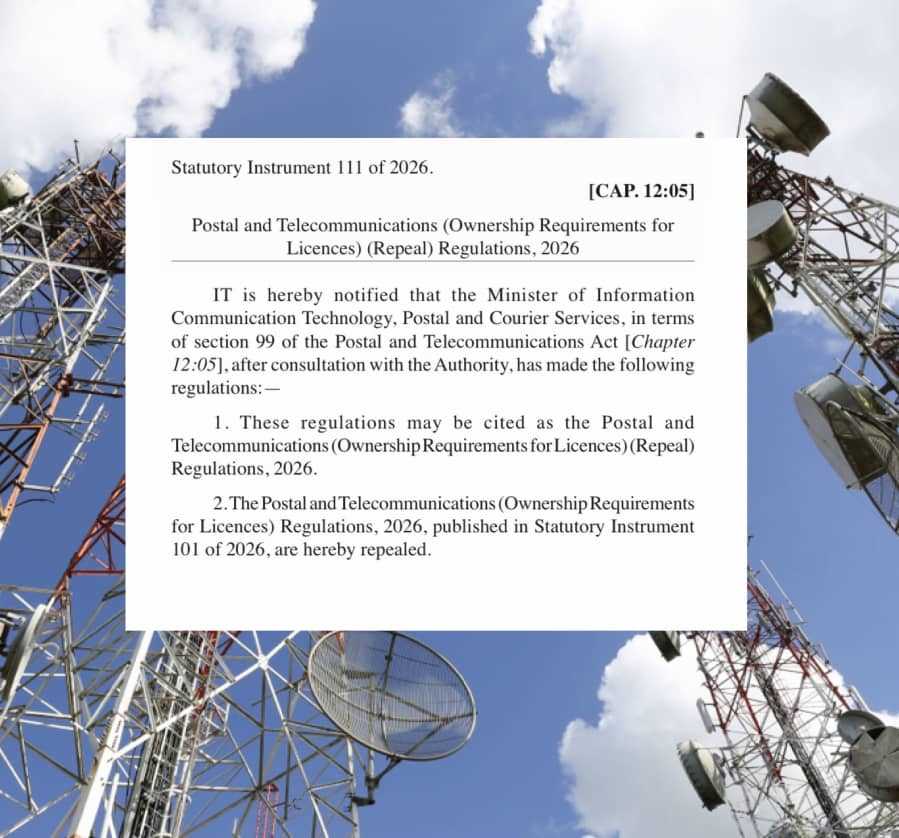
The Government has abruptly withdrawn controversial regulations that would have required telecommunications companies to be at least 75 percent Zimbabwean-owned, reversing a policy that had sparked concerns over investor confidence and regulatory certainty.
Through Statutory Instrument 111 of 2026, the Minister of Information Communication Technology, Postal and Courier Services repealed Statutory Instrument 101 of 2026, effectively cancelling the ownership requirements before companies began implementing them.
The repeal means telecommunications operators are no longer required to comply with the earlier regulations, which had capped foreign ownership at 25 percent, ordered existing licence holders to submit ownership restructuring plans within 90 days, and granted them three years to align with the new threshold.
The gazetted notice states:
"The Postal and Telecommunications (Ownership Requirements for Licences) Regulations, 2026, published in Statutory Instrument 101 of 2026, are hereby repealed."
While Government has not publicly explained the reversal, the decision removes what analysts viewed as a significant source of policy uncertainty in one of Zimbabwe's most capital-intensive sectors.
Telecommunications requires substantial long-term investment in infrastructure, including mobile towers, fibre optic networks, spectrum and digital technologies. Industry observers had warned that mandatory changes to ownership structures could discourage new investment or complicate future capital raising by operators with foreign shareholders.
The ownership regulations would have affected a sector that already has significant foreign investment and continues to attract international interest. Econet Wireless Zimbabwe, the country's largest mobile network operator, is majority owned through international investment structures linked to Econet Global, while NetOne and TelOne remain wholly state-owned. Liquid Intelligent Technologies Zimbabwe, part of the pan-African Cassava Technologies group, also has significant foreign investment links.
Related Stories
More recently, Starlink, operated by SpaceX, entered the Zimbabwean market through local partnerships after securing regulatory approval. Global telecommunications equipment manufacturers Huawei Technologies and ZTE Corporation have also remained key partners in expanding Zimbabwe's telecommunications infrastructure, supplying network equipment and supporting broadband development.
The policy reversal also comes as Zimbabwe is actively seeking to attract foreign direct investment while pursuing its digital economy agenda.
Authorities have repeatedly stated that expanding broadband connectivity, digital financial services and information communication technology infrastructure is central to achieving upper-middle-income status.
Recent policy discussions led by the Ministry of Finance, Economic Development and Investment Promotion have similarly stressed the need to mobilise private capital and improve the investment climate to finance economic growth, making regulatory consistency increasingly important for investors.
The now-repealed 75 percent local ownership requirement risked complicating future investment by international telecommunications companies at a time when Zimbabwe is seeking greater private capital to expand broadband coverage, roll out fifth-generation mobile networks and accelerate digital transformation. Stable and predictable regulations, they argue, are among the most important factors influencing investment decisions in capital-intensive sectors.
The repeal is likely to reassure existing telecommunications investors by removing immediate compliance obligations. However, it may also renew debate over policy predictability, as businesses seek greater certainty over regulatory changes that affect long-term investment decisions.
Economists have long argued that beyond tax incentives and investment promotion campaigns, investor confidence depends heavily on stable and predictable regulations. Frequent policy shifts can increase perceived investment risk, particularly in sectors such as telecommunications where infrastructure investments are recovered over many years.








Leave Comments