








Delta Corporation Limited has crossed a milestone once considered distant, posting more than US$1 billion in annual revenue — a landmark moment that signals both corporate execution and shifting dynamics in Zimbabwe’s economy.
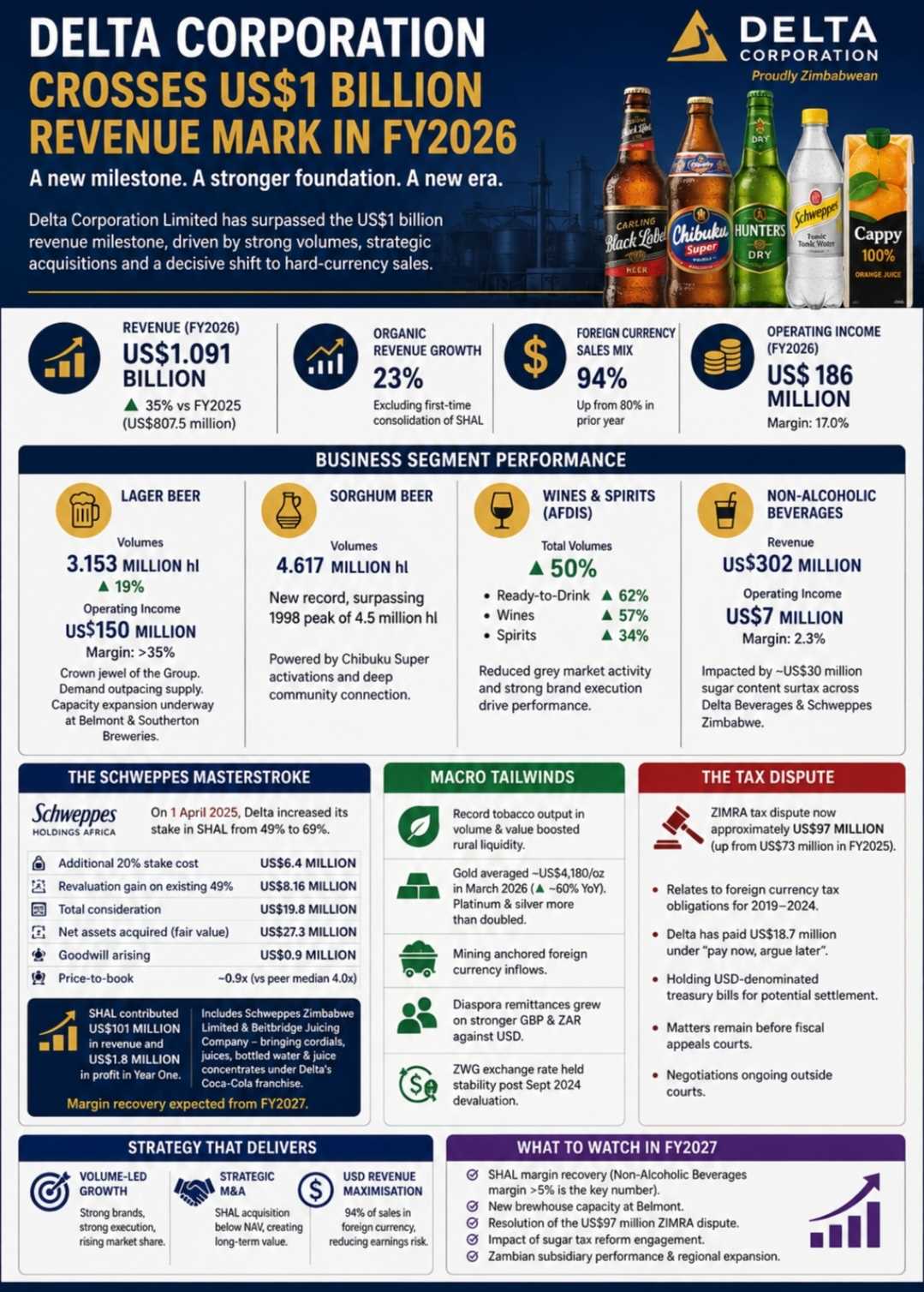
For the financial year ended 31 March 2026, the Group recorded revenue of US$1.091 billion, a 35% jump from US$807.5 million the previous year. Even excluding the first-time consolidation of Schweppes Holdings Africa Limited (SHAL), organic growth remained strong at 23%.
The results reflect more than financial restructuring. They point to rising volumes, strong brand positioning, improving macroeconomic conditions and a management strategy executed with precision.
A More Supportive Economic Environment
The operating environment improved markedly during the year. Relative exchange-rate stability following the September 2024 Zimbabwe Gold (ZWG) adjustment reduced currency volatility, while record tobacco output injected liquidity into rural markets — a key driver of beverage demand.
Mining exports strengthened foreign currency inflows, supported by higher gold prices and stronger diaspora remittances. Crucially, 94% of Delta’s domestic sales were denominated in foreign currency, up from 80% previously, effectively transforming the company into a hard-currency business operating locally and significantly reducing exchange-rate risk.
For investors, this shift improves earnings predictability and aligns Delta more closely with regional peers.
Cracking the Billion-Dollar Revenue Story
Lager Beer remains the Group’s profit engine. Volumes rose 19% to 3.153 million hectolitres, led by Carling Black Label, with operating income reaching US$150 million and margins exceeding 35%. Demand continues to outstrip supply, prompting capacity expansion at Belmont and Southerton Breweries.
Sorghum Beer volumes reached 4.617 million hectolitres, surpassing the previous peak recorded in 1998. Growth was driven by strong brand engagement initiatives linked to Chibuku Super, reinforcing loyalty in price-sensitive markets.
The standout performer was African Distillers Limited (Afdis), where Wines and Spirits volumes surged 50%, supported by Ready-to-Drink products and reduced grey-market competition.
The Non-Alcoholic Beverages segment delivered rapid revenue growth but weaker profitability. Despite revenues of US$302 million, operating income stood at only US$7 million, largely due to an estimated US$30 million sugar content surtax, which management views as the Group’s largest policy headwind.
The Schweppes Acquisition — A Strategic Masterstroke
Related Stories
Delta’s increase in its stake in SHAL from 49% to 69% on 1 April 2025 proved highly value-accretive.
The additional 20% stake cost US$6.4 million, while revaluation of the existing shareholding generated an immediate US$8.16 million gain. Total consideration amounted to US$19.8 million against net assets valued at US$27.3 million — effectively acquiring the business below net asset value.
SHAL contributed US$101 million in revenue and US$1.8 million in profit during its first year under consolidation. Management expects stronger returns from FY2027 once integration investments — including plant rehabilitation and supply contract restructuring — begin yielding efficiencies.
The acquisition brings cordials, bottled water and juice operations into Delta’s Coca-Cola franchise ecosystem, creating operational synergies expected to drive future margin expansion.
The ZIMRA Tax Dispute
One major uncertainty remains: a tax dispute with Zimbabwe Revenue Authority (ZIMRA), now valued at approximately US$97 million.
The dispute relates to whether taxes paid in local currency between 2019 and 2024 should be settled in foreign currency following subsequent devaluations. Delta has already paid US$18.7 million under the “pay now, argue later” principle while negotiations continue outside the courts.
Although management maintains it complied with the law at the time, the potential liability represents a significant risk should the full amount crystallise.
Strategy and Outlook
Delta’s results validate a clear three-pillar strategy:
volume-led organic growth, strategic acquisitions and maximising US-dollar revenues.
By sharply reducing ZWG exposure, acquiring SHAL at a favourable valuation and investing ahead of demand through capacity expansion, the Group has positioned itself for continued growth.
The key strategic wildcard remains the sugar tax. Should authorities align the levy with regional benchmarks, analysts estimate the Non-Alcoholic Beverages division could unlock an additional US$20–30 million in operating income.
Looking ahead, investors will watch several indicators closely — continued volume growth, SHAL’s margin recovery from FY2027, brewery expansion projects and the resolution of the ZIMRA dispute.
The decisive metric for FY2027 will be whether the Non-Alcoholic Beverages operating margin rises meaningfully above 5%. If achieved alongside sustained volume momentum, group earnings before interest and tax could approach US$240–260 million, cementing Delta’s position as one of Zimbabwe’s most resilient corporate success stories.






Leave Comments