






Zimbabwe’s sovereign wealth vehicle, the Mutapa Investment Fund, has reported a dramatic surge in profitability and asset growth for 2025.
However, a deeper analysis of its financial statements reveals significant structural weaknesses, governance concerns, and questions over the true economic value of its performance.
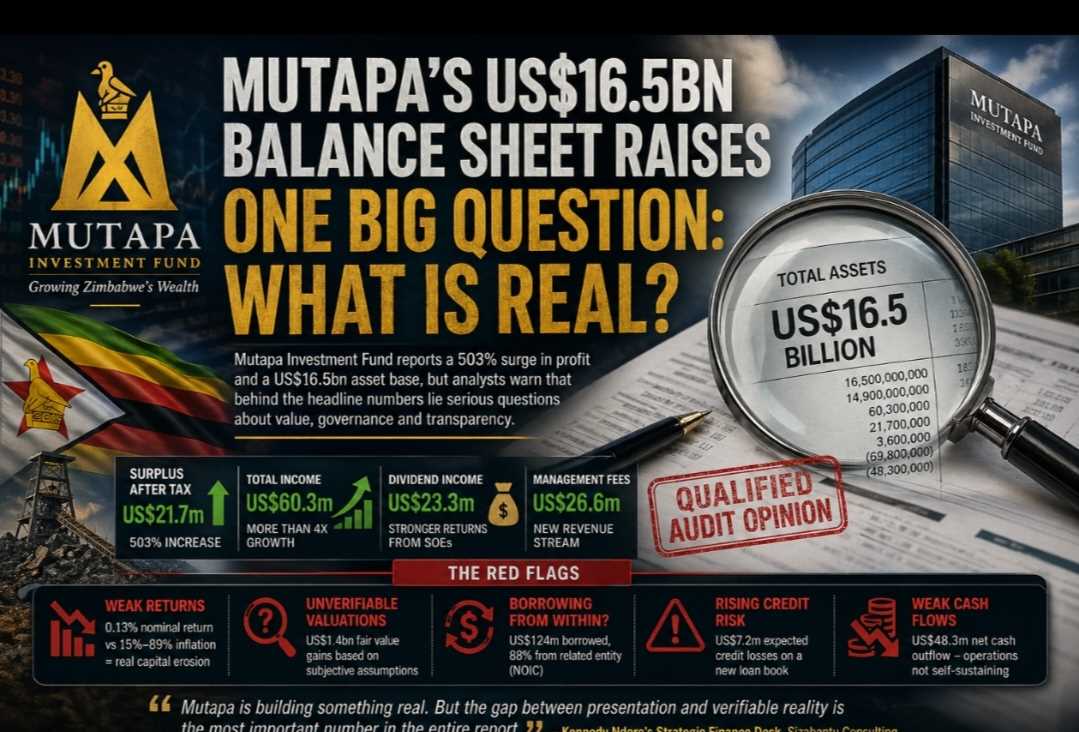
According to the Fund’s latest results, surplus after tax rose sharply by 503% to US$21.7 million, up from US$3.6 million in the prior period, driven largely by dividend inflows and the introduction of management fees from investee companies.
Total income increased more than fourfold to US$60.3 million, underpinned by dividend income of US$23.3 million and management fees of US$26.6 million.
Mutapa chief executive officer John Mangudya attributed the performance to governance reforms across State-owned enterprises.
“The Fund’s financial performance for the year demonstrates not only the strength of our balance sheet but also the effectiveness of the restructuring efforts being undertaken across our investment portfolio,” Mangudya said.
He added that improved oversight structures were key to unlocking value:
“Particular emphasis was placed on clarifying roles and responsibilities… strengthening risk identification… and reinforcing ethical conduct, compliance, and accountability.”
However, while the headline numbers suggest a rapidly strengthening sovereign wealth institution, independent financial analysis based on the Fund’s abridged audited statements points to a far more complex and concerning reality.
Strong growth, weak returns
Despite overseeing an asset base valued at US$16.5 billion, Mutapa generated a net surplus of just US$21.7 million, translating to a nominal return of approximately 0.13%.
This figure becomes more troubling when adjusted for Zimbabwe’s inflation environment. Depending on the measure used, inflation in 2025 ranged between 15% and as high as 89%, implying that the Fund’s real returns were deeply negative.
As an analysis produced by Kennedy Ndoro's Strategic Finance Desk at Sizabantu Consulting notes:
“A 0.13% nominal return in an economy running at 15% to 89% inflation is not a gain. It is capital erosion presented in accounting format.”
This raises fundamental questions about whether the Fund is preserving or eroding national wealth in real terms.
Asset growth driven by unverifiable valuations
Mutapa reported a total comprehensive income of US$1.4 billion, largely driven by fair value gains on its asset base, particularly in mining and property. Total assets increased to US$16.5 billion from US$14.9 billion.
Mangudya defended the valuation framework, saying:
“The valuation of assets is central to our mandate as a custodian of national wealth, and this outcome reflects the maturation of the comprehensive valuation framework established by the Fund.”
Yet analysts caution that these gains are heavily dependent on subjective valuation assumptions applied to unlisted State entities.
A qualified audit opinion issued by Grant Thornton flagged non-compliance with key accounting standards, IAS 21 (foreign exchange) and IFRS 13 (fair value measurement), both of which directly affect how asset values are determined.
Related Stories
Crucially, auditors were unable to fully verify whether the reported US$16 billion asset valuation fairly reflects economic reality, particularly in a volatile multi-currency environment.
Borrowing from within?
Another major red flag lies in the Fund’s funding structure. Mutapa took on US$124 million in new borrowings during the year, of which nearly 88% reportedly came from the National Oil Infrastructure Company of Zimbabwe.
If confirmed as a related party, this implies the sovereign wealth fund is effectively borrowing from entities within its own portfolio, raising questions about governance, transparency, and the true cost of capital.
“NOIC is widely understood to be a related entity within the same government portfolio that Mutapa oversees. If that relationship is confirmed, the fund is borrowing from its own subsidiary to finance operations.
“That raises serious questions about the arm’s-length nature of the transaction, the true cost of capital, and what happens if the subsidiary requires those funds back,” the analysis noted.
Rising credit risk and weak cash flows
The Fund also recorded expected credit losses of US$7.2 million on its relatively new loan book, an impairment rate of about 3.6%. Analysts say this is high for a portfolio still in its infancy, suggesting either aggressive lending practices or early signs of borrower distress.
At the same time, Mutapa’s operating cash flows remain under pressure. The Fund consumed US$69.8 million in operating activities and still recorded a net cash outflow of US$48.3 million after dividends and interest.
This indicates that operations are not yet self-sustaining and are reliant on borrowings and portfolio distributions.
Governance reforms versus transparency gaps
Mutapa maintains that governance reforms are central to its long-term strategy and its ability to attract global capital.
Board chair Chipo Mtasa said the Fund is positioning itself for expansion:
“Key priorities for 2026 include scaling up investments in mine expansion, supporting energy upgrades, modernising logistics, and revitalising industrial production.”
But analysts argue that governance improvements at portfolio level must be matched by transparency at Fund level.
The continued publication of abridged financial statements, rather than full disclosures, limits independent scrutiny.
The analysis stresses that without full transparency, clean audit opinions, and clear disclosure of related-party transactions, confidence in the Fund will remain constrained.
Mutapa’s rapid transformation from a passive holding entity into an active investment manager within two years is widely acknowledged as a significant institutional achievement.
It has built new revenue streams, expanded its treasury operations, and extracted higher dividends from State enterprises. These are tangible signs of operational progress.
Yet the gap between reported performance and underlying economic reality remains stark.
As Kennedy Ndoro's Strategic Finance Desk concludes:
“Mutapa is building something real. Its operational progress in under two years is genuine. But a 0.13% nominal return in a high-inflation economy, an unverifiable US$16 billion asset base, and a qualified audit opinion mean the reported numbers cannot be taken at face value.
“For a fund that exists to steward national wealth on behalf of every Zimbabwean, that gap between presentation and verifiable reality is the most important number in the entire report.”








Leave Comments