






A Commission of Inquiry into urban State land administration has exposed widespread corruption, political interference and abuse of office that cost Zimbabwe nearly US$3 billion in lost revenue over two decades.
The inquiry, chaired by retired High Court judge Tendai Uchena, uncovered what it described as a deeply compromised land allocation system in which politically connected land barons, housing cooperatives, developers and some public officials manipulated Government processes to illegally sell State land.
The findings were presented to President Emmerson Mnangagwa in December 2019 and revealed how thousands of home seekers purchased residential stands that lacked basic infrastructure such as roads, water supplies and sewer systems.
Justice Uchena said the Commission established that Government consistently failed to recover the intrinsic value of land allocated for urban development nationwide.
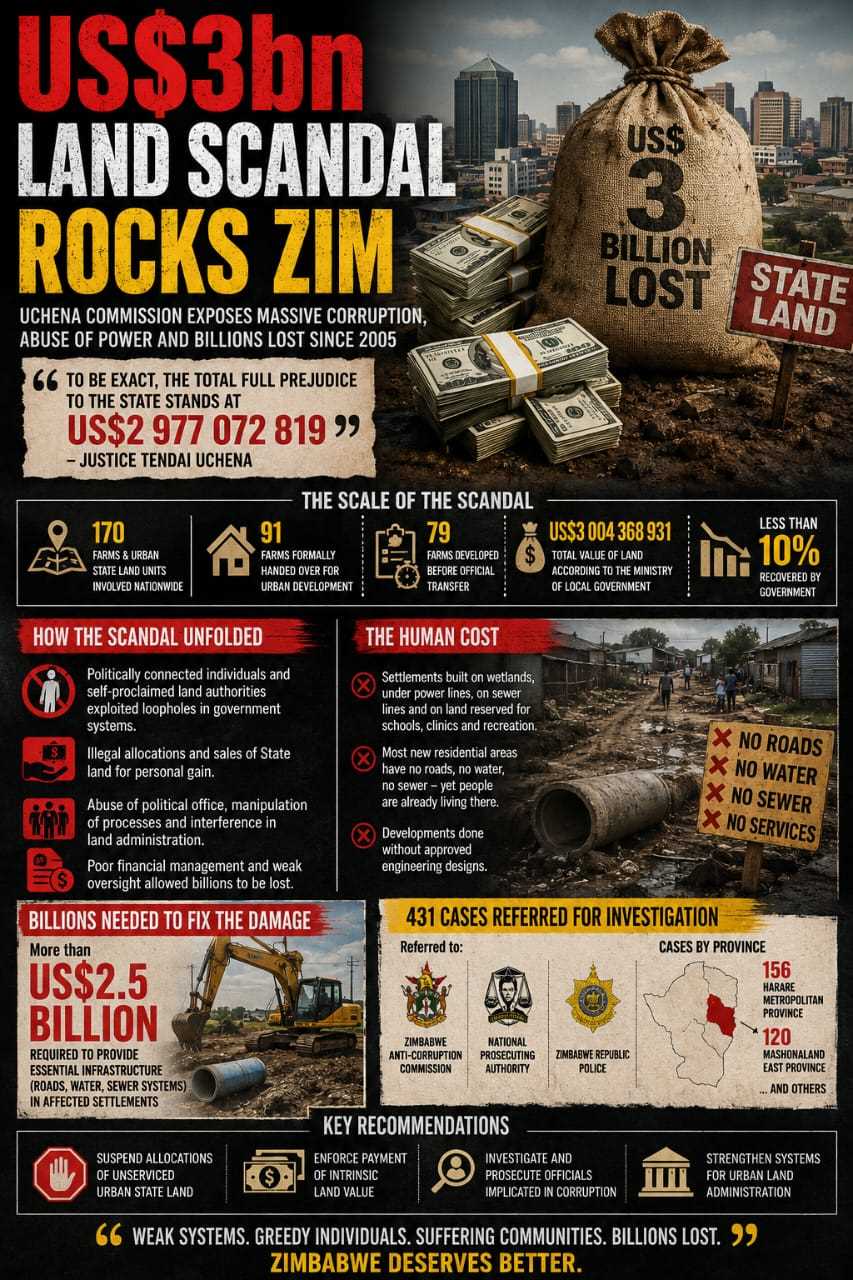
“The Commission’s computation of the total value of the farms according to the Ministry responsible for Local Government is USD3 004 368 931,” he said.
Investigations showed that urban development activities were conducted on 170 farms and State land units across the country. Of these, 91 farms had been formally handed over for urban expansion, while 79 were developed before official transfer procedures had been completed.
The report found that land valuation processes were routinely ignored, allowing developers and cooperatives to allocate and sell stands before Government determined or collected the required intrinsic land values.
As a result, the State recovered less than 10 percent of the land’s total value.
Related Stories
“To be exact, the total full prejudice to the State stands at USD2 977 072 819,” the report stated.
The inquiry also exposed how individuals claiming political backing exploited institutional loopholes to allocate land illegally for personal gain.
Investigators discovered that several settlements were established on wetlands, beneath power transmission lines, over sewer infrastructure and on land originally reserved for schools, clinics and recreational facilities.
“The Commission established with serious concern that most new residential estates on urban State land throughout the country have no services such as roads, water reticulation, sewer reticulation and amenities, yet these settlements are already occupied,” Justice Uchena noted.
The Commission further found that many developments proceeded without approved engineering designs for roads, water systems or sewer networks, creating long-term planning and environmental risks.
It estimated that more than US$2.5 billion would now be required to install essential infrastructure in affected settlements nationwide.
In response to its findings, the Commission referred 431 cases for further investigation by the Zimbabwe Anti-Corruption Commission, the National Prosecuting Authority of Zimbabwe and the Zimbabwe Republic Police.
Harare Metropolitan Province recorded the highest number of suspected cases at 156, followed by Mashonaland East Province with 120.
Among its key recommendations, the Commission urged Government to suspend allocations of unserviced urban State land, enforce payment of intrinsic land values, investigate implicated officials and strengthen oversight systems governing urban land administration.
The findings highlight longstanding structural weaknesses in Zimbabwe’s land management framework, raising renewed questions about accountability, urban planning and the protection of home seekers who invested savings into unserviced developments.





Leave Comments