





By Simbarashe Namusi
Zimbabweans have mastered the art of blame.
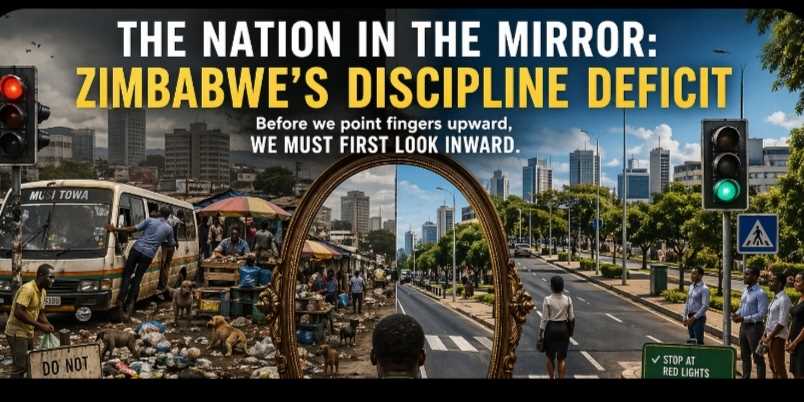
We blame politicians for corruption. We blame local authorities for uncollected refuse. We blame “the system” for everything that feels broken. Much of that criticism is justified. But there is an uncomfortable truth we rarely confront: the disorder we see in leadership is often mirrored in our own daily conduct.
We are not only victims of dysfunction. We are participants in it.
Consider our roads. National statistics show Zimbabwe recorded more than 28,000 road traffic accidents in the first half of 2025 alone, with fatalities rising alongside them. More telling is that up to 90 percent of these accidents are attributed to human error—speeding, reckless overtaking, ignoring traffic lights and general indiscipline.
This is not merely an infrastructure problem. It is a behavioural one.
We do not run red lights because the system failed us; we do so because we choose to. We overtake dangerously because we believe we can get away with it. Kombis stop wherever they please because we tolerate it—as passengers and as pedestrians. The chaos on our roads is not imposed on us. It is created by us.
Then there is the filth.
Urban environmental studies describe littering in Zimbabwean cities as “abysmal,” marked by widespread disregard for even clearly stated anti-littering rules. In Harare’s central business district, littering is linked to everyday habits—motorists throwing rubbish from car windows, households dumping waste improperly and communities failing to take ownership of shared spaces.
We complain about uncollected garbage, yet we create illegal dumpsites. We criticise councils, yet casually discard plastic onto streets. We organise clean-up campaigns, only to return to the same habits the next day.
We have normalised disorder.
Walk through many neighbourhoods and another pattern emerges: uncontrolled domestic animals. Dogs roam in packs, unvaccinated and unrestrained. Cats multiply unchecked, spilling into neighbouring homes. These are rarely policy failures. They are personal responsibilities abandoned at the gate.
Perhaps the most visible contradiction lies in the informal economy.
Street vending has become a survival mechanism, employing an estimated 76 percent of Zimbabwe’s economically active population. This reality reflects deep structural economic challenges that cannot be ignored.
Yet it also reveals something else.
We have collectively accepted a culture in which rules are negotiable. Pavements disappear beneath makeshift stalls. Sanitation systems collapse. Order gives way to improvisation. While unemployment and inequality drive informality, its persistence is also sustained by behaviour. We operate outside the system not only because we must, but because we can.
This is where the conversation becomes uncomfortable.
Discipline cannot be enforced only from the top. It is not merely policy—it is culture. And culture is built through small, often invisible decisions made every day.
Related Stories
Do we stop at a red light when no one is watching?
Do we carry our litter until we find a bin?
Do we respect shared spaces even when enforcement is weak?
In societies that function, the difference is not leadership alone. It is citizen behaviour. People queue. They follow rules. They understand that order is not oppression—it is the foundation of progress.
Zimbabwe’s challenge, therefore, runs deeper than politics. It is behavioural.
We cannot demand accountability from leaders while practising indiscipline in our own lives. The same mindset that ignores traffic laws can tolerate corruption. Casual disregard for rules at the grassroots creates fertile ground for abuse at the top.
In many ways, we rehearse the dysfunction we claim to oppose.
This does not absolve those in power. Leadership matters. Policy matters. Enforcement matters. But a nation is not built by laws alone; it is built by citizens who choose to do the right thing—even when it is inconvenient, even when no one is watching.
The hard truth is this: Zimbabwe will not change until Zimbabweans change.
Not through slogans or speeches, but through habits.
In how we drive.
In how we dispose of waste.
In how we treat public spaces.
In how we respect—or disregard—the rules that hold society together.
Before pointing fingers upward, we must first look inward.
Because the nation we complain about is, in many ways, the nation we are creating—one small act of indiscipline at a time.
The question is no longer whether our leaders are failing us.
The question is whether we are also failing ourselves.
Simbarashe Namusi is a peace, leadership and governance scholar and media expert writing in his personal capacity.








Leave Comments