







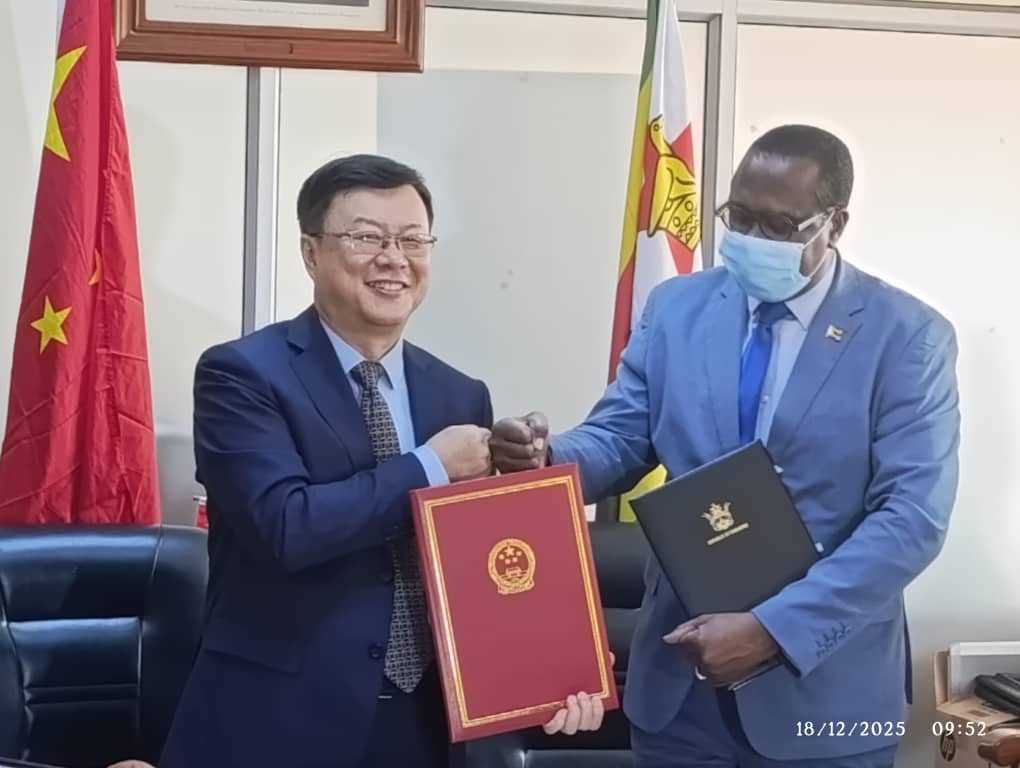
Zimbabwe and China today signed the Letters of Exchange on the China-Aid Upgrading and Maintenance of Irrigation Schemes Project in Harare, reinforcing their long-standing cooperation in economic development and infrastructure support.
The signing ceremony was officiated by Professor Mthuli Ncube, Zimbabwe’s Minister of Finance, Economic Development and Investment Promotion, and H.E. Ambassador Zhou Ding of the People’s Republic of China. The agreement marks another practical step in the two countries’ ongoing partnership, with a specific focus on strengthening agricultural productivity, water security, and rural development.
In his remarks, Minister Ncube described China as Zimbabwe’s “all-weather friend,” noting that cooperation between the two countries has consistently translated diplomatic goodwill into tangible development outcomes. He emphasized that the irrigation project comes at a critical moment, as Zimbabwe intensifies efforts to modernise agriculture, enhance food security, and strengthen resilience to climate variability.
“We are once again strengthening the long-standing cooperation between the Government of Zimbabwe and the People’s Republic of China,” Minister Ncube said, adding that the project reflects a shared commitment to sustainable growth and rural transformation.
The irrigation schemes project will focus on the upgrading and maintenance of key irrigation infrastructure, directly supporting farmers, improving water security, and increasing agricultural productivity. It builds on earlier China-supported water and agricultural investments that have already transformed livelihoods, irrigating hundreds of thousands of hectares and anchoring food production in vulnerable regions.
Minister Ncube also took the opportunity to acknowledge China’s broader development support to Zimbabwe, which has spanned grants, concessional loans, humanitarian assistance, and technical cooperation. From transport and energy to health, education, ICT, and water and sanitation, China’s footprint in Zimbabwe’s development landscape has been wide-ranging and impactful.
Related Stories
“This support has been extended across various sectors of our economy,” he noted, “and has been implemented through a range of past and ongoing programmes that continue to touch the lives of ordinary Zimbabweans.”
Among these are landmark projects such as the Hwange 7 & 8 Power Expansion, Kariba South Extension, the New Parliament Building in Mount Hampden, major airport upgrades, water and sanitation rehabilitation in Harare, and the supply of medical equipment, including critical assistance during the COVID-19 pandemic. Together, these initiatives tell a story of cooperation that goes beyond bricks and mortar, placing people at the centre of development.
Ambassador Zhou Ding, in turn, framed the signing as part of a broader strategic vision. He highlighted the strength of the Comprehensive Strategic Cooperative Partnership between China and Zimbabwe, noting that the two nations continue to align their development priorities in pursuit of shared prosperity. He stressed that agriculture, particularly irrigation, remains a cornerstone of inclusive growth and climate resilience.
The ceremony also took place against a wider continental backdrop of cooperation. Minister Ncube referenced China’s growing engagement with Africa through multilateral platforms, including increased contributions to development financing and support for African-led growth initiatives—an evolution that positions Africa not merely as a beneficiary, but as a co-investor in its own development trajectory.
Beyond the policy language and financial figures, the significance of the agreement lies in its expected impact on communities. Improved irrigation means more reliable harvests, job creation in rural areas, stronger local economies, and enhanced food security.
.








Leave Comments