






As China's leaders convene for the country's annual Two Sessions political meetings, Zimbabwe's ambassador to China, Abigail Shoniwa, has framed the Zimbabwe-China relationship in two words that signal a significant strategic shift: history and growth.
"This friendship is rooted in history," Shoniwa told CGTN's Cui Yingjie. "But now it is very much focused on high-quality development."
For Zimbabwe, a country where Chinese investors are deploying $900 million in lithium processing facilities, that shift in emphasis carries enormous economic weight.
A Bond Forged Before Independence
Shoniwa reflected on ties stretching back to Zimbabwe's liberation struggle, pointing to a recent symbolic gesture from Chinese President Xi Jinping, a personal reply letter to Zimbabwean liberation war veterans.
That acknowledgement, she said, "underscores the profound friendship between the Zimbabwean and Chinese people."
In Zimbabwe, liberation history is not ceremonial. It remains central to political identity and foreign policy posture. Beijing's recognition of that shared past reinforces a narrative that predates modern investment flows, mineral contracts, and the lithium boom now reshaping southern Africa's economic landscape.
But Shoniwa was clear that sentiment alone does not define the present phase of the relationship.
From Solidarity to Strategy: The Lithium Dimension
"China's development trajectory presents expanded opportunities for Zimbabwe," the ambassador said, highlighting agricultural exports, mineral processing, green energy, and infrastructure cooperation as priority areas.
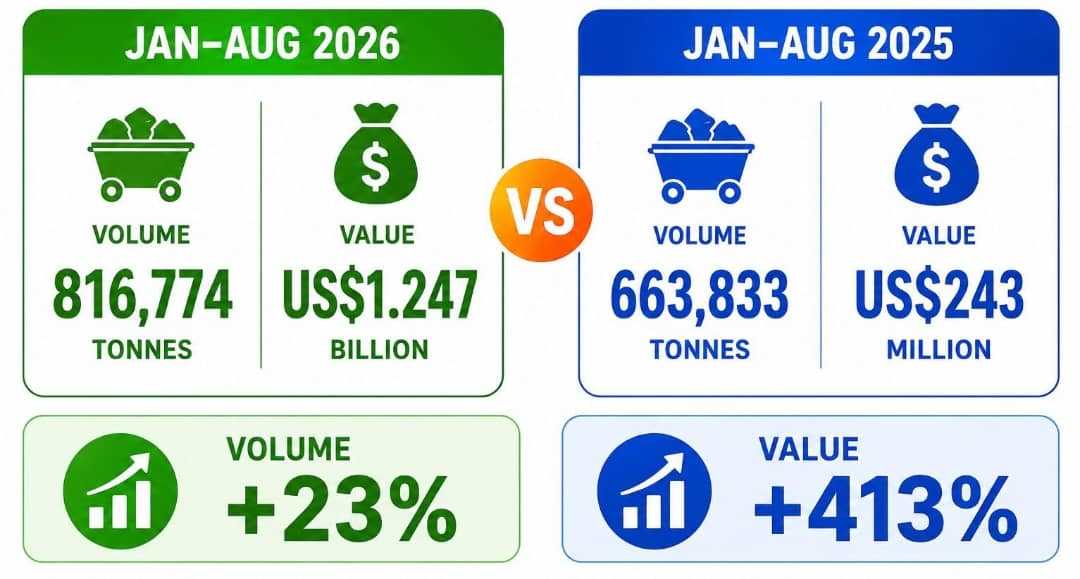
Those sectors are no longer theoretical. Zimbabwe is Africa's largest lithium producer and exported 1.128 million tons of spodumene concentrate in 2023, up 11% year-on-year, with the bulk of that volume shipped to China.
Zimbabwe's government suspended raw mineral exports on February 26, 2026—a move that triggered an immediate 6% surge in lithium carbonate prices on the Guangzhou Futures Exchange. The policy signals that Harare is no longer content to remain a raw material exporter.
Battery-grade lithium carbonate commands more than $7,000 per ton, compared to just $570 per ton for raw spodumene concentrate — a nearly 12-fold price premium that underpins the government's push for domestic beneficiation.
China is already Zimbabwe's largest source of foreign direct investment. Chinese firms Zhejiang Huayou Cobalt and Sinomine are deploying a combined $900 million in lithium processing facilities inside Zimbabwe — a direct response to Harare's demand for value addition on Zimbabwean soil.
When Shoniwa speaks of "high-quality development," she is echoing Beijing's own pivot toward industrial upgrading and technology integration. The implication is explicit: Zimbabwe is seeking deeper participation in global supply chains rather than continuing as a supplier of unprocessed minerals.
Related Stories
Vision 2030 and the Multilateral Framework
That ambition sits at the core of Zimbabwe's Vision 2030, which targets a transition to an upper middle-income economy within the decade. The China relationship is now structurally embedded in that national development agenda.
Beyond economics, Shoniwa reaffirmed Zimbabwe's diplomatic alignment. She said Zimbabwe gives "firm support to genuine multilateralism" and reiterated Harare's backing of the One China principle—consistent with Zimbabwe's long-standing foreign policy stance in forums including the Forum on China-Africa Cooperation (FOCAC).
In a global environment marked by geopolitical competition and shifting alliances, Zimbabwe's posture signals continuity. Beijing remains the central strategic partner.
The Domestic Question Zimbabwe Must Answer
Inside Zimbabwe, the conversation is evolving beyond diplomacy.
As Chinese investment deepens across mining and manufacturing, public debate has increasingly focused on four questions:
- Does mineral wealth translate into value addition on Zimbabwean soil?
- Do joint ventures strengthen domestic industrial capacity?
- Are environmental and labour standards being upheld?
- And can infrastructure partnerships support broader economic productivity rather than isolated megaprojects?
Shoniwa's language suggests Harare is ready to engage on the way forward.
"Zimbabwe is ready to deepen cooperation under our national development strategy, guided by shared interests and mutual respect," she said.
The phrase "shared interests" is deliberate. It signals a desire for economic complementarity rather than dependency, a framing that resonates with a Zimbabwean public increasingly attentive to the terms of foreign investment.
A Relationship Maturing at a Critical Moment
The tone of Zimbabwe-China engagement has shifted noticeably from earlier eras. The defensive solidarity of the sanctions period has given way to structured economic integration, industrial policy alignment, and development outcome targets.
Zimbabwe's export restriction policy has evolved from 2022 restrictions on raw ore exports to the February 2026 lithium concentrate ban, a regulatory progression that reflects escalating government commitment to capturing domestic value from its mineral endowment.
Liberation built the foundation. Investment expanded the structure. The current chapter, if Shoniwa's framing holds, is about consolidation, scale, and the terms on which Zimbabwe participates in the global energy transition.
As China prepares for another policy year under the Two Sessions framework, Zimbabwe is watching closely. Not merely as an observer of global power shifts, but as a resource-rich partner determined to position itself within them on better terms than before.
The relationship, long described as ironclad, is entering its most economically demanding and potentially most consequential stage yet.
Meta Description: Ambassador Shoniwa outlines how Zimbabwe-China ties are shifting from liberation solidarity to lithium, minerals, and Vision 2030 high-quality development.







Leave Comments