







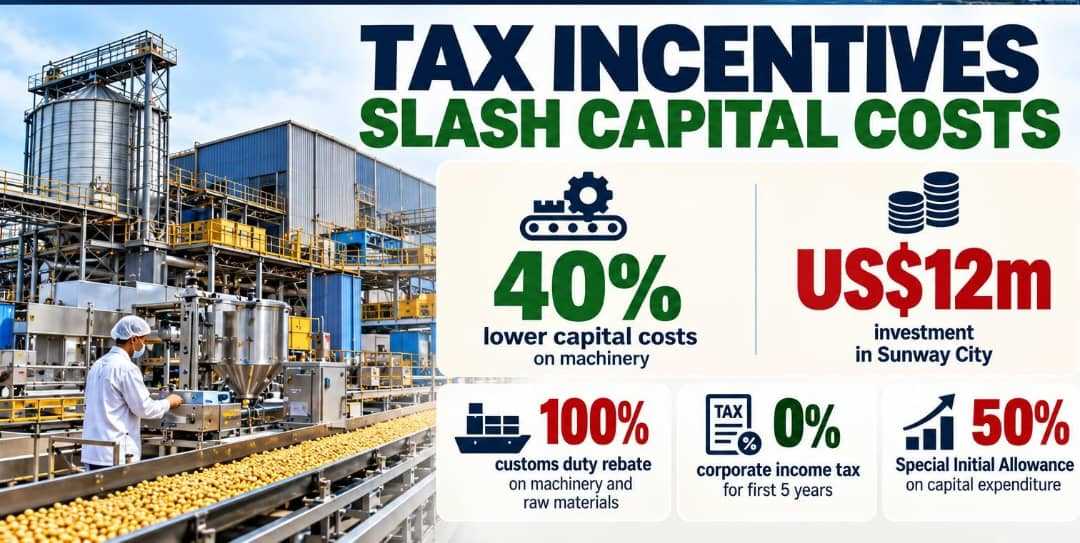
Zimbabwe’s Special Economic Zone (SEZ) incentives have reduced machinery acquisition costs by approximately 40%, giving Davipel Holdings a significant cost advantage in its US$12 million agro-processing investment at Sunway City, chief executive Davison Norupiri has said, as the country seeks to attract capital into productive industries.
The savings stem from incentives available to qualifying investors, including customs duty rebates on machinery and raw materials, tax relief on corporate profits during the initial years of operation, and allowances on qualifying capital expenditure. The measures are intended to lower the upfront cost of establishing industrial operations and improve the viability of investments in manufacturing and agro-processing.
“Let’s incentivise the machine, let’s not incentivise the profit,” Norupiri said on October 21, 2026, outlining an approach that places the cost of productive equipment at the centre of investment policy.
His remarks suggest that reducing machinery costs can be a more direct way of encouraging industrial development than relying exclusively on tax concessions linked to profits. For businesses entering capital-intensive sectors, the price of processing equipment can significantly influence the amount of money required before production begins.
Under Zimbabwe’s SEZ framework, qualifying investors can access a 100% customs duty rebate on eligible machinery and raw materials. The incentive reduces the duty burden associated with importing equipment and production inputs, although eligibility depends on the applicable requirements.
Investors can also benefit from a zero per cent corporate income tax rate for the first five years, as well as a 50% Special Initial Allowance on qualifying capital expenditure. Together, the measures are designed to improve the financial case for establishing operations in designated economic zones.
Related Stories
The incentives address different stages of an investment. Duty rebates reduce eligible import costs, the initial tax holiday lowers the corporate income tax burden during the first five years, while the Special Initial Allowance provides tax relief on qualifying capital expenditure. Their overall value to an investor depends on the scale and composition of the project, its eligibility and the applicable tax rules.
Davipel’s US$12 million agro-processing investment at Sunway City offers an example of how the incentives can support a project requiring substantial expenditure on industrial machinery. The reported 40% reduction, however, applies specifically to machinery acquisition costs and should not be interpreted as a similar reduction in the total project cost.
The Zimbabwe Investment and Development Agency (ZIDA) also provides a one-stop shop intended to streamline investment approvals and assist investors in navigating regulatory processes. Such facilitation is important for businesses that need to coordinate licensing, approvals and other administrative requirements before commencing operations.
In agro-processing, investment in machinery can help establish the capacity to transform agricultural commodities into products with greater value, potentially expanding domestic processing opportunities and creating links between farmers, suppliers, manufacturers and markets. The extent of these benefits depends on whether projects proceed to full operation and can compete in the market.
Norupiri’s comments also raise a broader question about how Zimbabwe can use investment incentives to build industrial capacity. Tax concessions can lower the initial cost of entry, but investors also consider the reliability of electricity and water supplies, access to finance, transport and logistics costs, the availability of skilled labour, and the predictability of regulations.
These operating conditions influence whether lower capital costs translate into sustained production, job creation and stronger domestic value addition. Incentives may make a project more attractive at the investment stage, but the long-term competitiveness of the resulting business also depends on its ability to operate efficiently and sell its products.





Leave Comments