







ZimNow International Desk
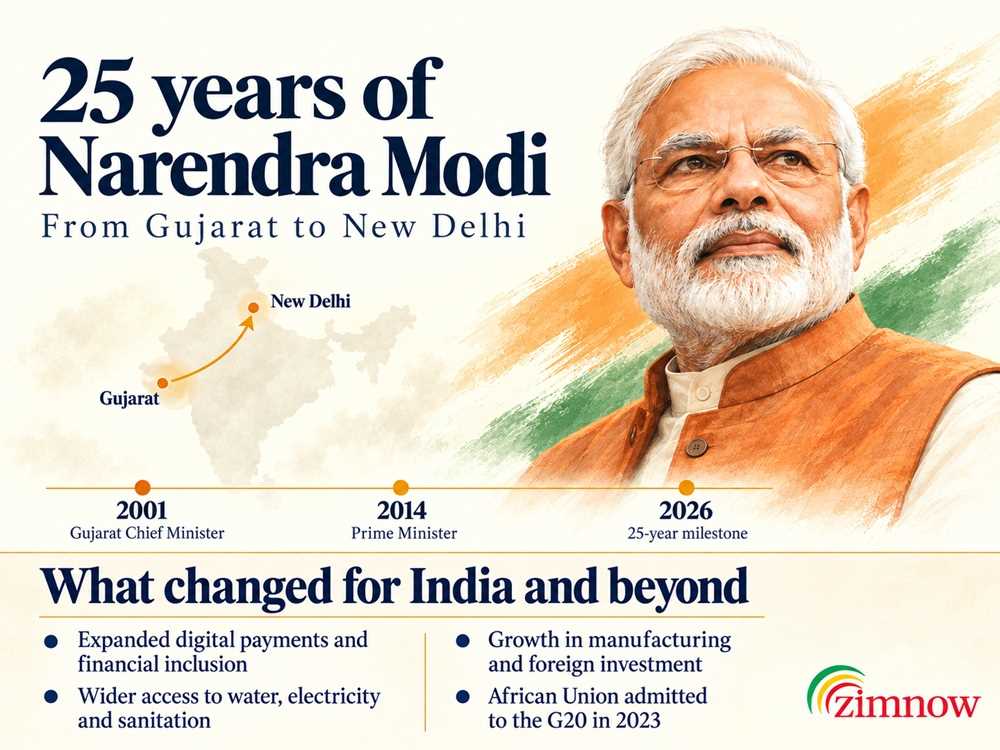
On October 7, 2026, Indian Prime Minister Narendra Modi marks 25 continuous years at the helm of elected government — a rare milestone in modern democratic politics.
Modi first took the oath as Chief Minister of the western Indian state of Gujarat on October 7, 2001. Thirteen years later, he moved from Gandhinagar to New Delhi after leading the Bharatiya Janata Party (BJP) to a decisive victory in India's 2014 general elections.
Since then, he has completed two full terms as Prime Minister and is now serving his third consecutive term, making his political career one of the defining stories of contemporary India.
For a country of more than a billion people, Modi's 25 years in executive office provide a window into India's transformation — from state-level governance in Gujarat to an increasingly assertive role on the global stage.
From Gujarat to the national stage
When Modi became Gujarat's Chief Minister in 2001, the state was dealing with significant economic, infrastructural and administrative challenges, including the aftermath of the devastating 2001 earthquake.
During his years in Gandhinagar, his administration placed considerable emphasis on infrastructure development, agricultural productivity, electricity supply, investment and the improvement of government delivery systems.y79One of the most prominent features of the Gujarat model was the expansion of reliable electricity and the development of systems designed to provide power around the clock, including to rural communities.
The experience helped shape a political brand centred on execution, administrative efficiency and economic development. By the time Modi entered national politics in 2014, he had built a reputation as a leader who emphasised large-scale projects, technological solutions and the rapid implementation of government programmes.
A new phase in New Delhi
Modi's election as Prime Minister in 2014 marked a significant change in India's political landscape. The BJP secured a majority in the Lok Sabha, India's lower house of Parliament, allowing Modi to form a government without relying on coalition partners to maintain a parliamentary majority. His administration subsequently placed strong emphasis on financial inclusion, digital technology, infrastructure and direct delivery of government benefits.
Programmes such as Jan Dhan Yojana sought to bring millions of previously unbanked Indians into the formal financial system. The expansion of Aadhaar, India's biometric identification system, together with digital payment platforms such as the Unified Payments Interface (UPI), helped create one of the world's largest digital public infrastructure ecosystems.
The approach has increasingly sought to connect citizens directly with government services and financial systems, reducing dependence on layers of intermediaries.
Taking basic services to the last mile
A major theme of the Modi years has been the expansion of access to basic services.
Government programmes have targeted the provision of electricity, household sanitation, clean cooking fuel, drinking water and other essential services, particularly in rural and economically disadvantaged communities. The objective has been to move beyond a traditional welfare model towards one in which government programmes are delivered directly to individual households.
For millions of Indians, these programmes have had a practical dimension: a bank account, a household toilet, access to electricity, a cooking gas connection or piped water can represent a significant change in everyday life. The scale of India's population, however, also makes such programmes an enormous administrative undertaking.
The digital transformation
Perhaps one of the most consequential developments during Modi's tenure has been India's digital transformation. The combination of Aadhaar identification, Jan Dhan financial accounts and mobile connectivity helped establish the foundations for what has become known as India's digital public infrastructure.
Related Stories
UPI has subsequently transformed everyday payments in India, allowing individuals and businesses to transfer money electronically on a massive scale. The Indian experience has attracted international interest, particularly among developing countries looking for ways to expand financial inclusion and deliver public services more efficiently.
For countries across Africa, where mobile technology has already transformed financial services, India's experience offers an important example of how digital infrastructure can be incorporated into national development strategies.
India's changing global role
Modi's 25-year political journey has coincided with India's growing influence in international affairs. Under his leadership, New Delhi has sought to strengthen its position as a voice for the Global South and deepen cooperation with developing countries.
India's G20 presidency in 2023 provided an important platform for this approach. New Delhi placed the concerns of developing countries at the centre of its agenda and hosted the Voice of Global South Summit, bringing together developing countries to discuss shared challenges and priorities.
For Africa, one of the significant outcomes was the African Union's admission as a permanent member of the G20 during India's presidency. The move strengthened Africa's representation in the forum and reflected India's emphasis on giving greater voice to developing countries in global affairs.
India's economic transformation
The economic transformation of India has been another defining feature of the Modi years. Since 2014, India's economy has expanded substantially, with nominal GDP rising from roughly US$2 trillion to nearly US$4 trillion by 2025. This growth has been supported by private investment, services, entrepreneurship and other economic reforms, while the government has focused on investment, infrastructure and industrial development.
Foreign direct investment has been an important part of this economic story. India's annual FDI inflow increased from US$36.05 billion in 2013-14 to US$81.04 billion in 2024-25. Over the eleven financial years from 2014 to 2025, India attracted approximately US$748.78 billion in FDI, compared with US$308.38 billion during the preceding eleven-year period. This represents a substantial increase in foreign investment flowing into the Indian economy.
Manufacturing has also become an increasingly important destination for foreign investment. FDI equity inflows into manufacturing reached US$19.04 billion in 2024-25, compared with US$16.12 billion a year earlier. Over the decade from 2014 to 2024, manufacturing FDI equity inflows amounted to approximately US$165.1 billion, reflecting India's growing attractiveness as a manufacturing destination.
The electronics sector provides one illustration of the shift. India has moved from being heavily dependent on imported mobile phones to becoming a major manufacturing base, with domestic electronics production and mobile-phone exports increasing dramatically over the past decade.
The wider merchandise export story has also strengthened, although exports have fluctuated from year to year. India's merchandise exports rose from around US$310 billion in 2014-15 to more than US$440 billion in 2025-26, while the combination of merchandise and services exports has reached considerably higher levels.
Together, the expansion of the domestic economy, rising foreign investment, growth in manufacturing and increasing exports point to an India seeking to move beyond its traditional image as primarily a large consumer market towards becoming a major global manufacturing, investment and export hub.
The challenge for the coming years will be to ensure that this expansion generates sufficient employment, raises productivity and spreads economic opportunity more widely across India's vast population.
Looking towards 2047
The next major target in Modi's political vision is India's centenary of independence in 2047. His government has promoted the concept of Viksit Bharat, or Developed India, as an ambition to transform India into a developed country by the time it marks 100 years of independence.
Achieving that objective will require sustained economic growth, job creation, technological advancement, infrastructure investment, education, healthcare and continued improvements in living standards. It will also test whether the systems and institutions developed during Modi's years in office can outlast the political personality who championed them.
A quarter-century that changed India
Narendra Modi’s 25 years in elected office have coincided with a period of significant transformation in India — from infrastructure and digitalisation to economic growth and a stronger global presence. For Africa and the wider developing world, India’s experience offers lessons in technology, financial inclusion, infrastructure and economic development.
As Modi begins his 26th year in executive office, his lasting legacy will ultimately be measured by whether these changes continue to shape India in the decades ahead.





Leave Comments