






Chinese President Xi Jinping’s recent proposition on China-Africa mining cooperation deserves examination beyond the diplomatic applause.
Its emphasis on African ownership, technology transfer, value addition and sustainable financing addresses important African development priorities. The question is how much practical change those principles can deliver, and what remains to be negotiated.
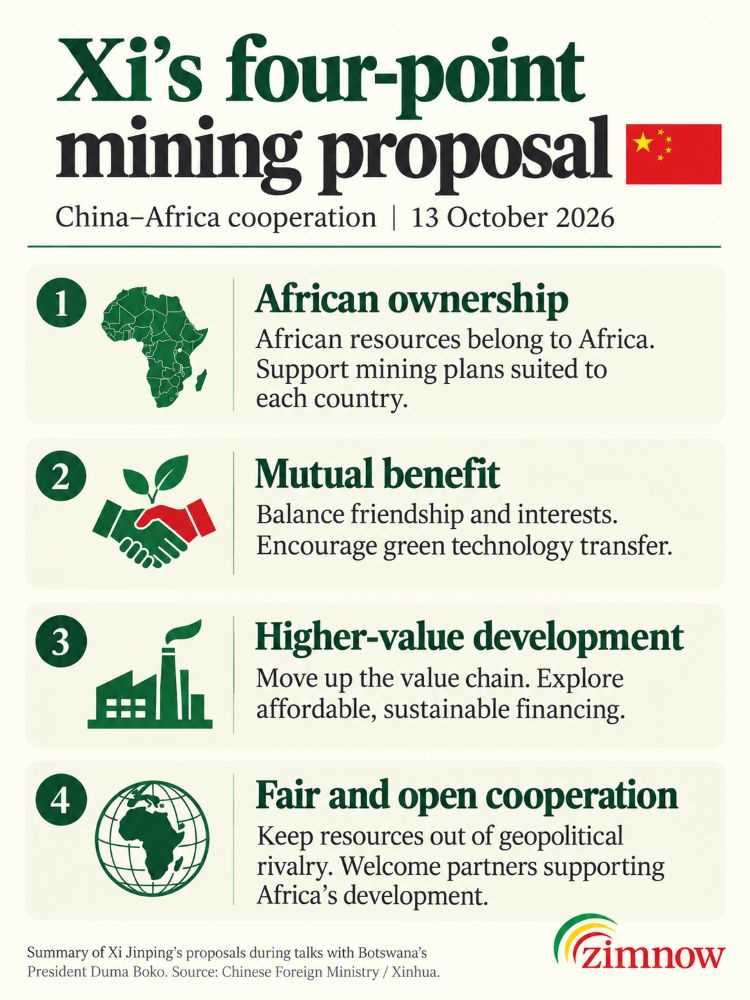
Presented during talks with Botswana’s President Duma Boko on October 13, the four-point proposition combines resource sovereignty, mutual benefit, higher-quality development and an open environment for cooperation. It offers a framework for engagement rather than a detailed investment programme.
A statement of direction can create room for better deals while it does not settle their terms.
The first proposition, that African resources belong to Africa, establishes an important starting point. Coupled with support for mining plans adapted to individual countries, it recognises that mineral development should serve the priorities of the resource owner.
The opportunity is to connect mining investment to a wider economic strategy: energy, transport, domestic suppliers, skills and public revenue.
The limitation is that ownership of resources does not automatically translate into control over their economic value. A country can retain sovereignty over its deposits while accepting agreements that leave it with little influence over financing, processing or sales.
Support with planning could help close technical gaps. But African institutions must retain the capacity to assess that advice independently, particularly where prospective investors could benefit from the resulting plans.
The second proposition links mutual benefit with the transfer of green technologies suited to African conditions.
This offers scope for cooperation that develops local capabilities while improving mining operations. Properly implemented, it could help African engineers, technicians and enterprises acquire knowledge they can use beyond a single project.
Yet buying equipment and acquiring technological capability are different achievements. What would be transferred? Would local personnel learn to operate machinery, or also maintain, adapt and eventually design it? Would domestic firms gain access to useful technical knowledge? Who would hold the relevant licences?
The proposition encourages companies to transfer technology, but supplies no common delivery timetable, measurable requirements or enforcement mechanism. These would need to be established through subsequent agreements.
“Mutual benefit” also needs numbers. Both sides can gain while receiving very different shares of the value. Equitable mutual benefit is the goal so must be translated into investment obligations, wages, procurement, taxes and returns.
The third proposition, moving cooperation towards industrial value addition while exploring affordable and sustainable financing, may offer the greatest economic opportunity.
Related Stories
More processing within Africa could support skilled employment, supplier businesses and industrial capability. Financing that matches the long development periods of major projects could help make that possible.
But value addition must survive a feasibility study. A processing plant needs dependable power, water, transport, suitable feedstock and buyers. Its economics must withstand less favourable commodity prices. Otherwise, a country can exchange the frustration of exporting raw materials for the expense of supporting an uncompetitive factory.
The financing proposition is similarly promising but incomplete. Affordability depends on the full cost, including fees, guarantees and any commitments over future production. Sustainability depends on who carries the risk when prices fall or construction is delayed. Calling finance innovative does not tell us whether it is a good bargain.
The fourth proposition calls for a fair, open cooperation environment and rejects turning African resources into instruments of geopolitical rivalry. For Africa, the potential advantage is freedom to work with multiple partners. Competition can broaden access to finance, technology and markets.
The difficulty is that mineral investment already intersects with the strategic priorities of powerful states. China has commercial interests to pursue, as do its competitors. The practical test will be whether African countries can diversify partnerships and negotiate independently without pressure to align their resources with someone else’s rivalry.
An open environment should also provide predictable rules and fair treatment for investors while preserving governments’ ability to enforce labour, environmental and tax obligations.
Taken together, Xi’s propositions offer a constructive basis for negotiation. Their strongest feature is the recognition that mining cooperation should develop African economies beyond extraction. Their principal weakness is the absence, in the published outline, of the detail needed to assess delivery. That is where Africa’s preparation becomes decisive.

Washington is mobilising resources for critical mineral supply chains. Britain is pursuing mining partnerships, while the EU’s Zimbabwe engagement emphasises trade and investment. These initiatives differ, but each prospective partner arrives with interests of its own to counter the rising resource nationalism sweeping across the global south.
Zimbabwe needs negotiating teams capable of assessing the whole transaction: community rights, geology, taxation, finance, engineering, energy, environmental obligations and commercial law. The lifetime value of a concession deserves more attention than the allowances attached to the trip.
Consultation must precede negotiations. Communities, workers, suppliers, local authorities and researchers can identify costs and opportunities that a visiting delegation’s presentation may overlook. Their input should shape a clear mandate, minimum acceptable outcomes and permission to walk away.
Preparation must also include domestic capital. Zim Now reported, citing IPEC Commissioner Grace Muradzikwa, that pension funds held US$3.47 billion in assets at June 30, 2026. About 73% was invested in property and shares. That is an existing asset base, rather than cash waiting to be spent, but it raises a legitimate question about financing local participation in sound projects.
Pooling suitable domestic capital could allow Zimbabwean institutions to negotiate equity and governance rights alongside foreign partners. Local funding is not automatically cheaper, but it can broaden participation in ownership and returns.
Xi’s proposition should therefore be judged neither by applause nor suspicion alone. Its value will emerge in the agreements, the capabilities developed and the benefits delivered.
Beijing has outlined principles Africa can use to ask more precise questions. Those principles also provide a standard against which future cooperation can be assessed.
The signing ceremony should mark the end of our homework and not the beginning of our understanding what is on the table.






Leave Comments