








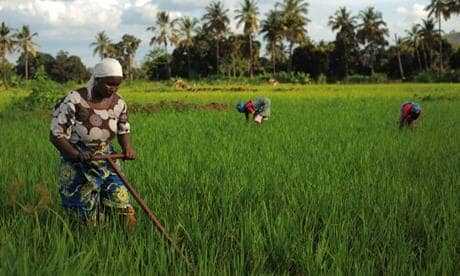
Rural women in Zimbabwe have reduced the time spent on labour-intensive agricultural tasks by 76% through labour-saving technologies introduced under a climate resilience programme that has reached more than 2.8 million people, the United Nations Development Programme (UNDP) has reported.
The Climate Resilient Livelihoods project, implemented in partnership with the Government of Zimbabwe and supported by the Green Climate Fund, is expanding women's access to agricultural technology, financial services, climate information and leadership opportunities across 15 districts in Manicaland, Masvingo and Matabeleland South.
In a statement marking the 2026 International Day of Rural Women, UNDP said 229,414 women had directly benefited from the programme, while women headed 65% of the households reached.
Women account for 53% of the more than 2.8 million people reached by the project, which seeks to strengthen agricultural productivity, household incomes and communities' capacity to withstand climate shocks.
UNDP Zimbabwe Resident Representative Ayodele Odusola said empowering rural women was central to building resilience to climate change and advancing sustainable development.
“Rural women are not only among those most affected by climate change; they are also central to the solutions,” Odusola said.
“When women have access to productive technologies, finance, climate information and decision-making opportunities, entire communities benefit.”
The programme's reported results show how technology is changing the demands of agricultural work, particularly tasks traditionally performed manually by rural women.
The introduction of earth augers, multi-crop threshers and grinder-choppers has contributed to an overall 76% reduction in women's workloads, according to UNDP.
Preparing planting basins under the Pfumvudza farming model, for example, now takes 6.3 hours, down from 39.4 hours. The time required for cereal threshing has also fallen from 58.2 hours to 5.2 hours.
UNDP said 83% of women participating in the project had experienced significant or very significant reductions in their workloads, potentially freeing up time for income-generating activities, farming, childcare and other household responsibilities.
Beyond reducing physical labour, the initiative seeks to strengthen women's participation in decisions governing agricultural resources, particularly irrigation infrastructure and water management.
Related Stories
Women's representation on Irrigation Management Committees in supported schemes has risen from less than 20% at baseline to approximately 49%.
Women have also assumed leadership positions as chairpersons, secretaries and treasurers, while managing Operations and Maintenance Funds in four of the 13 developed irrigation schemes.
These changes are intended to give women a greater voice in decisions affecting water access, agricultural production and the long-term sustainability of irrigation infrastructure.
Financial inclusion is another component of the programme, with 463 Village Savings and Lending groups established across the project areas.
The groups comprise 5,981 farmers, of whom 77.7% are women. By December 2025, they had accumulated US$329,374 in savings, which members can use to finance livestock purchases, agricultural inputs, children's education and other livelihood activities.
The savings groups provide a community-based mechanism for women to build financial reserves and invest in small-scale economic activities, particularly where access to formal financial services may be limited.
The project is also investing in agricultural knowledge and climate information to help farmers make decisions amid increasingly unpredictable weather conditions.
Through 230 Farmer Field Schools, the initiative has reached 82,434 farmers, including 53,392 women. A further 282 female extension officers have received training in climate-smart agriculture, agroecology, gender mainstreaming, financial inclusion and sustainable farming practices.
UNDP said 199,062 women had received tailored weather and climate advisories, while more than 58,000 farmers, 52% of them women, had used Participatory Integrated Climate Services for Agriculture approaches to plan their crops and farming seasons.
The information is distributed through radio programmes, bulk SMS, WhatsApp and community meetings, helping farmers make informed decisions about planting times, irrigation and agricultural production.
Odusola said the results demonstrated the importance of placing women's leadership and economic empowerment at the centre of climate adaptation strategies.
“These results demonstrate the importance of investing in women's leadership and economic empowerment as essential foundations for climate resilience and sustainable development,” he said.






Leave Comments