







Zimbabwe generated an estimated US$15.9 billion in foreign-currency receipts between January and September 2026, a 33.7% increase from the corresponding period last year, with export earnings dominating inflows even as imports highlighted opportunities to expand domestic production and services.
Lethukuthula Kozah highlighted the scale of the earnings, noting the dominance of exports and the contribution of diaspora remittances.
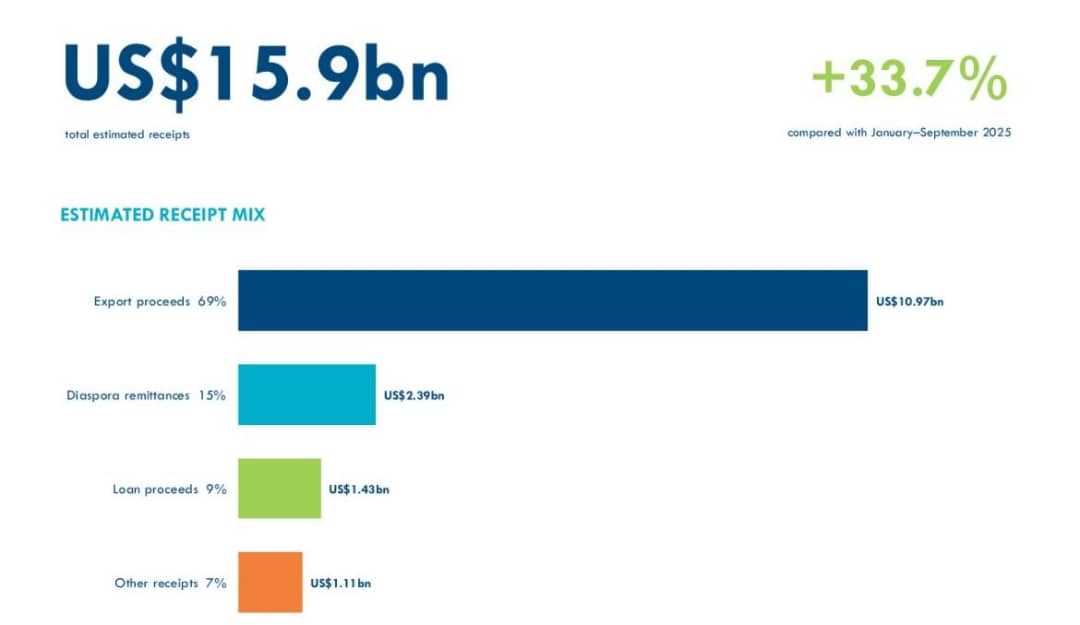
“Zimbabwe generated an estimated US$15.9 billion in foreign-currency receipts from January to September 2026, up 33.7% year-on-year. Exports contributed 69%, followed by diaspora remittances at 15%,” Kozah said.
An analysis by Hikari Inc, based on the Reserve Bank of Zimbabwe’s third-quarter 2026 snapshot, estimates that export proceeds contributed US$10.97 billion, or 69% of total receipts.
Diaspora remittances accounted for an estimated US$2.39 billion, representing 15% of inflows, while loan proceeds contributed US$1.43 billion, or 9%. Other receipts made up the remaining US$1.11 billion, equivalent to 7%.
The figures suggest that export performance remains central to Zimbabwe’s foreign-currency position. Hikari noted that mineral exports dominate the pool and argued that attention should be directed towards meeting the operational requirements of exporters in the mining and agricultural sectors.
Supporting these sectors could help sustain production and export earnings, although the estimated receipt categories do not provide an exact breakdown of the amounts received by individual industries.
The country’s foreign-currency payments stood at US$11.6 billion during the same nine-month period, according to Hikari’s analysis, leaving an estimated surplus of US$4.3 billion as receipts exceeded payments.
However, the composition of import demand raises questions about the extent to which local industries can supply the goods, equipment and services required by businesses.
Fuel and petroleum products remain essential to transport, mining, farming and backup power generation. Mechanical machinery supports factories, mines and agricultural processing, while imported motor vehicles underpin commercial transport and distribution.
Related Stories
Electrical machinery is required for automation and power distribution, while industrial supplies such as chemicals, metals and production inputs support various manufacturing and processing activities. Food imports and agricultural inputs also remain important to consumer supply and farm production.
Rather than viewing these imports solely as an outflow of foreign currency, Hikari argues that they reveal opportunities for domestic businesses to develop capabilities that could reduce costs and improve service delivery.
The analysis identifies machinery maintenance, spare parts, equipment refurbishment, fleet management, vehicle servicing, electrical installation and testing, fabrication, specialist distribution, recycling, irrigation, food processing and storage as areas where local enterprises could expand their participation.
For example, local engineering companies could build capacity to maintain imported industrial machinery, reducing equipment downtime and dependence on overseas service providers. Businesses could also expand the supply of spare parts and refurbishment services for mines, factories and agricultural processors.
In the transport sector, improved fleet servicing and component supply could support operators while creating opportunities for local suppliers. Agricultural businesses could similarly invest in irrigation systems, processing facilities and storage to strengthen domestic value chains.
Hikari cautions, however, that the import map identifies potential business opportunities rather than established market shares. The RBZ snapshot did not disclose category-level payment values in the analysis, meaning the available figures cannot establish how much foreign currency was spent on each import category.
The analysis argues that local businesses must compete on price, reliability and quality if they are to capture demand currently met through imports.
“The key is superior service at the right price,” Hikari said in its assessment of the opportunities for domestic businesses.
The distinction is important for Zimbabwe’s industrialisation ambitions. Import substitution is unlikely to succeed through calls for local purchasing alone if domestic suppliers cannot consistently meet production requirements, offer competitive prices or provide reliable after-sales support.
At the same time, the scale of foreign-currency receipts presents an opportunity to strengthen productive capacity, particularly in sectors that generate exports or provide essential inputs and services to exporters.
Mining and agriculture remain important to that effort because their performance affects export earnings and demand for supporting services, equipment and infrastructure.






Leave Comments