






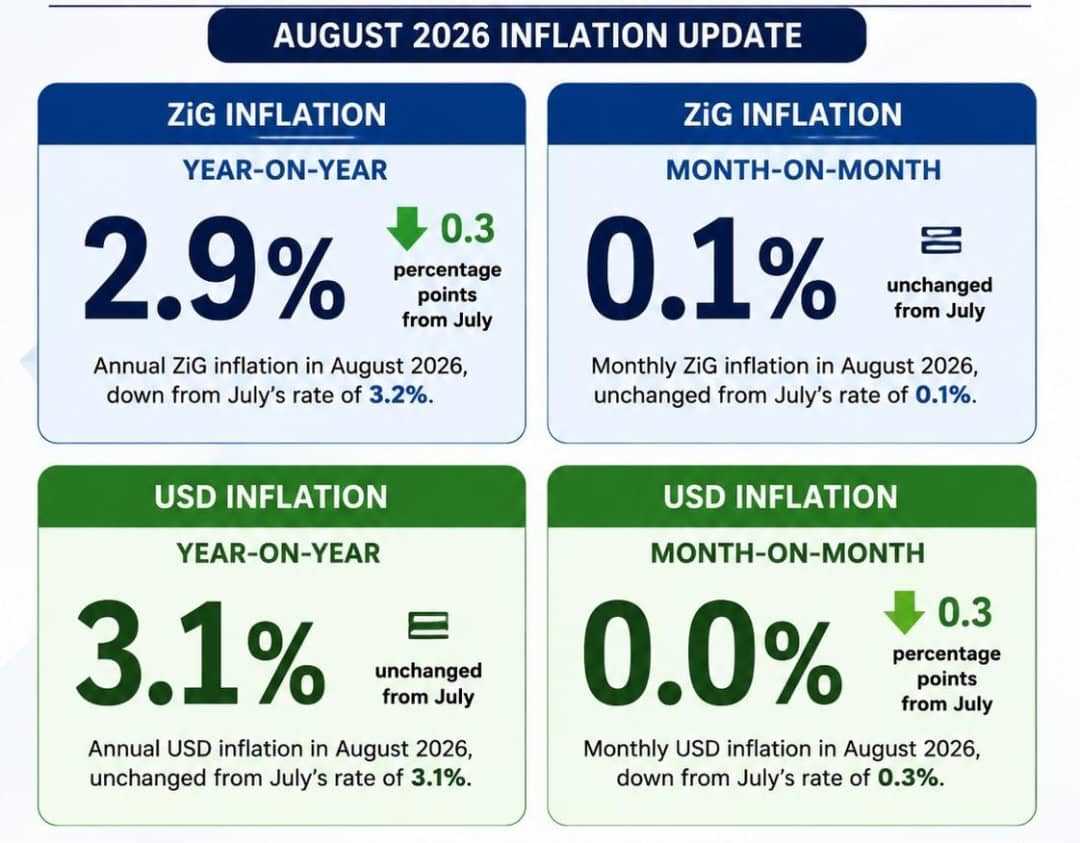
Zimbabwe’s annual inflation, measured in Zimbabwe Gold (ZiG), fell to 2.9% in August 2026, down from 3.2% in July, extending the country’s run of single-digit inflation but shifting attention to where price pressures are now coming from.
The latest ZIMSTAT figures show that monthly ZiG inflation remained at 0.1%, while annual US-dollar inflation held at 3.1%. Monthly US-dollar inflation, however, fell to 0%, from 0.3% in July.
The August movement is significant because it shows that the disinflation process has continued even as the composition of price increases has changed.
ZIMSTAT’s August presentation identifies transport as the division where the main increases in the Consumer Price Index (CPI) were recorded.
That contrasts with June, when the main increases in the ZiG index were recorded in housing, water, electricity, gas and other fuels, while the US-dollar index was mainly affected by furniture and equipment, according to the ZIMSTAT material supplied.
From 95.8% to 2.9%
The scale of the disinflation becomes clearer when August is compared with last year.
ZiG annual inflation reached 95.8% in July 2025 before falling to single digits in January 2026. The Reserve Bank of Zimbabwe says single-digit inflation persisted for seven consecutive months through July.
The IMF has attributed the sharp reduction to a combination of tighter monetary policy, the cessation of monetary financing and improved fiscal conditions, alongside exchange-rate stability.
The RBZ itself says its monetary framework is designed to align money-supply growth with real economic activity while maintaining liquidity conditions consistent with its inflation objective.
In its 2026 Monetary Policy Statement, the central bank said:
“annual ZiG inflation is expected to remain within single-digit levels”
and linked the expected stability to prudent monetary policy and complementary fiscal policy.
The August figure of 2.9% is therefore substantially below the trajectory envisaged when the 2026 Budget was prepared. Treasury had projected average ZiG inflation of 12.1% for 2026, based on expectations of exchange-rate stability and stronger monetary-fiscal coordination.
The headline number alone does not show where households are experiencing price increases.
The ZIMSTAT August figure states:
“For the month of August 2026, increases in the index were mainly observed on the Transport division.”
That is important because it follows a different pattern from June.
Related Stories
The June ZIMSTAT data showed ZiG month-on-month inflation at 0.6% and annual inflation at 4.7%, with increases mainly observed in Housing, Water, Electricity, Gas and Other Fuels.
For the US-dollar measure, June monthly inflation was 0.1%, while annual inflation stood at 3.1%, with the main increases observed in Furniture and Equipment.
By August, monthly ZiG inflation had fallen to 0.1%, while the main movement in the index had shifted towards transport.
The data therefore points to a much narrower price-growth environment than earlier in the year, rather than an economy in which all prices are moving uniformly.
The second important feature of the August release is the behaviour of US-dollar prices.
Annual US-dollar inflation remained at 3.1%, unchanged from July, while monthly US-dollar inflation moved from 0.3% to zero.
This means the August data recorded no monthly increase in the US-dollar CPI.
The RBZ’s July figures had recorded US-dollar annual inflation of 3.12% and monthly inflation of 0.28%, broadly consistent with the ZIMSTAT July figures.
The continued convergence of low inflation across the two measures is significant in an economy where both ZiG and US dollars are used in transactions.
The central bank has explicitly connected the disinflation process to monetary conditions.
In its January 2026 Monetary Policy Statement, the RBZ reported that annual ZiG inflation had fallen from 95.8% in July 2025 to 4.1% in January 2026. It said the reduction represented the first time in more than 30 years that local-currency inflation had returned to single digits.
The IMF reached a similar conclusion, saying Zimbabwe’s recent stability followed changes in macroeconomic policy, including the cessation of monetary financing and tightening of the monetary stance.
RBZ Monetary Policy Committee member Persistence Gwanyanya has also linked the disinflation to exchange-rate stability. In comments published earlier this year, he said:
“ZiG performance largely reflects exchange rate stability.”
He further pointed to the narrowing of the parallel-market premium and the stability of basic prices as evidence of the change in the inflation environment.
The RBZ expects annual ZiG inflation to average around 5% in 2026 and remain within the 3–7% SADC macroeconomic convergence range by year-end.
At 2.9%, August annual ZiG inflation is already below the lower boundary of that target range. However, the target is expressed as an annual convergence range, while the current 2.9% figure is the year-on-year rate for one month.
The central bank has said it will continue using monetary policy to preserve price and exchange-rate stability, while the IMF has stressed that fiscal pressures and financing constraints remain important risks to macroeconomic stability.







Leave Comments