








Zimbabwe’s estimated average monthly take-home salary of US$180 would cover only about 59 percent of the combined minimum consumption benchmark for a family of six, based on the latest September poverty-line figures and the official exchange rate. This highlights the gap between earnings and the resources needed to meet basic needs.
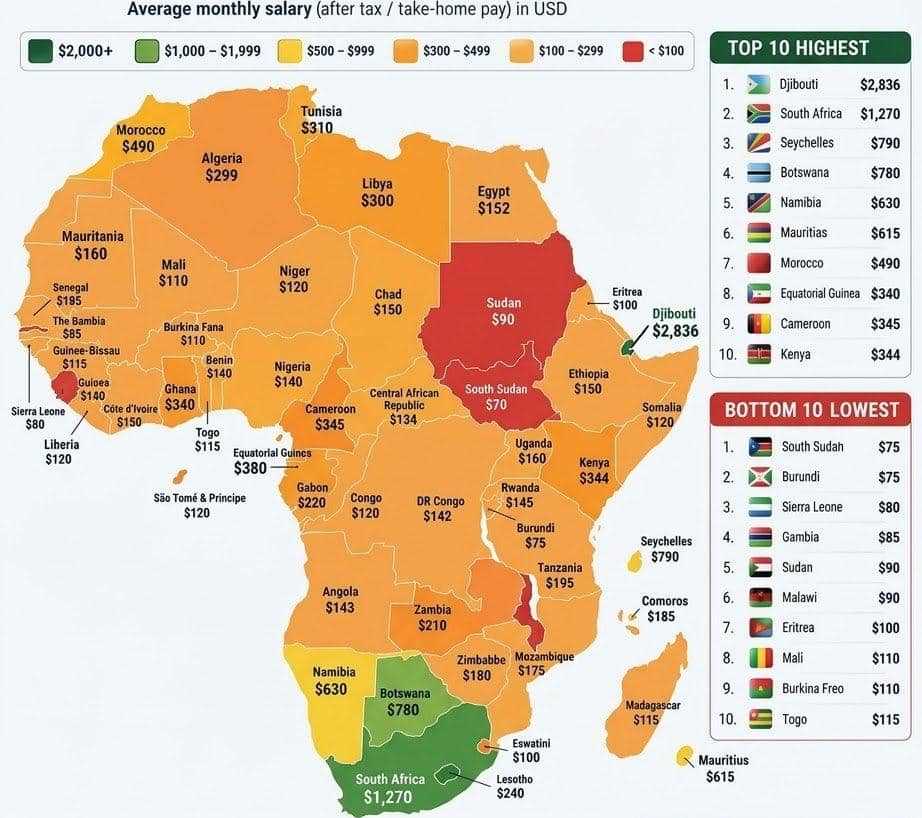
The estimate, published in a 2026 African salary map attributed to LiveGdp, places Zimbabwe’s average net monthly pay at US$180, compared with US$1,270 in South Africa, US$780 in Botswana and US$630 in Namibia.
“Africa’s salary gap is staggering. Djibouti leads at an estimated $2,836 monthly, while South Sudan sits at just $70. South Africa led Southern Africa at $1,270, while Zimbabwe averages $180,” Kozah said, drawing attention to the disparity between countries’ estimated take-home earnings.
The Zimbabwean figure is not an official national average salary published by the Zimbabwe National Statistics Agency (ZimStat). However, comparing it with ZimStat’s poverty thresholds provides a way to assess what the estimate could mean for workers supporting dependants.
ZimStat’s September 2026 figures put the Food Poverty Line at ZWG926.24 per person per month and the Total Consumption Poverty Line at ZWG1,353.35. The agency said the latter represents the amount an individual requires “to purchase both non-food and food items” to avoid being classified as poor.
At the official interbank mid-rate of ZWG26.6237 to the US dollar on October 13, the salary map’s US$180 figure translates to approximately ZWG4,792 a month. This is around 3.5 times the individual Total Consumption Poverty Line, but the calculation changes when the income is expected to support an entire household.
Multiplying the individual poverty line by six produces an illustrative benchmark of about ZWG8,120 a month. Against that figure, the converted US$180 salary would cover approximately 59 percent, leaving a shortfall of about ZWG3,328.
The same comparison using the Food Poverty Line gives a combined benchmark of about ZWG5,557 for six people. The estimated salary would cover roughly 86 percent of that amount, before accounting for the wider non-food needs included in the Total Consumption Poverty Line.
Related Stories
These calculations are illustrative rather than an official classification of a household’s poverty status. ZimStat publishes its poverty lines on a per-person basis, while household circumstances, provincial prices and consumption patterns affect actual needs. The salary map is also an estimate rather than a representative wage survey of Zimbabwean workers.
Nevertheless, the comparison points to the central issue behind Kozah’s observation: a salary that may exceed the minimum consumption benchmark for one individual can fall short when one earner is responsible for several family members.
The pressure is not limited to food. ZimStat’s Total Consumption Poverty Line includes essential non-food needs, while households must also manage expenses such as rent, transport, school fees, healthcare and utilities. The share of income remaining after these expenses determines how much room families have to deal with emergencies or rising prices.
The Consumer Council of Zimbabwe provides another perspective through its Family of Six Basket for a low-income urban household. The council says it conducts regular price surveys to monitor basic commodities and produces the basket to assist with household budgeting and wage negotiations.
The basket differs from ZimStat’s poverty lines: it estimates the monthly cost of meeting the needs of a specified family, while the poverty line measures minimum consumption requirements per person. A current September or October 2026 Family of Six Basket total could not be independently verified for this report, so it has not been used to make a numerical comparison.
The African salary map places South Africa’s average net salary at more than seven times Zimbabwe’s estimate, while Botswana’s is more than four times as high. Those differences are striking, but they do not independently establish which country’s workers enjoy greater purchasing power, as local prices, taxation and the methods used to calculate average salaries may differ.









Leave Comments