






South Africa’s November 4 local government elections are entering a new phase of political fragmentation, with the African National Congress recording a sharp decline in support while its challengers occupy an increasingly larger share of the electoral space.
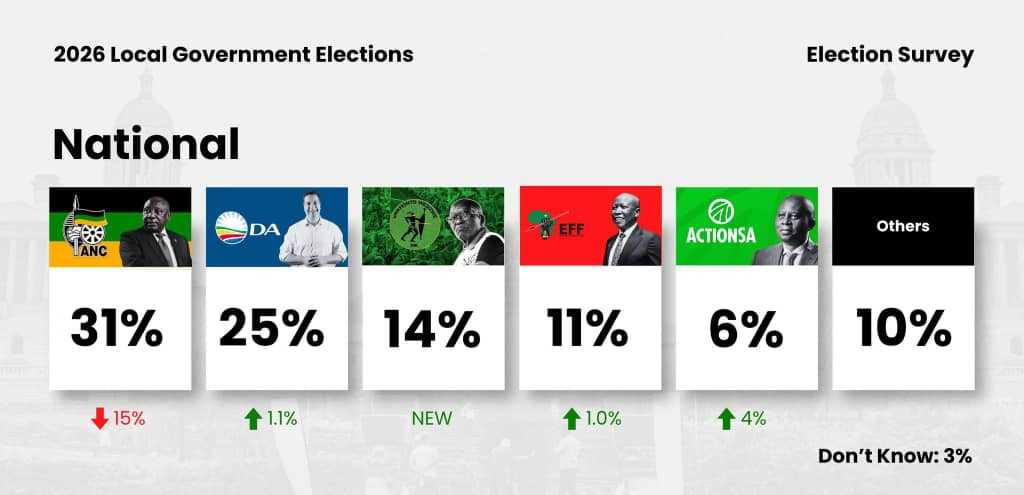
An election graphic published by ERC Africa, citing the latest Ipsos survey, puts the ANC at 31%, down 15 percentage points, while the Democratic Alliance rises to 25%, the uMkhonto weSizwe Party enters at 14% and the Economic Freedom Fighters records 11%, up one percentage point.
The figures were summarised by ERC Africa as indicating “a significant drop in vote share for the ANC while main opposition parties will gain”, but the more consequential feature of the survey is not simply the ANC's decline. It is the fragmentation of the vote among several opposition parties. The DA, MK and EFF collectively account for 50% in the ERC Africa graphic, before smaller parties are taken into consideration. That does not constitute a political bloc, but it illustrates how support outside the ANC is being dispersed across parties with different political bases and strategies.
Related Stories
The Ipsos survey should nevertheless not be treated as a forecast of the November result. Ipsos interviewed 3,600 randomly selected respondents in June and July, with the results weighted to the adult population, and says the figures reflect current support rather than a prediction of the final election outcome. Turnout, undecided voters and changes in voter preferences before election day could therefore alter the eventual result.
What the survey does reveal is a changing structure of South African local politics. In March, Ipsos measured ANC support for the local elections at 38%, compared with 22% for the DA, 14% for MK and 12% for the EFF. The September figures therefore show the ANC falling to 31%, while the DA moves to 25%, MK remains at 14% and the EFF sits at 11%. The movement is significant because the ANC's lost support has not consolidated behind a single challenger.
That makes the November election less straightforward than an ANC-versus-DA contest. The emergence of MK as a significant force, particularly in KwaZulu-Natal, the EFF's continued presence and the support retained by smaller parties mean that the distribution of council seats could be highly fragmented. Where no party secures a majority, the ability to form governing coalitions could become as important as which party finishes first.
The metropolitan picture reinforces that point. Ipsos identifies Johannesburg, Ekurhuleni, Nelson Mandela Bay and Buffalo City as competitive ANC-DA contests, while MK is particularly strong in eThekwini and ActionSA has its strongest showing in Gauteng. The result is a political map in which the balance of power could vary considerably from one municipality to another.





Leave Comments