









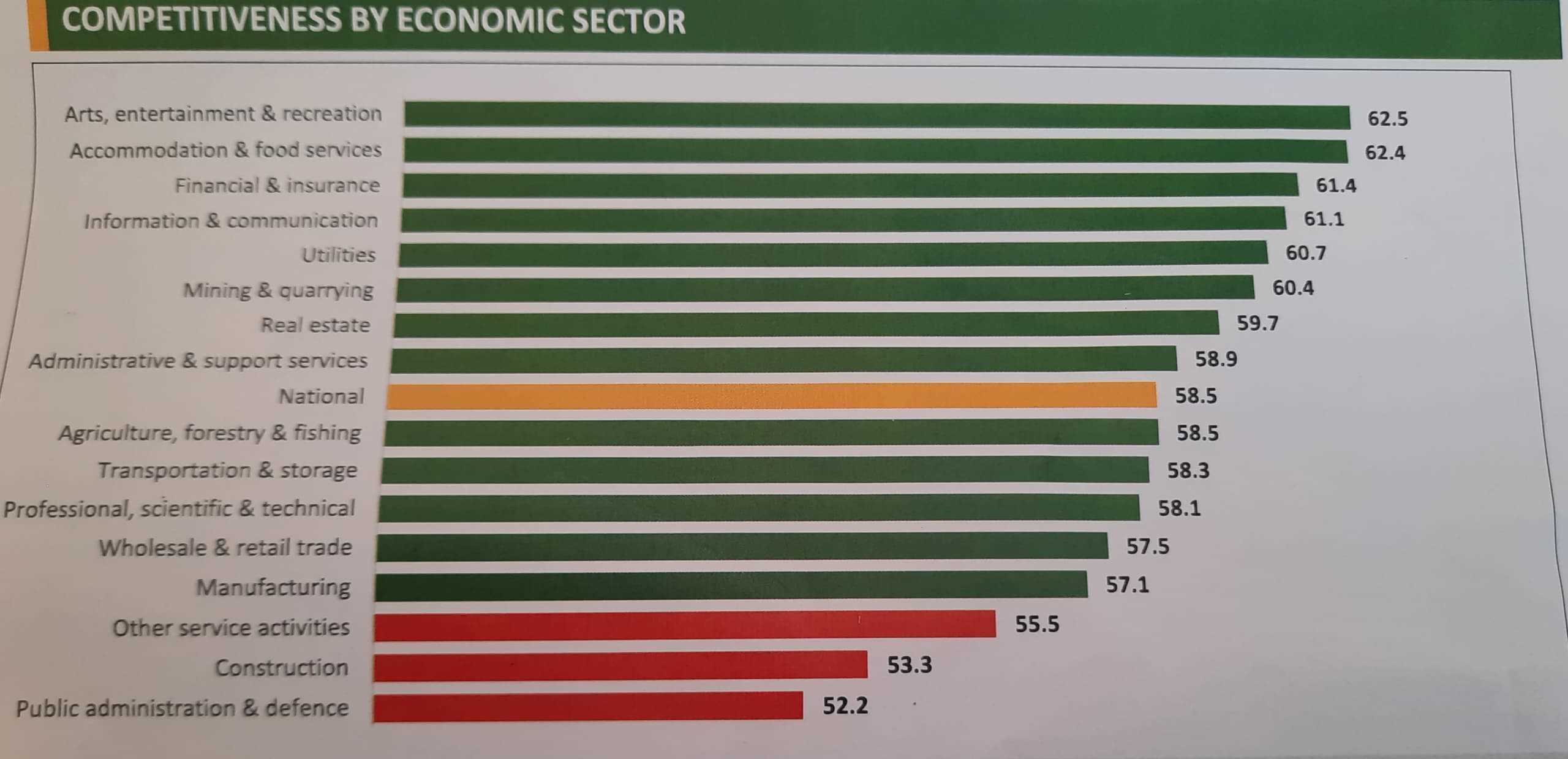
Zimbabwe’s public administration and construction sectors have recorded the country’s weakest competitiveness scores, with public administration and defence scoring 52.2 out of 100 and construction 53.3, exposing gaps in the business environment that could undermine efforts to improve productivity and attract investment.
The findings are contained in the 2025 National Competitiveness Baseline Survey, conducted by the National Competitiveness Commission (NCC) and the Zimbabwe National Statistics Agency (ZimStat), which gave Zimbabwe an overall score of 58.5 out of 100, classified as “moderate competitiveness”.
Construction’s performance was particularly concerning in terms of resilience, where it scored just 49.3, making it the only sector to fall below 50 on that pillar. The result raises questions about the sector’s ability to withstand disruptions, while the low public administration score highlights the need to examine the institutional and regulatory conditions under which businesses operate.
The survey assessed executives’ perceptions across four pillars: innovativeness, inclusiveness, sustainability and resilience. Its findings provide a baseline for tracking competitiveness and identifying areas requiring policy intervention, although the scores alone do not establish the specific causes of the weak performance in public administration and construction.
Across the four pillars, sustainability was the weakest nationally, at 56.0, followed by resilience at 57.4. Innovativeness scored 59.1, while inclusiveness led at 61.5.
The survey describes sustainability as being “constrained by climate change cost and low investment in green production”. The assessment points to the financial burden associated with climate-related challenges and the limited adoption of greener production methods as issues requiring attention.
On resilience, the report identifies a “strong talent base, weighed down by judicial impartiality, corruption costs, crime”. These concerns suggest that the availability of skills alone may not be enough to strengthen business performance when firms also face institutional and security-related pressures.
The innovativeness pillar was “driven by tertiary/vocational skills matching industry needs” but “held back by low competition in services and restrictive FDI rules”. The findings point to a gap between the skills available in the economy and other conditions necessary to translate those skills into stronger business competitiveness.
Inclusiveness, the highest-scoring pillar, was associated with equal opportunities in hiring and promotion, although access to finance and utilities remained weak points. Its score of 61.5 therefore does not mean businesses are free from constraints in accessing the resources needed to operate and expand.
Related Stories
The sectoral results show that the challenges are not uniform across the economy. Arts, entertainment and recreation recorded a score of 62.5, followed by accommodation and food services at 62.4, financial and insurance activities at 61.4, and information and communication at 61.1.
Manufacturing scored 57.1, below the national average, while other service activities recorded 55.5. Construction and public administration and defence occupied the bottom of the sectoral assessment, at 53.3 and 52.2, respectively.
The public administration result is significant because government institutions shape the regulatory and administrative environment in which companies operate. However, the survey’s overall sector score does not specify which procedures, services or institutional shortcomings account for the result, and further evidence is needed to identify the reforms most likely to improve performance.
Construction’s resilience score of 49.3 also deserves closer examination, given the sector’s role in infrastructure development and investment. The baseline identifies the weak result but does not, on its own, establish whether it was driven by financing constraints, project delays, input costs or other operational pressures.
Regional disparities further complicate the national picture. Manicaland recorded the highest provincial competitiveness score, at 62.5, followed by the Midlands at 61.1 and Mashonaland West at 60.0. Mashonaland East scored 55.9, the lowest among the 10 provinces, while Harare recorded 57.4.
Only four provinces reached or exceeded the national score of 58.5, indicating that business executives’ perceptions of competitiveness vary considerably across the country. Manicaland led in the overall score, while the Midlands recorded the highest resilience score, at 60.8.
The survey interviewed 1,107 establishments from a sample of 1,641, representing a response rate of 67.5 percent. The participating establishments reported a combined workforce of 319,397 people. Wholesale and retail trade accounted for 36.1 percent of respondents, while manufacturing accounted for 13.7 percent. Private limited companies made up 77.6 percent of the establishments surveyed.
The NCC and ZimStat said the survey addresses the need for “reliable, nationally representative domestic competitiveness data that reflects Zimbabwe’s unique economic and business environment”. The institutions said it establishes a baseline for “tracking competitiveness, identifying gaps and assessing the impact of policy reforms”.
The exercise follows the National Development Strategy 1 Mid-Term Review, which identified national competitiveness as a priority and called for periodic indices to monitor the country’s performance.







Leave Comments