






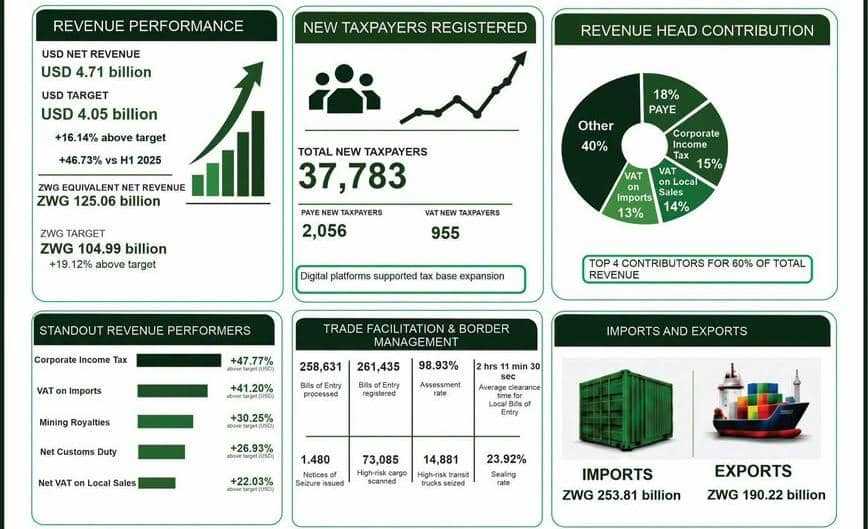
The Zimbabwe Revenue Authority says it collected US$4.71 billion in the first half of 2026, exceeding its target by 16.14 percent and recording a 46.73 percent increase from the US$3.21 billion collected during the same period last year, as the tax authority moves to widen the number of taxpayers contributing to the fiscus.
ZIMRA Board chairman Anthony Mandiwanza said the first-half performance was supported by stronger compliance, digitalisation, trade facilitation and border controls, while the authority registered 37,783 new taxpayers during the period.
“ZIMRA delivered strong H1 2026 performance, collecting USD 4.71 billion - 16.14% above target and 46.73% higher than H1 2025 - while registering 37,783 new taxpayers. Progress in digitalisation, trade facilitation and border controls strengthened service delivery and compliance,” Mandiwanza said.
The increase means ZIMRA collected about US$1.50 billion more than in the first half of 2025. The authority's own H1 target was US$4.05 billion, while the latest performance highlights indicate an expected US$5.65 billion in the second half, implying a full-year collection level of about US$10.36 billion if that forecast is achieved. Government's 2026 national budget, however, set an overall revenue target of about US$9.4 billion, while ZIMRA's 2026-2030 strategic planning documents set a US$9.2 billion revenue-collection target for 2026.
The gap between the first-half performance and the annual fiscal target illustrates how quickly revenue mobilisation has strengthened. If ZIMRA were to maintain the US$4.71 billion first-half pace through the second half, collections would reach about US$9.42 billion for the year, broadly in line with the Government's budget target. The authority's US$5.65 billion H2 forecast would take the total materially higher.
The composition of the collections also shows that the gains are not coming from a single tax stream. PAYE accounted for 18 percent of total revenue, followed by Corporate Income Tax at 15 percent, VAT on local sales at 14 percent and VAT on imports at 13 percent. Together, those four heads generated about 60 percent of total collections.
Corporate Income Tax was 47.77 percent above target, VAT on imports exceeded target by 41.20 percent, mining royalties were 30.25 percent above target, net customs duty was 26.93 percent above target and net VAT on local sales was 22.03 percent above target.
In Zimbabwe Gold terms, net revenue reached ZWG125.06 billion against a target of ZWG104.99 billion, a positive variance of 19.12 percent. Gross collections stood at ZWG132.53 billion, while ZIMRA paid ZWG7.48 billion in refunds, equivalent to 5.64 percent of gross collections.
The numbers also point to a significant change in the tax administration model. ZIMRA says 78.2 percent of the excess revenue over target was generated through compliance enforcement, with the remainder attributed to greater visibility through its Tax and Revenue Management System and Fiscalisation Data Management System , staff focus and debt control. TaRMS was 98 percent complete and FDMS 99 percent complete, with integration between the two systems at 100 percent.
That digital infrastructure is increasingly important to the strategy of broadening the tax base. During the first half, 22,679 taxpayers had been onboarded onto the fiscalisation system, national onboarding had reached 92 percent and 20.4 million fiscal invoices had been processed. All 16 banks had also been integrated for payments.
Related Stories
The expansion of the taxpayer register provides another source of potential revenue growth. Of the 37,783 new taxpayers registered, 2,056 were PAYE taxpayers and 955 were VAT taxpayers. While the number of new registrations cannot automatically be translated into a specific amount of additional revenue, bringing previously unregistered economic activity into the formal tax system creates a larger base from which recurring collections can be generated.
Finance, Economic Development and Investment Promotion Minister Mthuli Ncube told ZIMRA's 25th anniversary celebrations in early September that the authority needed to expand alongside the economy.
“Over these 25 years, ZIMRA has responded to the changing economic dictates of our country. From collecting millions in its early years, the Authority now mobilises billions in revenue,” Ncube said. “As our economy expands, ZIMRA must rise with it.”
At the same engagement, Ncube said Government wanted the tax-to-GDP ratio to rise from about 17 percent to 22 percent by 2030, arguing that stronger domestic revenue mobilisation was necessary to finance development.
The target is significant because Zimbabwe's revenue challenge is not simply how much existing taxpayers pay, but how much of the economy remains outside the formal tax net. ZIMRA's own 2026-2030 strategy identifies tax-base expansion as one of its central mandate pillars and aims to integrate the informal sector while using data-driven compliance systems to improve collections.
Ncube has also acknowledged that widening the base cannot be achieved by enforcement alone. In August, he proposed linking local authority vendor licences with ZIMRA tax compliance and integrating council and ZIMRA registration systems so that businesses already known to municipalities could be identified and brought into the appropriate tax categories.
“The proposed reform underscores Treasury's increasing focus on economic activity that is already visible to local authorities but remains outside the formal national tax system,” Ncube said.
The significance of that approach is its potential effect on the pattern of revenue collection. A larger registered taxpayer population can broaden recurring PAYE, VAT, corporate tax, presumptive tax and other collections, reducing the extent to which annual revenue growth depends on higher collections from the same established taxpayers.
The first-half figures already provide an indication of that shift, although the available H1 results do not provide a Q1-versus-Q2 revenue split that would allow a precise quarterly growth calculation. The stronger comparison available is year-on-year: H1 2026 collections rose 46.73 percent from H1 2025, while the authority exceeded its own first-half target by 16.14 percent.
ZIMRA's trade-facilitation figures suggest that the authority is simultaneously trying to increase compliance without slowing legitimate commerce. It processed 258,631 Bills of Entry and registered 261,435, achieving a 98.93 percent assessment rate, while the average clearance time for local Bills of Entry was two hours, 11 minutes and 30 seconds. It also scanned 73,085 high-risk cargo consignments, seized 14,881 high-risk transit trucks and issued 1,480 seizure notices.
The authority's revenue performance is therefore increasingly tied to its ability to see more of the economy, rather than simply imposing higher taxes on those already within the system. Its strategic plan targets revenue collections of US$9.2 billion in 2026, rising to US$10.67 billion in 2027 and US$12.29 billion in 2028, alongside a continuing target of registering 50,000 new taxpayers a year.
With 37,783 new taxpayers already registered by June, ZIMRA has covered more than three-quarters of that annual new-taxpayer target in the first half. If registration and compliance gains continue, the effect should extend beyond the current year's headline collection figure by increasing the pool of taxpayers from which subsequent monthly, quarterly, and annual revenue can be generated.







Leave Comments