








Zimbabwe's official smartphone imports have almost doubled during the first four months of 2026, a development that may reflect less of a sudden consumer technology boom than the growing impact of tighter border enforcement against informal import networks that have dominated the country's electronics trade for years.
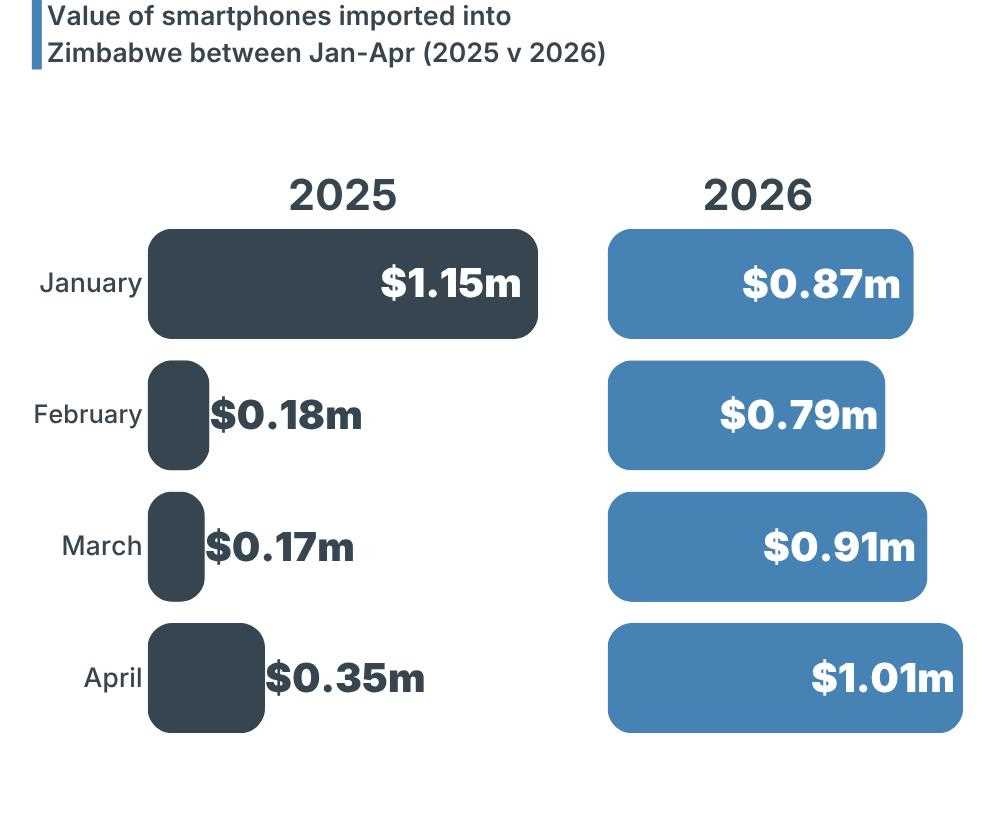
Latest figures released by the Zimbabwe National Statistics Agency show Zimbabwe officially imported smartphones worth US$3.57 million between January and April 2026, compared to US$1.85 million over the same period in 2025, representing a 93 percent increase.
According to the Zimbabwe National Statistics Agency, smartphone imports reached US$0.87 million in January, US$0.79 million in February, US$0.91 million in March and US$1.01 million in April, marking the first time monthly imports have crossed the US$1 million threshold.
The statistics agency noted that smartphone imports have steadily increased throughout the first quarter before reaching their highest monthly value in April.
While the figures point to stronger formal imports, they are also consistent with intensified efforts by the Zimbabwe Revenue Authority to curb smuggling and redirect previously informal trade through official customs channels.
For years, Zimbabwe's smartphone market has been overwhelmingly supplied through informal "runner" networks. These traders travel primarily to Dubai in the United Arab Emirates and Shenzhen and Guangzhou in China, buying smartphones in bulk before bringing them into Zimbabwe through road and air routes, often avoiding full customs declarations.
The informal model has allowed consumers to access cheaper devices from global brands including Apple, Samsung, Xiaomi, Tecno, Infinix, Oppo and Huawei, but has also deprived the Treasury of significant customs revenue while creating unfair competition for registered retailers.
The Zimbabwe Revenue Authority has repeatedly identified smuggling as one of the biggest threats to domestic revenue collection.
The authority has stated:
Related Stories
"Smuggling remains one of the major causes of revenue leakages and undermines legitimate business."
It has also maintained that intensified border enforcement is intended to ensure "every importer pays the correct duty and taxes due to Government."
In recent months, the revenue authority has stepped up anti-smuggling operations at ports of entry, introduced enhanced cargo profiling, expanded post-clearance audits and increased surveillance of high-risk imports, including electronic goods.
Those measures coincide with a noticeable rise in officially declared smartphone imports.
The figures may therefore represent a formalisation of trade that previously bypassed customs rather than a dramatic increase in consumer demand alone.
Zimbabwe's appetite for smartphones continues to grow as digital banking, mobile money services, e-learning, online commerce and social media become increasingly central to everyday life.
However, affordability remains a major challenge.
Industry players say many consumers still prefer purchasing devices from informal traders because they often offer lower prices than registered retailers, partly due to reduced tax costs and direct sourcing from suppliers in Dubai and China.
Government has repeatedly argued that formalising imports is essential not only for protecting revenue but also for improving consumer protection by reducing counterfeit products and ensuring compliance with import standards.
If anti-smuggling operations continue to tighten, Zimbabwe could witness further growth in official smartphone import statistics even without a corresponding surge in actual demand, signalling a shift from the informal economy into the formal trading system rather than a pure technology boom.








Leave Comments