









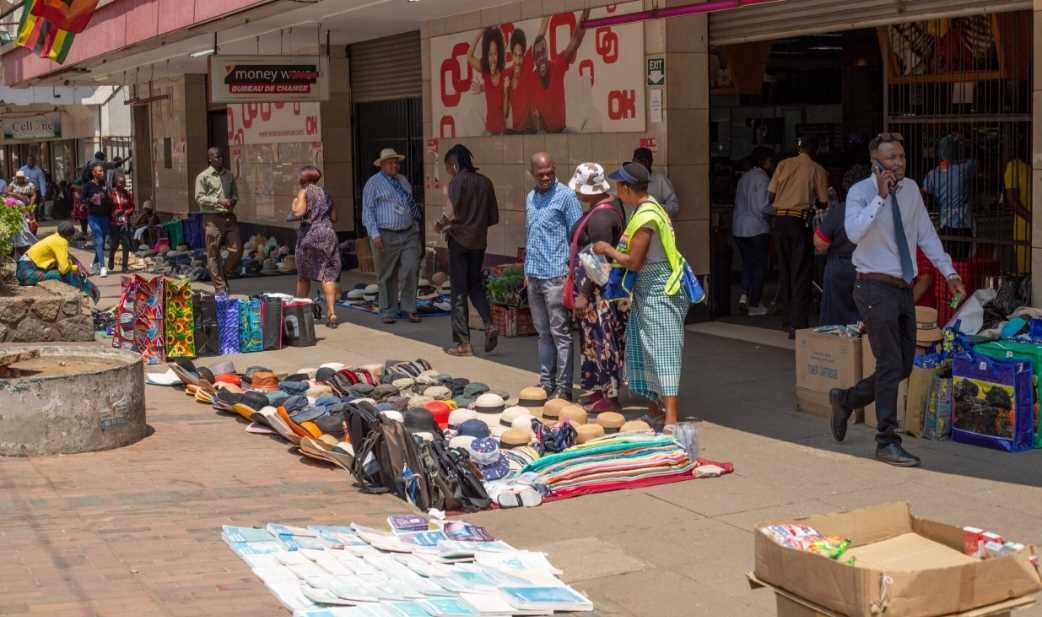
Government says it is chasing street vendors out of Zimbabwe’s cities to restore order, improve sanitation and create cleaner public spaces.
But as the September 9 deadline for informal traders approaches, the crackdown is raising another question: is Government also trying to protect formal retailers from the growing competition posed by the informal economy?
Local Government and Public Works Minister Daniel Garwe has ordered vendors operating from undesignated sites in Harare and the wider metropolitan province to leave by September 9, warning that a “comprehensive, zero-tolerance clean-up operation” will follow.
Speaking on ZiFM, Garwe said Government was not opposed to informal trading but wanted it moved to designated markets.
“We want clean cities without litter everywhere. Now we have litter and dirt everywhere, including hotels, and we have vendors selling in front of formal retailers such as Pick n Pay,” Garwe said.
“These formal retailers pay taxes and rentals unlike vendors, which is unfair. We cannot have a city whereby anyone can just randomly sell in places without sanitation facilities.”
Garwe said the directive was not about bullying vendors, arguing that informal traders simply needed to operate from legal and designated places.
But the Minister's reference to competition with formal retailers gives the clean-up campaign an economic dimension.
It comes as established retailers face growing competition from informal traders and tuckshops, many of which sell the same goods and can sometimes offer lower prices.
In 2023, OK Zimbabwe, one of the country's largest retailers, complained that informal operators were mostly engaging in arbitrage and had “caused more headaches than good for the formal guys like OK Zimbabwe, TM Pick n Pay, Gain Cash & Carry and so many more.”
Yet Finance and Investment Promotion Permanent Secretary George Guvamatanga offered a markedly different response at the time.
Guvamatanga argued that the dominance of large supermarkets without formidable competition was itself an anomaly in Zimbabwe's economic structure.
He said big retailers complaining that they could not compete with tuckshops should “fire their managers”, arguing that such management would be failing to respond to competition.
Three years later, Government is preparing to remove thousands of informal traders from commercially attractive spaces where many compete directly with established businesses.
That does not prove that the clean-up is designed to protect formal retailers.
But it raises a difficult question about how Zimbabwe should balance urban order, formal business interests and the livelihoods of people who have increasingly turned to informal trading because formal employment is scarce.
‘Our survival is in the streets’
For vendors, the streets are not simply illegal trading spaces.
They are where the customers are.
Cephas Muchegwa, who says he has traded in Harare for about 10 years, described the ultimatum as disconnected from the economic reality facing ordinary Zimbabweans.
“The minister is insensitive. Our survival is in the streets. We will not go anywhere. There are no jobs in the industry. We have graduates at home,” he said.
“So what can we do to survive?”
Another Harare vendor, Annah Tariro Muchaya, made a similar argument when vendors rejected a previous Government eviction order in 2025, saying many street traders were graduates unable to find formal employment.
Vendors for Economic Development has previously argued that vending cannot simply be eliminated, while its national chairperson Samora Chisvo has been involved in efforts to expand vendor infrastructure, including plans announced earlier this year to establish vendor malls across the country's provinces.
This exposes one of the contradictions confronting Government: the informal economy is simultaneously being treated as a problem to be removed and a constituency to be empowered.
Formalisation or displacement?
The Vendors Initiative for Social and Economic Transformation (VISET) has taken a more institutional approach.
The organisation accepts that Government has a responsibility to maintain clean and orderly cities, but says enforcement should be implemented within the country's formalisation policy.
VISET executive director Samuel Wadzai said:
“Formalisation cannot mean simply removing people from where they currently earn a living.”
“It must create pathways for informal traders to transition into safer, more secure and sustainable forms of economic activity.”
Wadzai wants informal traders involved in decisions about relocation, with adequate alternative trading spaces established before displacement and protection against harassment and confiscation of goods.
His argument carries particular weight because Cabinet approved the National Formalisation Strategy in April 2026, aimed at integrating informal workers and enterprises into the formal economy through improved access to social protection and economic opportunities.
If formalisation means bringing informal workers into the regulated economy, eviction without a commercially viable transition route risks producing the opposite result — pushing traders deeper into informality.
The Zimbabwe Chamber of Informal Economy Associations (ZCIEA) has also criticised the Government's approach.
ZCIEA national president Lorraine Sibanda has urged authorities not to criminalise informal work.
The organisation's concerns are not new.
When Government banned night vending and second-hand clothing trading in Harare in August 2025, ZCIEA secretary-general Wisborn Malaya described the move as sudden and lacking consultation.
“We are failing to understand the meaning of the ban,” Malaya said at the time.
He argued that many traders operated at night because daytime trading had become increasingly restricted.
“No one would want to trade at night, but they are trading at night because if they trade during the day, the local authority is nail neck on them saying you are trading in front of shops... So they resorted to option B, which is when shops are closed, they start to sell.”
Malaya also rejected the argument that banning night trading would necessarily address social problems, saying many young people and women depended on vending for their livelihoods.
Women face another livelihood shock
Women could be among those hardest hit by the September 9 deadline.
The Women and Law in Southern Africa-linked advocacy organisation WALPE has warned that removing vendors without clear alternatives could push vulnerable women deeper into poverty.
For many women, vending pays for food, school fees and other household needs.
WALPE has therefore questioned whether designated markets have enough spaces and whether those spaces are affordable, accessible and safe.
The organisation also wants women vendors and their representative organisations consulted before enforcement.
Its concern is partly rooted in history: similar clean-up operations have taken place before, only for vendors to return to the streets.
That raises a basic question — what has changed this time?
A cycle of eviction and return
Zimbabwe has a long history of vendor ultimatums.
In 2015, Government gave vendors in Harare seven days to leave the CBD and move into designated vending zones. Authorities planned approximately 6,000 designated spaces.
In 2017, Harare City Council issued another 48-hour ultimatum to food vendors operating in the CBD.
In 2019, Gweru City Council gave vendors at Kudzanayi long-distance bus terminus seven days to vacate stalls that were not in its database.
The COVID-19 period brought demolitions and further clean-up campaigns.
Research into Harare's informal businesses has documented how demolitions during the pandemic reshaped urban space, while broader academic research has found a recurring pattern of harassment, removal and attempts to impose hygiene and spatial controls on street traders.
Yet the economic activity itself proved difficult to eliminate.
Related Stories
In November 2023, Government gave Harare City Council seven days to remove vendors from undesignated areas during the cholera outbreak.
One trader, identified as Varaidzo, responded:
“We need jobs. There are no jobs in the country. Ngavatipe mabasa kuState House ikoko. Where can we go from here?”
She said many traders were widows and single mothers supporting their children through vending.
The argument sounds familiar today.
In August 2025, Garwe again ordered the clearing of street vendors from Harare's CBD and banned night vending alongside the Government's ban on second-hand clothing imports and sales.
Vendors were initially given a month to clear their stocks.
VISET warned that the measure would destroy livelihoods and called instead for regulation, training, market access and resource allocation.
But by August 19, vendors were still operating at night in the CBD.
Government now says municipal police will be deployed to prevent traders from returning after the September 9 deadline.
That raises another question: what will be different this time?
Where are the markets?
The Government says vendors should move into designated markets.
But informal-sector organisations want proof that those markets have enough space and can sustain the people being displaced.
A market can be legally designated but economically useless if customers cannot easily reach it.
A vendor moves to the CBD because the customers are there.
Moving several kilometres away may satisfy a municipal requirement while destroying the trader's ability to earn a living.
A viable vending site therefore requires more than a piece of land.
It needs foot traffic, affordable fees, water, sanitation, security, storage and reliable access.
Harare City Council itself recognised the infrastructure challenge in 2025 when it agreed to ring-fence 25 percent of revenue collected from markets for market and vending infrastructure, a move VISET welcomed.
That raises an uncomfortable question: if authorities already know that vending infrastructure needs investment, why is enforcement running ahead of that investment?
ZimRights has put the issue even more sharply.
“A deadline is not consultation. An eviction is not a livelihoods policy,” the organisation said.
It has called for the September 9 deadline to be suspended, with Government engaging vendor associations and civil society and providing serviced, accessible and affordable markets before removals.
The organisation has also called for protection against violence, arbitrary arrests and destruction or confiscation of goods, which it says constitute the working capital of many families.
‘Vendors are not the disease. Poverty is’
ZimRights argues that Government risks treating the visible manifestation of poverty rather than its underlying causes.
Its statement declared:
“Vendors are not the disease. Poverty is.”
The organisation said vendors include graduates, retrenched workers, widows and young people who depend on informal trading after other economic options fail.
“Before they are vendors, they are mothers, fathers, sons and daughters,” ZimRights said.
“Vending is not a choice; it is the last item on a long list of things that did not work out.”
The organisation wants structured dialogue, serviced trading areas, protection of goods and an economic strategy focused on job creation and industrial revival.
Commentator Blessing Makumire made a similar argument, drawing on his own experience of growing up in poor communities.
“These are the stories that make me stand with and defend our people. Vendors must be allowed to survive with dignity,” Makumire said.
“Problem ndeyekuti vanhu varikunzi maillegal vendor aya ndivanamai nanambuya vedu. Isu takakurira mugheto saka tinozvinzwisisa. Hakuna anombosarudza kutengesera pazuva. Inhamo iyi, ngatipedze urombo kwete kupedza murombo.”
Makumire also questioned whether repeated bans and demolitions amount to an economic policy.
“The language the Minister seems to understand is BAN, MUST STOP, DEMOLISH, and GO BACK WHERE YOU CAME FROM. What else?” he said.
The Government has a case
But the argument cannot simply be reduced to Government versus poor vendors.
Harare's streets cannot become permanent open-air markets without consequences.
Blocked pavements affect residents, workers and people with disabilities.
Poor waste management creates health risks. Informal structures can interfere with emergency access. Unsafe food handling can threaten public health.
Formal retailers also have a legitimate complaint when they pay rent, licences, rates, taxes and compliance costs while competing with traders operating outside the same regulatory framework.
Garwe's argument that cities need rules, sanitation and designated trading areas therefore cannot simply be dismissed.
The problem is what happens next.
The numbers behind the crackdown
Zimbabwe's informal economy is now too large to treat as a marginal sector.
ZIMSTAT's Economic Census found 204,798 operational establishments, of which 76.1 percent were informal, while 87.9 percent were micro-enterprises.
Labour-market data has also shown about 1.36 million people in informal non-agricultural employment, representing 41.3 percent of total employment.
These figures make mass displacement an economic gamble.
If traders are removed from the streets but no viable alternatives exist, the economic activity does not necessarily disappear.
It moves.
The same customers, traders and demand remain.
This is why the September 9 operation presents Government with a test that goes beyond whether municipal police can clear a pavement.
It must demonstrate whether Zimbabwe can formalise informal businesses without destroying the livelihoods that sustain them — and whether it can protect legitimate formal businesses without treating informal traders as the problem itself.
The bigger question is therefore not simply whether vendors should be removed from undesignated spaces.
It is whether Government can build clean, orderly cities while creating an economy in which people no longer have to choose between breaking municipal rules and going hungry.







Leave Comments