




Zimbabwe has identified power generation, transport infrastructure and urban mass transit as the first projects it hopes to finance through the BRICS New Development Bank (NDB), with Government viewing its admission as a borrowing member as an opportunity to unlock long-term capital for projects that have historically been constrained by funding rather than technical feasibility.
The development comes as Zimbabwe seeks alternative sources of infrastructure finance after years in which external debt arrears limited access to new concessional lending from traditional multilateral financiers. While the country has recently completed major projects such as Hwange Units 7 and 8 and rehabilitated more than 525 kilometres of the Harare-Beitbridge Highway, large infrastructure investments continue to require financing that extends beyond what the national budget can support.
Finance, Economic Development and Investment Promotion Minister Mthuli Ncube said the Government is now assembling a portfolio of projects for submission to the NDB.
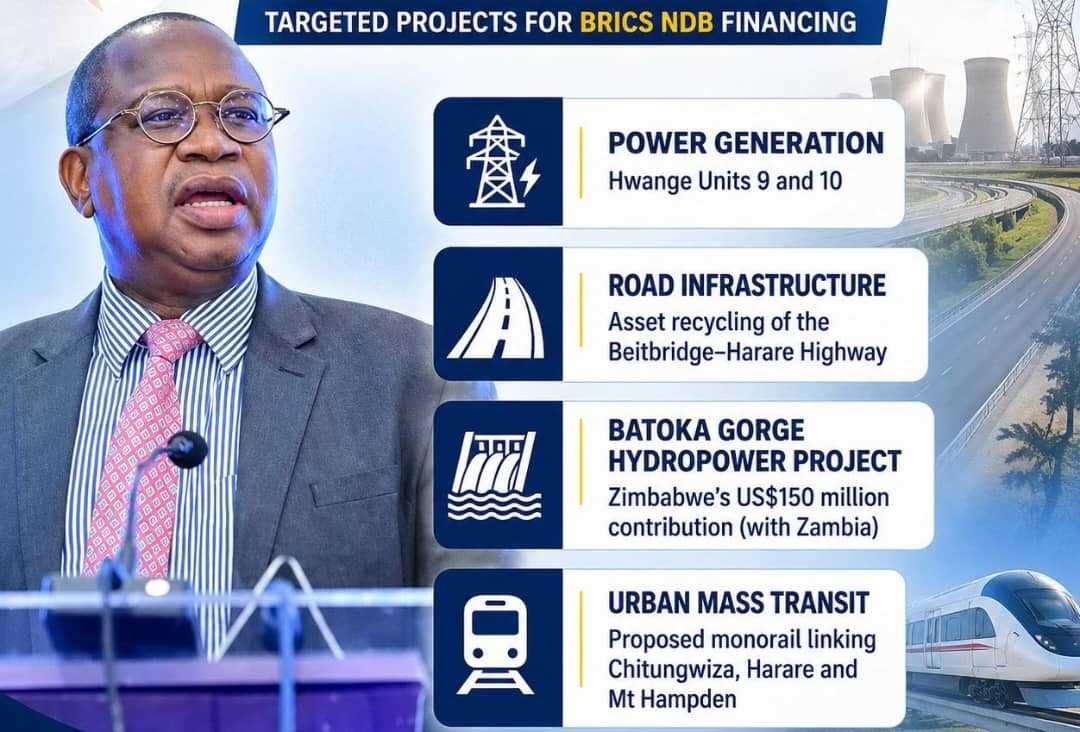
"We are looking at a number of projects that could be financed through the New Development Bank. These include Hwange Units 9 and 10, the Batoka Gorge Hydropower Project, the Beitbridge-Harare Highway through asset recycling, and the proposed monorail linking Chitungwiza, Harare and Mt Hampden."
The projects span sectors that continue to shape Zimbabwe's economic competitiveness.
Electricity shortages remain one of the country's biggest constraints on industrial growth, with the mining sector alone projected to require about 2,000 megawatts of additional electricity as new investments come on stream. Although the commissioning of Hwange Units 7 and 8 eased supply pressures, demand continues to outstrip available generation, making further expansion of Hwange a strategic priority.
The Government also hopes the NDB can finance Zimbabwe's US$150 million equity contribution towards the long-delayed Batoka Gorge Hydropower Project, a joint initiative with Zambia expected to generate 2,400MW, to be shared equally between the two countries.
Among the proposed projects, the refinancing of the Beitbridge-Harare Highway represents a notable shift in infrastructure financing.
Rather than seeking funding for new construction, the Government intends to recover capital already invested in the highway through an asset recycling model.
Related Stories
Ncube explained how the arrangement would work.
"On the Beitbridge-Harare Highway, we want to undertake asset recycling so that Government recovers the capital already invested, while the financing is repaid through toll revenues over a 25 to 30-year concession period."
The proposal reflects an approach increasingly adopted internationally, whereby completed, revenue-generating infrastructure is refinanced to release capital for new projects without immediately increasing pressure on public finances.
If successfully implemented, the model could provide Zimbabwe with an additional mechanism for financing future infrastructure while allowing the Treasury to redirect resources towards other priority investments.
The Government is also proposing financing for a monorail linking Chitungwiza, Harare and Mt Hampden, a project aimed at improving urban mobility as traffic congestion continues to intensify along one of the country's busiest transport corridors.
However, each of the proposed investments will have to satisfy the NDB's lending requirements.
Unlike bilateral financing arrangements, the New Development Bank finances projects based on their technical, financial and environmental viability. Membership therefore creates access to financing, but it does not guarantee loan approval.
The African Development Bank estimates that Africa requires between US$130 billion and US$170 billion annually to meet its infrastructure needs, yet the continent faces an annual financing gap of up to US$108 billion. Zimbabwe's infrastructure pipeline reflects many of those challenges, particularly in the energy, transport and urban development sectors.
Ncube said Zimbabwe's admission as a borrowing member broadens the country's financing options for projects capable of supporting long-term economic growth.
"Membership gives us another platform to mobilise affordable, long-term financing for transformative infrastructure that supports economic growth."



Leave Comments