




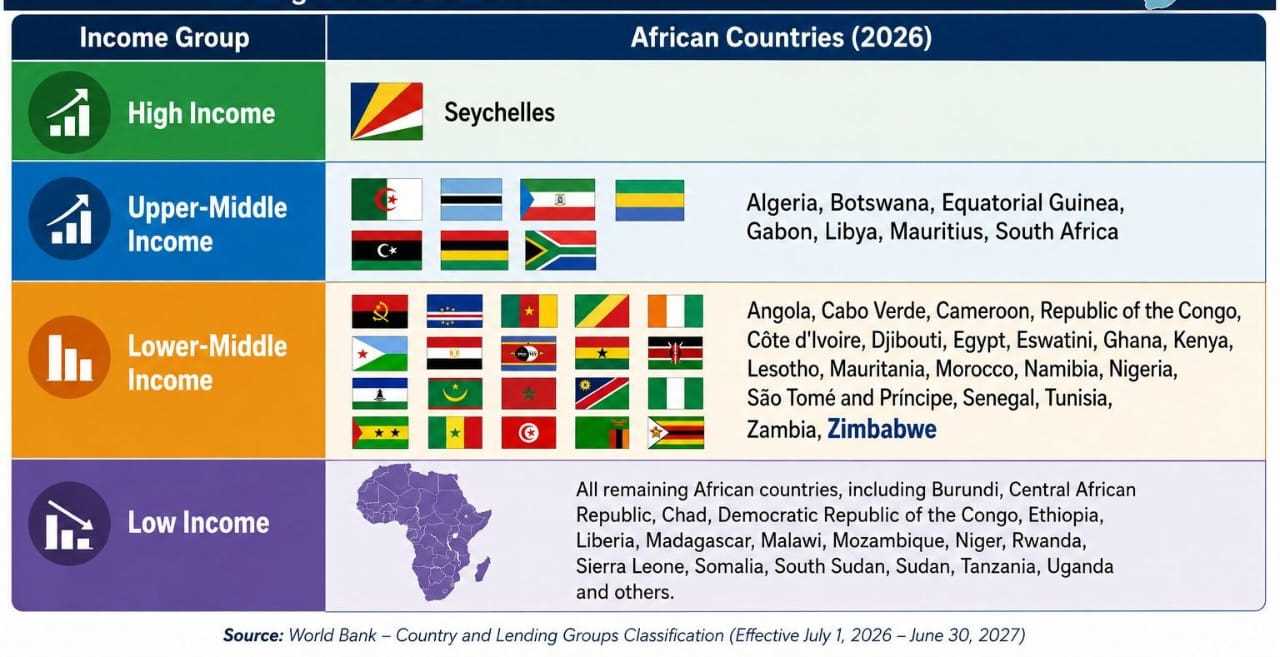
Zimbabwe has retained its lower-middle-income classification in the World Bank's latest income rankings, underscoring both the progress the country has made in stabilising its economy and the significant distance it still needs to cover if it is to achieve the Government's ambition of becoming an upper-middle-income economy by 2030.
The World Bank's latest classification, effective from 1 July 2026 to 30 June 2027, places Zimbabwe among economies with a Gross National Income per capita of between US$1,176 and US$4,635, calculated using the World Bank Atlas method. Upper-middle-income economies are those with GNI per capita between US$4,636 and US$14,375, while high-income economies have GNI per capita above US$14,375.
Explaining the classification, the World Bank says its system enables countries to be "aggregated, grouped, and compared" using internationally recognised statistical measures.
"Economies are currently divided into four income groupings: low, lower-middle, upper-middle, and high. Income is measured using Gross National Income per capita, in U.S. dollars, converted from local currency using the World Bank Atlas method." The institution further notes that countries are reassigned to income groups every July using estimates from the previous calendar year, with the classifications remaining fixed for the entire fiscal year even if data are subsequently revised.
Zimbabwe joins countries such as Zambia, Kenya, Ghana, Nigeria, Egypt, Morocco, Namibia and Tunisia in the lower-middle-income category, while Botswana, South Africa, Mauritius, Algeria, Libya, Equatorial Guinea and Gabon remain upper-middle-income economies. Seychelles remains Africa's only high-income economy.
The latest classification comes at a critical stage for Zimbabwe's Vision 2030 programme, which seeks to transform the country into an upper-middle-income economy before the end of the decade. With only four years remaining, the World Bank's assessment indicates that while macroeconomic stability has improved, average national income has not yet reached the threshold required for reclassification.
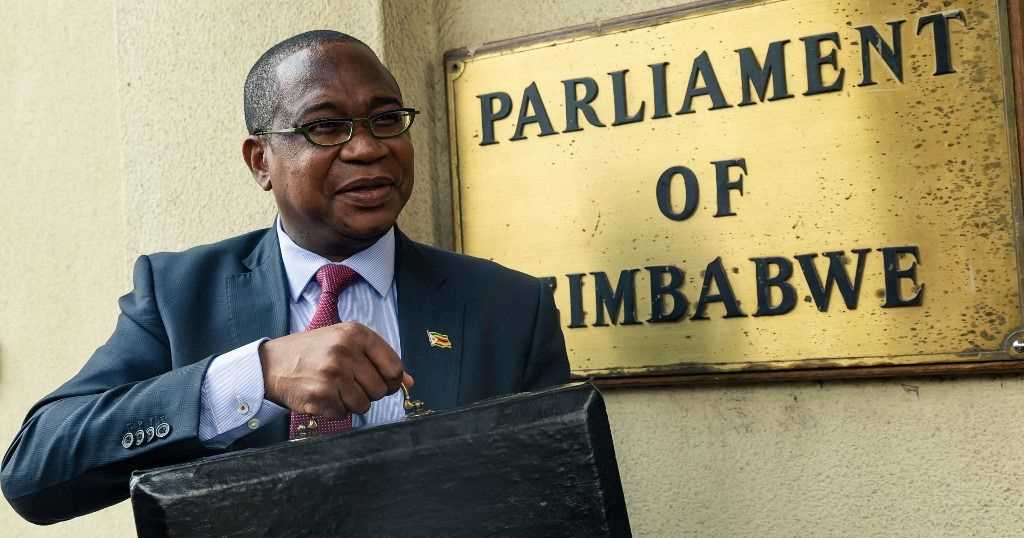
Finance, Economic Development and Investment Promotion Minister Mthuli Ncube has consistently argued that Zimbabwe remains on course to achieve that target through sustained macroeconomic reforms. In recent Budget Statements and economic policy presentations, Ncube has maintained that fiscal discipline, exchange rate stability, infrastructure development, mining expansion, agricultural recovery and private sector-led growth are laying the foundation for achieving Vision 2030.
Government has pointed to a number of economic indicators supporting that position. Zimbabwe recorded one of Africa's strongest economic rebounds in 2025, driven by recovery from drought, record gold production, improved agricultural output, rising foreign currency receipts and continued fiscal surpluses.
Authorities have also cited declining inflation, exchange rate stability under the Zimbabwe Gold currency, infrastructure investment and progress in the arrears clearance and debt resolution process as evidence that economic reforms are beginning to deliver results.
Related Stories
The challenge, however, lies in whether economic growth can translate into sufficiently higher incomes to move Zimbabwe into the next World Bank income category.
The International Monetary Fund projects Zimbabwe's economy will grow by about 5 percent in 2026, following an estimated 8.3 percent expansion in 2025, supported by agriculture, mining and favourable international gold prices.
Growth is expected to moderate to around 4.2 percent in 2027, with downside risks including climate shocks, global commodity price fluctuations and external economic uncertainty.
The African Development Bank similarly forecasts 4.3 percent growth in 2026 and 4.5 percent in 2027, while noting that inflation has eased, fiscal management has strengthened and financial sector stability has improved. However, it also cautions that poverty remains around 40 percent, unemployment is estimated at 20.4 percent, youth unemployment approaches 28 percent, and nearly 59 percent of employment remains in the informal economy.
The World Bank's methodology highlights why strong Gross Domestic Product growth alone may not be enough to achieve upper-middle-income status. The classification is based on Gross National Income per capita, meaning national income must rise consistently faster than population growth while remaining resilient to exchange-rate movements because Atlas GNI is calculated in United States dollars. In practical terms, Zimbabwe will need sustained increases in productivity, household earnings and investment alongside continued macroeconomic stability if it is to surpass the US$4,636 threshold.
Economic analysts have long argued that Zimbabwe's journey to upper-middle-income status will depend on more than macroeconomic stability. Resolving external debt arrears, expanding manufacturing, improving electricity supply, strengthening institutions, increasing value addition, attracting private investment and creating formal employment remain critical if economic growth is to translate into higher living standards.
The African Development Bank has similarly argued that Zimbabwe's medium-term outlook depends on maintaining macroeconomic stability while accelerating structural reforms that improve productivity, strengthen governance, attract investment and expand value addition. While the Bank expects continued economic growth over the next two years, it says long-term progress will also depend on addressing infrastructure constraints, improving the business environment and creating quality employment capable of lifting household incomes.
The International Monetary Fund has also acknowledged Zimbabwe's recent progress under its Staff-Monitored Programme, noting improvements in macroeconomic stability, fiscal discipline and economic resilience while stressing that continued reforms remain essential to sustain growth, restore debt sustainability and unlock broader access to international financing.
By the numbers, Zimbabwe remains in the lower-middle-income category, where GNI per capita ranges from US$1,176 to US$4,635. To graduate to upper-middle-income status, the country must exceed US$4,636 per person. The International Monetary Fund forecasts 5 percent GDP growth in 2026, while the African Development Bank projects 4.3 percent in 2026 and 4.5 percent in 2027, leaving only four years before the Government's Vision 2030 target.
For ordinary Zimbabweans, the World Bank's classification does not immediately affect wages, taxes or public services. Instead, it serves as an internationally recognised benchmark used by investors, development partners and policymakers to measure a country's level of economic development and compare its progress with peers.
While remaining in the lower-middle-income category confirms that Zimbabwe has maintained the gains that lifted it out of the low-income bracket several years ago, the latest World Bank assessment also illustrates the scale of the challenge ahead. The next four years will determine whether the country's current economic reforms and projected growth rates can translate into sufficiently higher incomes to fulfil the Government's long-standing Vision 2030 promise of becoming an upper-middle-income economy.








Leave Comments