








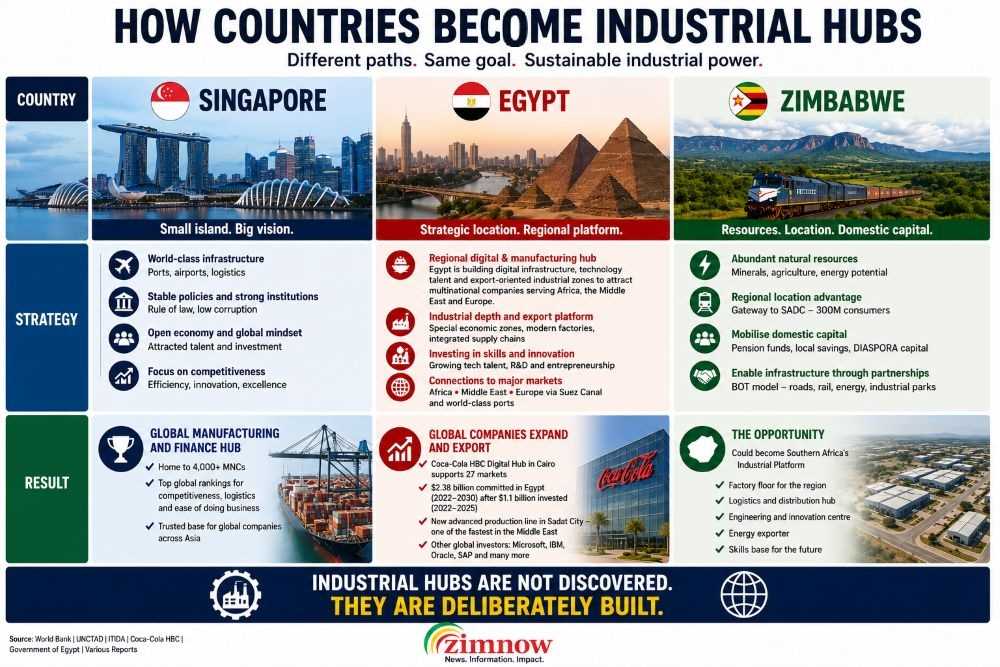
In August 1965, Singapore was expelled from Malaysia. A tiny island, no meaningful resources, high unemployment, little reason for optimism. Today it ranks among the world's leading financial, logistics and manufacturing centres.
Zimbabwe's story runs almost opposite. Some of Africa's richest mineral deposits. Fertile land. A strategic position at the heart of Southern Africa. One of the continent's most educated populations. Yet industrialisation remains unfinished business.
Apples and oranges, but one principle travels, though. Singapore did not legislate prosperity. It built conditions that made prosperity commercially attractive.
A more recent example and closer to home is Egypt. Coca-Cola HBC, Coca-Cola’s strategic bottling partner, this month inaugurated a major Digital Hub in Cairo to support operations across 27 European and African markets. The facility, opened with Egypt’s ITIDA, employs 250 professionals and is expected to grow to 450 by 2027, while adding about US$34 million annually to Egypt’s digital exports. The company has also committed a further US$1.28 billion investment in Egypt through 2030, after investing US$1.1 billion between 2022 and 2025.
From compelling investment to attracting it
Zimbabwe has rightly named beneficiation and value addition as national priorities. Exporting raw minerals while importing finished goods rarely builds sustained prosperity. But legislation does not build factories. No investor moves because Parliament passed a law demanding local processing. Investors build where the commercial environment makes more sense than the next country over. To enable industrialisation, the task is to make Zimbabwe the easiest, safest, most profitable place in Southern Africa to industrialise.
Zimbabwe's market is bigger than Zimbabwe
Egypt's entry point as an investment centre is its large domestic market, currently at around 120.2 million people, while Singapore sold itself as the gateway to Southeast Asia. With a population of 17 million, Zimbabwe cannot win on market dynamics but can build itself into the industrial gateway to a region of over 300 million. It borders countries facing near-identical constraints: raw mineral exports, a push for value addition, and a need for manufacturing jobs and reliable industrial infrastructure.
Copper from Zambia. Lithium from Zimbabwe. Agricultural output from Malawi and Mozambique. Engineering services for mines across the region. Manufacturing that serves Botswana, Zambia, Mozambique and Malawi. Zimbabwe's opportunity is not to compete with its neighbours. It is to become the place where regional production happens.
Industrialisation begins with competitiveness
Industrial hubs are not built on instruction. They are built on consistently outperforming the alternative location. Reliable electricity. Efficient transport. Fast customs clearance. Predictable taxation. Stable regulation. Professional investment support. None of it glamorous. All of it decisive in where a factory gets built. Zimbabwe already holds advantages that cannot be replicated elsewhere. The task now is turning infrastructure and policy into competitive advantage rather than recurring liability.
Related Stories
Industrialisation without electricity is an irrigation scheme without water. Zimbabwe's rising coal output around Hwange offers an immediate bridge, not a destination. Additional generation from Hwange can provide baseload power while solar, hydro and other renewables expand behind it. Industry needs certainty. Reliable electricity provides it. Then there are the dormant assets. Munyati, Harare and Bulawayo thermal stations already exist. The real question is not whether government has the money to rehabilitate them. It is whether Zimbabwe is looking in the right place for the financing.
Look inward before looking abroad
Zimbabwe habitually waits on foreign governments or international financiers for transformational infrastructure. External capital has its place. Singapore welcomed it too. But Singapore also became exceptional at mobilising domestic capital alongside it. Zimbabwe has substantial pools of long-term domestic savings sitting in pension funds, insurers and banks. Much of that capital flows into commercial property, office parks, shopping centres, housing. Fair enough. But should productive infrastructure claim a larger share of those portfolios?
Picture a consortium of Zimbabwean pension funds, insurers and development finance institutions rehabilitating Munyati Thermal Power Station through a commercially structured special-purpose vehicle. Revenue from long-term electricity supply agreements with mines and industrial users. Additional income from grid supply and exports through the Southern African Power Pool. That is exactly the kind of predictable, long-duration cash flow pension funds finance globally, from airports to toll roads to power networks.
The requirement is bankability: strong governance, transparent procurement, commercially viable tariffs, independent oversight, and credible guarantees. The question is what Zimbabwe must fix to make Munyati an asset trustees would confidently back with retirement savings.
Roads. Railways. Water systems. Industrial parks. Logistics hubs. Much of this can move through well-structured Build-Operate-Transfer arrangements: private investors finance construction, recover investment over an agreed concession period through user charges or service revenue, then hand ownership back to the state. Government keeps its fiscal space. Infrastructure arrives sooner. Industry benefits immediately. The goal is acceleration.
Becoming indispensable
Perhaps Singapore's greatest achievement was becoming indispensable. Global companies established operations there because Singapore consistently solved problems better than alternative locations.
Egypt is building digital infrastructure, technology talent and export-oriented industrial zones to attract multinational companies including Microsoft, IBM, Oracle and SAP have expanded technology and business operations in Egypt to serve markets across Africa, the Middle East and Europe. It is positioning itself as a production, technology and export platform for surrounding markets.
Zimbabwe's opportunity is different, but the principle is remarkably similar. It needs to become the place where Southern Africa's industrial ambitions naturally converge. The region's factory floor, logistics hub, engineering centre, energy exporter and skills base. It has to be the logical commercial choice.
Because the lesson from Singapore and Egypt, in the end, is simple: countries become investment and development centres because when boards debate options, they are the best on the table.










Leave Comments