





By Simbarashe Namusi
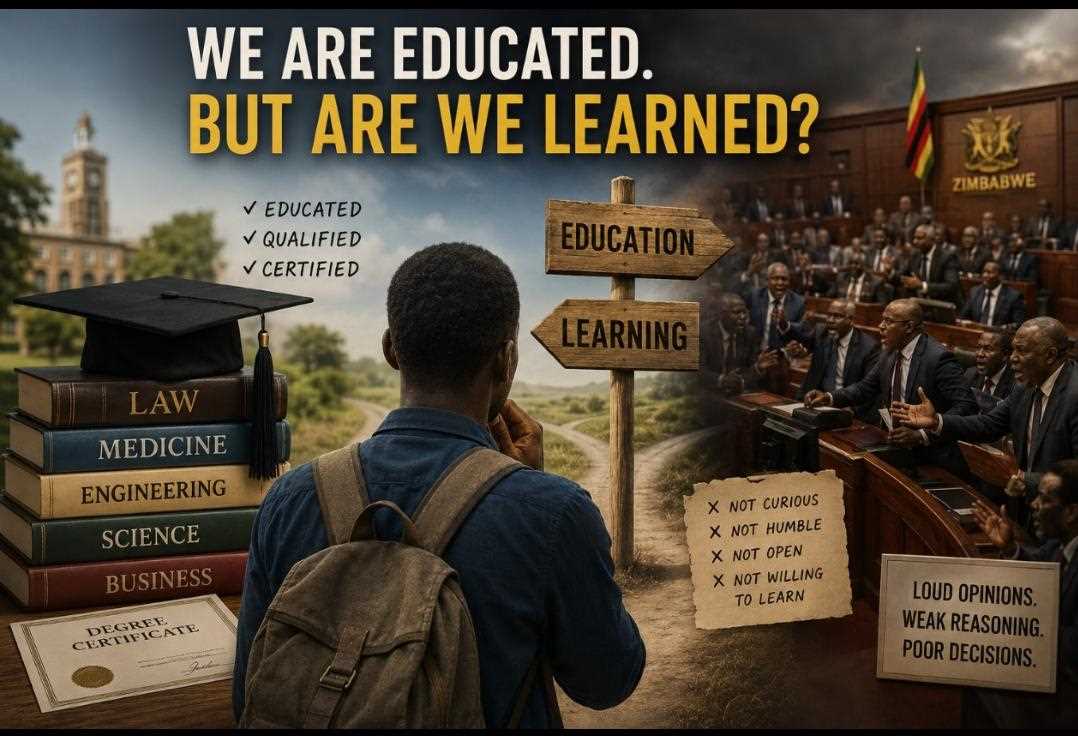
I was listening to Parliament last week.
Not for the first time. But perhaps for the first time with this particular feeling — a slow, settling disappointment that had nothing to do with policy positions or party allegiances. It had to do with how people were thinking. Or rather, how they were not.
Honourable members rose to speak with great confidence. Titles were invoked. Credentials were cited. The chamber filled with the sound of certainty.
But very little light.
Arguments collapsed under the weight of their own assumptions. Questions were deflected rather than engaged. Opposing views were not wrestled with — they were dismissed. What passed for debate was, in truth, a sequence of performances. Each speaker demonstrated not that they had thought deeply, but that they had arrived already decided.
I left thinking about the difference between education and learning.
Zimbabweans love education. We celebrate examination results as national achievements. Families sacrifice enormously to send their children to university. Graduation photographs flood timelines every year. We introduce one another by titles: Doctor. Professor. Engineer. Advocate.
There is nothing wrong with any of that.
Education has long been one of Zimbabwe's genuine strengths. In a country that has endured so much uncertainty, it remains one of the few investments families still believe can change a child's future.
But education and learning are not the same thing.
Education can be certified. Learning must be demonstrated.
Education earns you a degree. Learning teaches you how to use it.
We live in an era where information has never been more accessible. Entire libraries fit inside mobile phones. Expert opinion is only a few clicks away. Yet misinformation spreads faster than correction. Educated people share stories they have not verified. Intelligent people repeat rumours that confirm what they already believe.
That is not a failure of education.
It is a failure of learning.
Learning requires curiosity. It demands that we question our assumptions and test our beliefs against evidence. It requires the humility to admit that we may be wrong.
And humility is becoming rare.
Public debate has become a competition rather than a conversation. People are less interested in understanding opposing views than in defeating them. Every disagreement becomes a battle. Every criticism becomes an attack.
We speak more. We listen less.
Related Stories
We react faster. We reflect less.
We have become skilled at expressing opinions and deeply uncomfortable with examining them.
Which is why some of the most learned people I know hold no formal qualifications. The grandmother who has navigated decades of hardship possesses insights no university teaches. The farmer who reads changing seasons and human behaviour understands adaptation better than many consultants. The artisan who has spent years mastering a craft knows lessons about patience and discipline that no textbook contains.
Their wisdom comes not from certificates on walls, but from years of observation, experience and honest reflection.
This is not an argument against formal education.
Zimbabwe needs more teachers, scientists, engineers, researchers and innovators. We need better schools, stronger universities and greater access to knowledge. That argument does not need to be made — it is settled.
But education should be the beginning of learning, not its end.
Somewhere along the way, many of us began treating qualifications as destinations rather than foundations. We collected certificates and assumed the journey was complete. We stopped reading outside our areas of expertise. We became resistant to new ideas. We mistook confidence for competence.
Back in that parliamentary chamber, I kept thinking: these are educated people. Many of them genuinely so. Degrees from reputable institutions. Years of professional experience. Letters after their names.
And yet.
The willingness to be uncertain. To be corrected. To sit with a hard question rather than rush toward a comfortable answer. That was largely absent.
That absence is not a parliamentary problem. It is a national one. It shows up in our workplaces, our family discussions and our social media arguments. We have produced a society that sometimes knows a great deal and understands very little.
The truly learned person is rarely the one who claims to know everything. More often, it is the person still asking questions.
As Zimbabwe continues to celebrate academic achievement, perhaps we should place equal value on something less visible but equally important:
The willingness to keep learning.
Because the measure of a society is not how many degrees its citizens hold.
It is whether those degrees produce wiser decisions, better reasoning and stronger communities.
We are undoubtedly educated.
Whether we are truly learned — Parliament reminded me — remains an open question.
Simbarashe Namusi is a peace, leadership and governance scholar writing in his personal capacity.






Leave Comments