









What consumers want to know:
- Will local products remain available after restrictions are introduced?
- Will prices rise when import competition is reduced?
- Will quality improve or decline?
- Will retailers pass any local production benefits to consumers?
- Will Government publish a clear list of affected products and exemptions?
Government’s plan to restrict imports of goods that can be produced locally could give Zimbabwean manufacturers a bigger market, but early shelf checks suggest consumers will judge the policy by one simple question: will local products be affordable, available and good enough?
The Herald reported Monday that Government intends to restrict the importation of goods worth about US$4.5 billion which can ordinarily be manufactured locally, as part of measures to support domestic industry and reduce pressure on foreign currency. The report follows recent import control measures under Statutory Instrument 59 of 2026, which tightened import rules on several product categories.
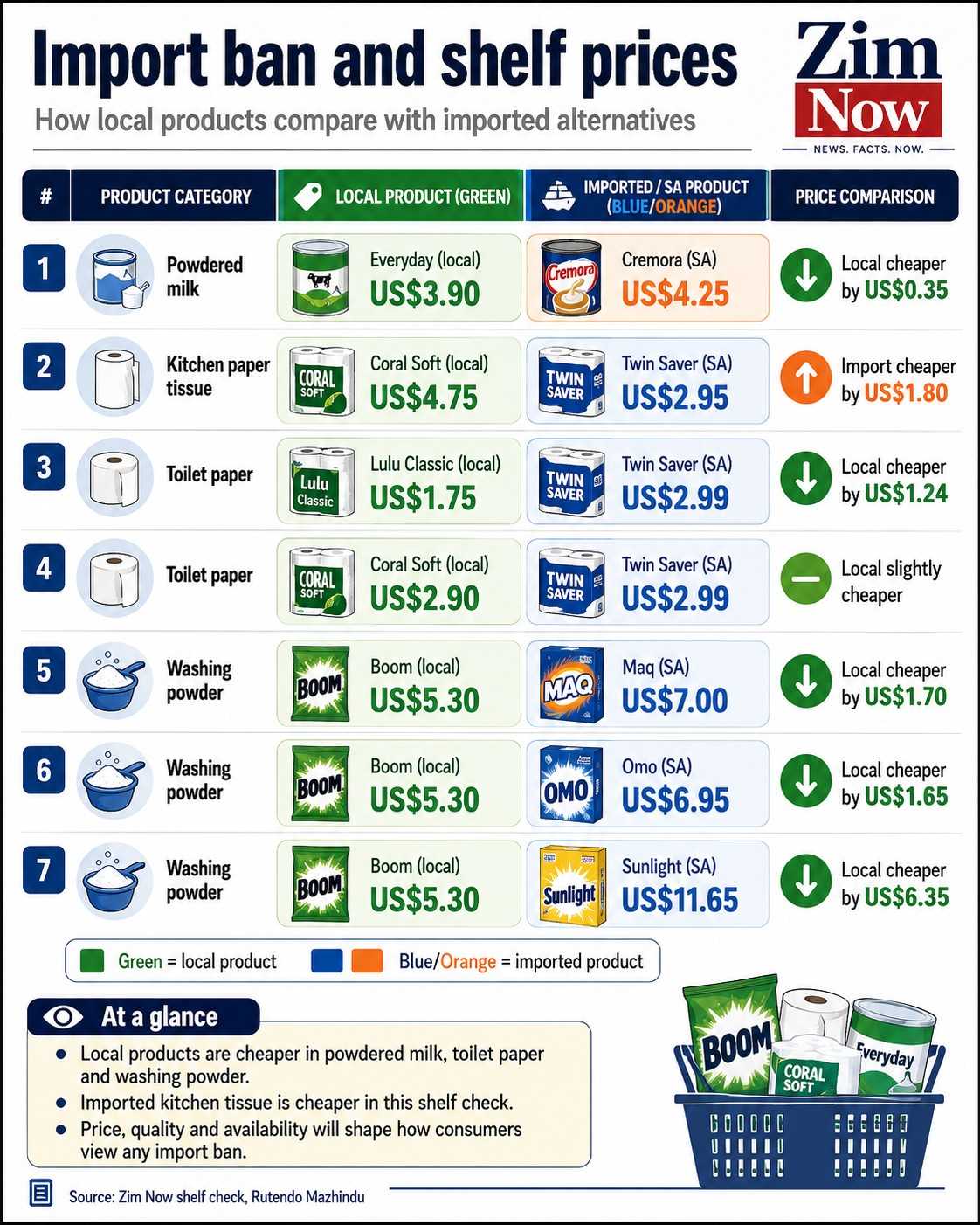
A Zim Now price check in Harare showed a mixed picture. In some categories, local products were cheaper than South African imports. In others, the imported product was significantly cheaper.
In powdered milk, Zimbabwean product Everyday was selling at US$3.90, compared with US$4.25 for South African product Cremora. That makes the local option about US$0.35 cheaper.
For washing powder, local brand Boom was also cheaper than the South African brands checked. Boom was selling at US$5.30, compared with US$7 for Maq, US$6.95 for Omo and US$11.65 for Sunlight.
Toilet paper also showed local competitiveness. Lulu Classic, a Zimbabwean product, was selling at US$1.75, compared with US$2.99 for South African Twin Saver. Coral Soft toilet paper, also Zimbabwean, was selling at US$2.90, just below Twin Saver.
Related Stories
But kitchen paper tissue told a different story. South African Twin Saver was selling at US$2.95, while Zimbabwean Coral Soft was selling at US$4.75. That means the local product was US$1.80 more expensive, or about 61 percent higher than the imported option.
If local products are cheaper, import restrictions may strengthen domestic industry without hurting households. But where local goods are more expensive, consumers may feel the policy at the till, especially at a time when many families are already stretching every dollar.
The key question is whether import restrictions will be matched by measures to help local manufacturers scale up production, improve quality, lower costs and keep shelves stocked.
Zimbabwe has used import controls before to protect local industry. Supporters argue that local manufacturers cannot grow if they are permanently competing with cheaper imports from economies with stronger production systems, cheaper finance and larger markets.
The argument is that Zimbabwean firms need a guaranteed market in order to invest, employ more people and increase production.
A smart import policy would need to separate products where local industry is already competitive from products where consumers would be forced to pay more. It would also need clear benchmarks for local producers, including price stability, quality, production capacity and reliable supply. Without those safeguards, the policy may shift the burden from importers to ordinary shoppers.
The shelf check suggests that Zimbabwean producers are not automatically uncompetitive. In powdered milk, toilet paper and washing powder, some local products are already holding their own against imports. But the kitchen tissue example shows why Government may need a product-by-product approach, rather than a broad ban that treats all locally produced goods the same.
For consumers, the issue is not whether a product is local or imported. It is whether it works, whether it is affordable and whether it is available when needed. For local manufacturers, the proposed restrictions could be a major opportunity. But protection should come with performance. If Government closes the import door, local producers will have to prove they can fill the shelves without punishing the pocket.
The proposed restrictions could support jobs, factories and local value chains. But the real test will be whether the policy builds competitive local industry or simply limits consumer choice. A successful “buy local” policy must make Zimbabwean products easier to choose, not harder to afford.










Leave Comments