







ZimNow Business Desk
Zimbabwe’s push to attract more foreign investment still faces a major trust test, with European Union Ambassador to Zimbabwe Katrin Hagemann warning that corruption remains a barrier to investor confidence despite progress on reform and debt dialogue.
Speaking at the Integrity and Accountability Summit organised by Transparency International Zimbabwe in Harare, Hagemann said Zimbabwe had made progress, including through the arrears clearance and debt resolution process, but needed to move from policy promises to practical institutional change.
The warning matters because Zimbabwe is trying to reposition itself as an investment destination after years of difficult relations with Western partners, debt overhang, policy uncertainty and weak investor confidence.
Hagemann said the EU viewed integrity as central to Zimbabwe’s economic future, especially because investors look beyond resources and market opportunity when deciding where to put long-term capital.
“Investors are drawn by opportunity and by integrity,” she said.

She added that partners could support reforms, but “only Zimbabwe can carry this agenda to completion.”
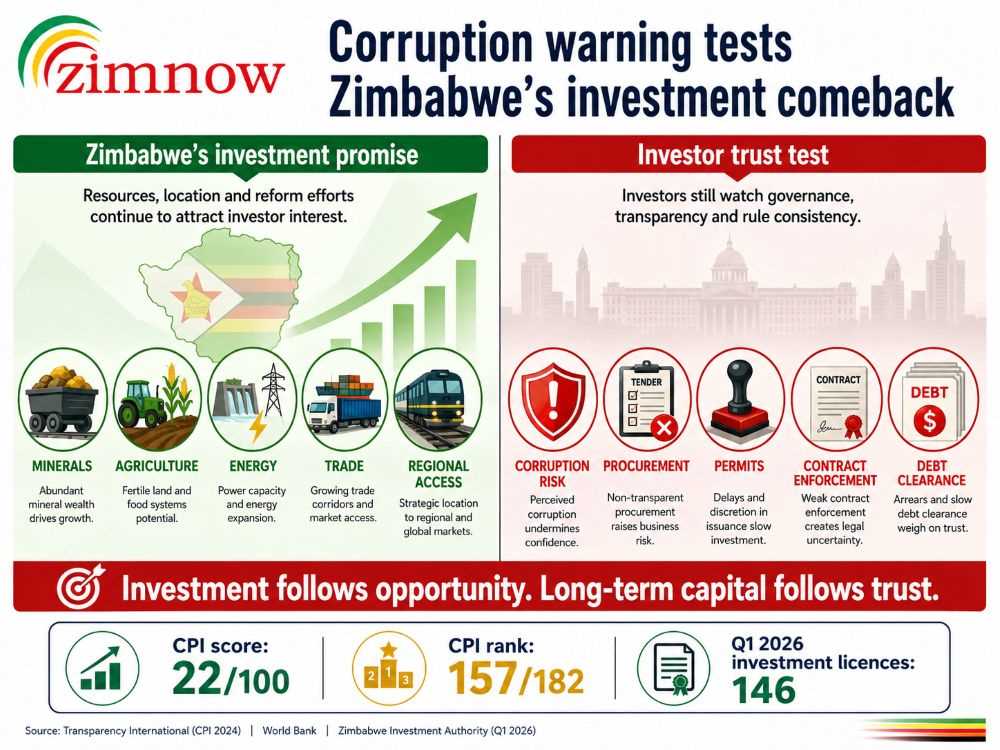
Corruption can raise the cost of doing business through unofficial payments, delayed approvals, unfair tendering, inconsistent enforcement and uncertainty over whether contracts will be honoured.
For a country seeking long-term capital in mining, energy, agriculture, infrastructure and manufacturing, the corruption issue goes beyond governance concerns into an economic competitiveness issue.
Related Stories
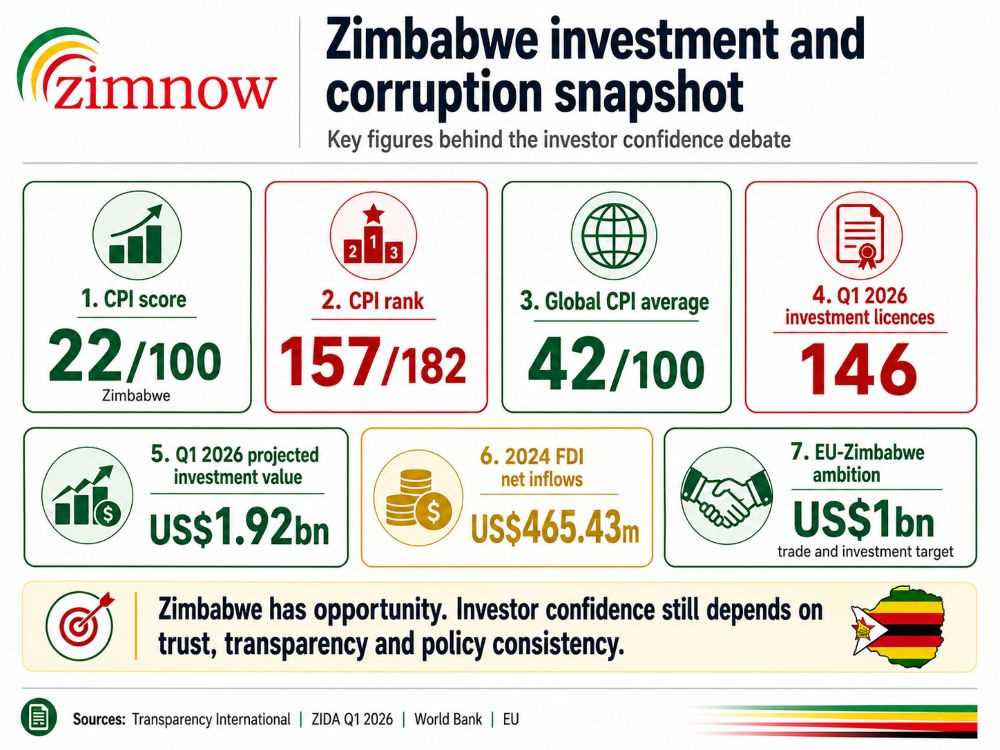
Transparency International’s 2025 Corruption Perceptions Index gives Zimbabwe a score of 22 out of 100, ranking it 157 out of 182 countries. The index measures perceived levels of public sector corruption, where 0 is highly corrupt and 100 is very clean.
The CPI reflects views from experts and businesspeople, the same broad group whose confidence Zimbabwe needs to turn investment promises into viable projects. Transparency International says the global average score in 2025 was 42 out of 100, meaning Zimbabwe remains well below the world average.
ZIDA’s Q1 2026 report shows Zimbabwe issued 146 new investment licences with projected investment value of US$1.92 billion. This was a 62% increase from the US$1.19 billion recorded in Q4 2025, although it was lower than the US$4.76 billion recorded in Q1 2025.
World Bank-linked data also shows Zimbabwe recorded US$465.43 million in foreign direct investment net inflows in 2024, underlining that while capital is coming in, the scale remains modest compared with the country’s resource potential and infrastructure needs.
The EU has been openly pushing to deepen trade and investment relations with Zimbabwe. In 2025, it hosted the first EU-Zimbabwe Business Forum in Harare, with stated goals that included promoting EU foreign direct investment, diversifying trade and maximising the benefits of the Economic Partnership Agreement.
The EU also said in 2025 that it was committed to reaching US$1 billion in both trade and investment with Zimbabwe in the near future.
That makes Hagemann’s corruption warning important as a signal that re-engagement, debt talks and trade access will not be enough if investors still fear leakages, favouritism and weak enforcement.
Who is affected?
| Group | Impact |
|---|---|
| Government | Needs reform credibility to support debt clearance and investor confidence |
| Investors | Need predictable rules, fair approvals and protection from hidden costs |
| Local businesses | Corruption can create unfair competition and favour connected players |
| Workers | Delayed or cancelled investments mean fewer formal jobs |
| Consumers | Weak investment can affect production, supply, prices and service quality |
| Anti-corruption institutions | Pressure rises to show results, not just arrests or policy statements |
For Zimbabwe’s reform agenda to produce measurable improvements in investor experience there must be fewer opaque deals, faster and cleaner approvals, stronger public procurement systems, protection for whistleblowers, visible consequences for corruption and better communication of reforms already being implemented.





Leave Comments