








Zim Now Analysis Desk
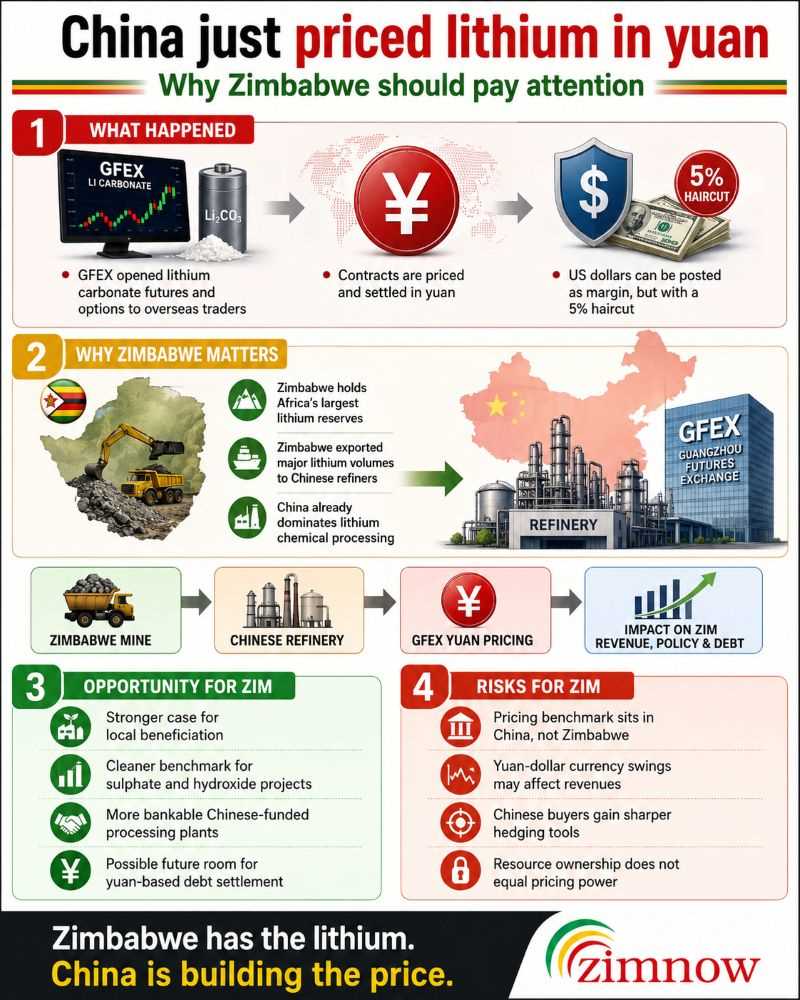
On July 3, 2026, the Guangzhou Futures Exchange opened its lithium carbonate futures and options to overseas traders for the first time. The contracts are denominated and settled in yuan. Foreign traders can post US dollars as margin, but the exchange applies a 5% haircut, meaning only 95 cents of every posted dollar counts as collateral. Everything else, from pricing to settlement, happens in China's currency.
Catch the explainer in 30 seconds here- https://youtube.com/shorts/voDHJyqfL6s?feature=share
This technical adjustment means China has started building the financial infrastructure to price lithium on its own terms, in its own currency, on its own exchange.
Zimbabwe holds Africa's largest lithium reserves and sold Chinese refiners the bulk of its output last year. What happens on a trading floor in Guangzhou now reaches directly into Harare's mining revenues, its export strategy, and arguably its debt conversations with Beijing.
What changed
The Guangzhou Futures Exchange, known as GFEX, launched lithium carbonate futures domestically back in July 2023. The contract has grown steadily since then. By June 2026, average daily turnover on the lithium contract had reached 25.81 billion yuan, roughly $3.6 billion, according to Chinese state media reporting on exchange data. In May alone, GFEX recorded 6.3 million lots of trading volume for lithium carbonate. The CME's competing lithium contract in the United States managed 1,051 lots over the same month. The London Metal Exchange's lithium hydroxide contract recorded zero trades.
Western exchanges have tried for years to build an alternative lithium benchmark that does not run through China, and they have failed, largely because China controls both ends of the trade: it is the world's largest lithium consumer and, more importantly, home to the overwhelming majority of global lithium chemical conversion capacity. Whether spodumene comes out of the ground in Zimbabwe, Australia, or Chile, it typically ends up in a Chinese refinery before it becomes battery-grade material. A futures contract that reflects that processing economics accurately has a strong claim to becoming the global reference price, simply because that is where the product gets made.
Opening the contract to foreign traders now extends China's pricing gravity outward. Beijing's own regulator has been explicit about the goal. The China Securities Regulatory Commission flagged the lithium contract for internationalisation at the start of 2026 as part of a wider push, alongside the Shanghai Futures Exchange's nickel contract, to expand global use of the yuan and strengthen China's influence over commodity pricing.
Why this matters for Zimbabwe specifically
Zimbabwe is one of the countries whose mineral wealth gives the Chinese benchmark its weight.
In the year to December 2025, Zimbabwe exported 1.128 million metric tonnes of lithium-bearing spodumene concentrate, up 11% on the prior year and accounting for roughly 15% of China's total spodumene imports. That is large enough that Zimbabwe's own export policy decisions have measurably moved Chinese processing economics this year, and large enough that Zimbabwean producers cannot meaningfully hedge, price, or plan around lithium without engaging, directly or indirectly, with the Guangzhou benchmark.
Three implications follow.
First, currency exposure becomes unavoidable, not optional. Zimbabwean concentrate has historically been priced and paid for in US dollars in bilateral contracts with Chinese buyers. As the yuan-denominated GFEX contract becomes the reference price that those bilateral deals are benchmarked against, even producers who never touch a futures account inherit currency risk they did not have before. A weakening yuan against the dollar, or vice versa, will now ripple into contract renegotiations for Zimbabwean concentrate and, eventually, sulphate and hydroxide, in ways that were previously buffered by opaque bilateral pricing.
Related Stories
Second, it strengthens the argument for beneficiation, on both sides. Zimbabwe's government suspended exports of unprocessed lithium concentrate on February 25, 2026, compressing a planned January 2027 ban into immediate effect, and has since moved to a quota system alongside a 10% export tax on concentrate ahead of the full 2027 prohibition. The policy logic was always about value capture: as of May 2026, lithium sulphate delivered to China traded at roughly $8,751 a tonne against $2,595 for spodumene concentrate on the same date, a difference of over 230%. A liquid, transparent, yuan-priced futures market makes that beneficiation math easier to model and easier to hedge for whoever is doing the processing. Chinese firms including Zhejiang Huayou Cobalt, Sinomine, and Sichuan Yahua have already committed close to $900 million combined to build sulphate processing capacity inside Zimbabwe rather than simply shipping concentrate home. A credible reference price makes those investment decisions less speculative. It cuts both ways: it also gives Chinese processors a cleaner tool to manage price risk on inputs sourced from Zimbabwe, which strengthens their hand in offtake negotiations just as much as it strengthens Harare's beneficiation argument.
Third, Zimbabwe gains a pricing reference it does not control. For all the government's assertiveness on export policy, the benchmark against which its lithium sulphate and future battery-grade output will be judged sits on a Chinese exchange, denominated in a currency Zimbabwe does not issue and cannot influence.
This is the structural bind that has defined mineral-rich Africa's position in global markets since the colonial era, regardless of which capital sets the benchmark. London and New York never priced Zimbabwean ore in Harare's interest. The IMF and World Bank have made access to capital conditional on policy terms Zimbabwe didn't write. Guangzhou is simply the newest address for the same arrangement: the country with the resource supplies the input, and the country with the exchange, the refining capacity, and the currency sets what it's worth. Beneficiation policy is Zimbabwe's strongest tool for shifting that balance, because it moves the point of value capture closer to home.
The debt question
Zimbabwe's relationship with Chinese capital cannot be separated from its debt position. Zimbabwe's Public Debt Management Office has confirmed the country owes China approximately $2 billion, a portion of a wider $6.2 billion bilateral external debt load, of which roughly three-quarters sits in arrears. China remains Zimbabwe's largest non-Paris Club creditor and has previously written off smaller tranches of interest-free loans as a goodwill gesture, without addressing the larger commercial debt stock.
The yuan's expanding role in commodity settlement adds a new dimension to that relationship. As more of Zimbabwe's mineral trade gets priced and eventually settled in yuan, and as Chinese policy banks such as China Development Bank and the Export-Import Bank of China extend financing for the processing plants now being built on Zimbabwean soil, the practical entanglement between Zimbabwe's mining sector and Chinese monetary policy deepens.
A country with debt to service and export revenue increasingly denominated in yuan has, in principle, more room to explore settling some of that debt in the same currency it is earning, rather than converting everything back into scarce US dollars along the way. Whether Harare has the technical capacity or political will to pursue that is a separate question.
What to watch next
Three things will tell us how much this actually changes for Zimbabwe. First, whether Zimbabwean producers or the Minerals Marketing Corporation of Zimbabwe begin referencing GFEX pricing directly in contracts, rather than continuing to negotiate off opaque bilateral terms.
Secondly, whether the pace of Chinese-funded sulphate and hydroxide plants inside Zimbabwe accelerates now that input and output pricing has a cleaner benchmark to model against.
And finally, whether any future Zimbabwe-China debt conversation starts referencing yuan settlement, even in narrow, symbolic form, as a signal of where the currency relationship is heading.
None of this changes the fundamental fact that Zimbabwe sits on the resource and China sits on the processing capacity and, increasingly, the price. The Guangzhou contract does not hand Harare new leverage. It sharpens the terms of a negotiation that was already underway, and it means Zimbabwe's mining ministry, treasury, and MMCZ now need people in the room who understand yuan futures markets as fluently as they understand spodumene grades.
This article draws on public exchange announcements, Zimbabwean government mining policy statements, and Zimbabwe's public debt registry. Figures on Chinese processing investment and lithium pricing are drawn from multiple industry and state media sources current as of June and early July 2026.







Leave Comments