






Zimbabwe remains one of Southern Africa's highest-risk investment destinations, with investors demanding returns of about 20 percent in US dollar terms simply to compensate for the risks of operating in the country, according to a new economic report that highlights the steep cost of capital confronting businesses.
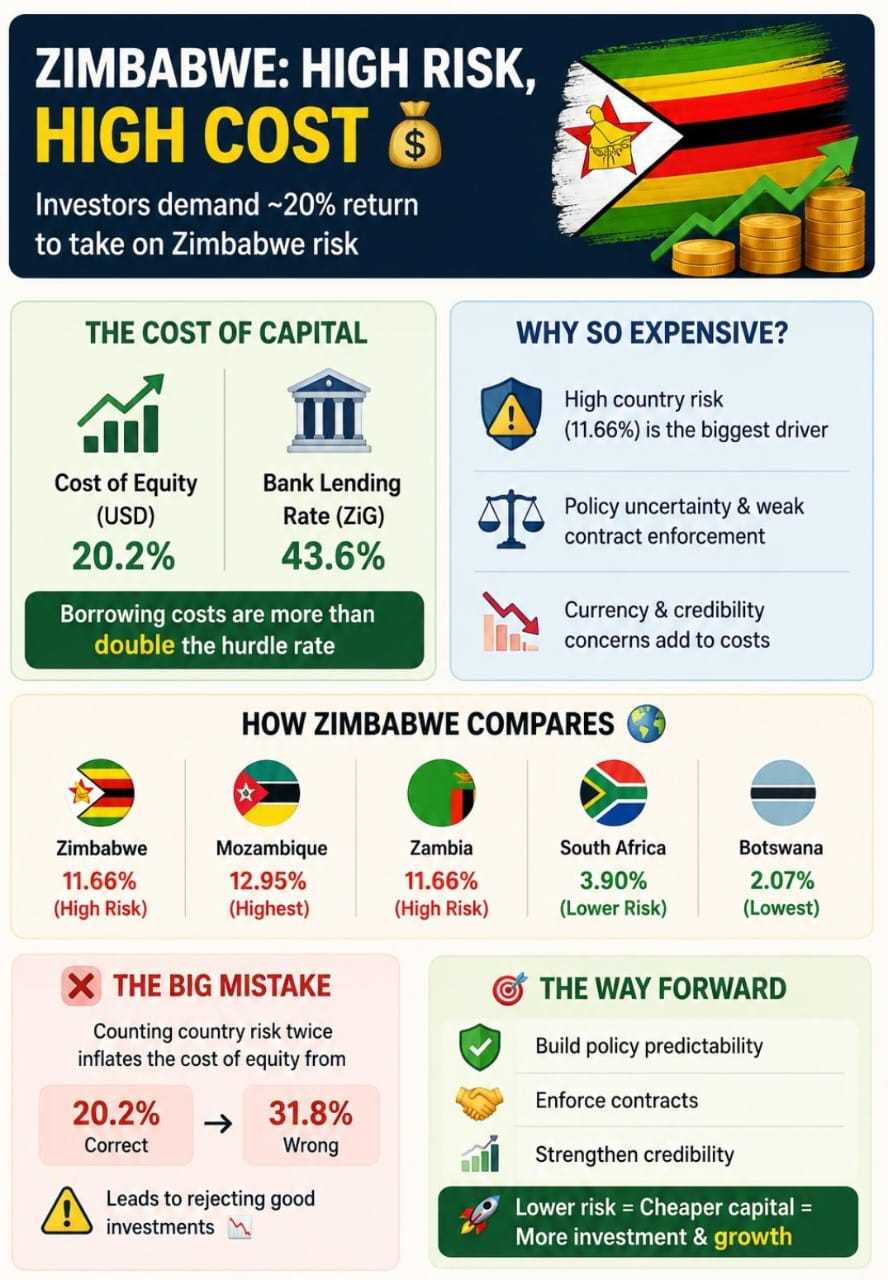
The report, The 20% Hurdle — and Why Borrowing Costs Double That, published by Streetwise Economics, estimates Zimbabwe's US-dollar cost of equity at 20.2 percent while commercial bank lending rates stand at approximately 43.6 percent, exposing what the report describes as a wide gap between the country's theoretical cost of capital and the actual price of borrowing.
"What does capital cost in Zimbabwe?" the report asks.
"Every pricing decision, every expansion, every inventory build and every loan embeds an answer to a single question: what does capital cost?"
According to the study, many Zimbabwean businesses either underestimate the cost of capital by assuming access to cheap dollar financing or overestimate it through flawed valuation methods that double-count country risk.
Using the internationally recognised Damodaran country-risk framework, Streetwise Economics calculates Zimbabwe's cost of equity from three components: a US-dollar risk-free rate of 4.29 percent, a mature-market equity risk premium of 4.23 percent and a Zimbabwe country risk premium of 11.66 percent.
Combined, these produce a required hard-currency return of approximately 20.2 percent.
"The fundamentals-based US-dollar hurdle is about 20%. The bank lending rate is about 44%. Understanding why those two numbers differ — and which one applies to which decision — is the most useful thing a Zimbabwean decision-maker can carry out of this report," the study says.
The report argues that country-specific risk remains the primary factor driving Zimbabwe's high cost of capital.
"The 11.66% country risk premium is the single largest component, larger than the risk-free rate and mature-market premium combined. Most of what makes Zimbabwean capital expensive is Zimbabwe-specific risk, not global conditions," the report states.
Regional comparisons reinforce that conclusion.
Zimbabwe's country risk premium of 11.66 percent places it among the highest-risk investment environments in Southern Africa, matching Zambia and trailing only Mozambique at 12.95 percent. The figure is nearly three times South Africa's 3.9 percent premium and more than five times Botswana's 2.07 percent.
"The honest reading is not 'Zimbabwe is the worst' — it is not — but that Zimbabwe sits firmly in the region's high-risk tier," the report says.
The findings come as the Reserve Bank of Zimbabwe begins cautiously easing monetary policy after months of maintaining some of the highest interest rates in the region to defend the Zimbabwe Gold (ZiG) currency.
Last week, the RBZ's Monetary Policy Committee reduced the benchmark policy rate by 500 basis points from 35 percent to 30 percent, citing declining inflation and improving exchange-rate stability.
The central bank said annual inflation had fallen from a peak of 95.8 percent in July 2025 to 4.4 percent in May 2026, while foreign currency reserves backing the ZiG had risen to more than US$1.5 billion. Foreign currency inflows reached US$8.3 billion during the first five months of 2026, compared to US$6 billion during the same period last year.
"The decision to reduce the Bank Policy Rate does not entail easing monetary policy at this stage, but a realignment of the policy rate to the structural shift in inflation dynamics," the Monetary Policy Committee said.
However, Streetwise Economics argues that the rate cut does little to alter the country's underlying cost of capital.
Related Stories
After the policy adjustment, the weighted commercial bank lending rate remained around 43.6 percent, more than double the estimated 20.2 percent US-dollar hurdle rate.
"The gap between the ~20% hurdle and ~44% lending — the price of currency and credibility — remains the central story," the report states.
According to the study, the disparity cannot be explained by global risk pricing alone.
While part of the difference reflects currency considerations, as the lending rate is denominated in ZiG while the cost of equity is measured in US dollars, the report says additional factors include thin market liquidity, weak contract enforcement, policy uncertainty and broader credibility concerns.
"If a bank charges about 44% in ZiG and the underlying dollar cost of capital is about 20%, the remaining ~24 points are, loosely, what the market expects to lose to depreciation and credibility combined," the report says.
The study also highlights a major valuation error that it says is widespread among analysts and investors.
According to Streetwise Economics, some practitioners mistakenly add Zimbabwe's country risk premium twice when calculating investment hurdle rates. The error inflates the cost of equity from about 20.2 percent to 31.8 percent.
"The hurdle is about 20% in US dollars. Anyone quoting 32% has counted Zimbabwe's risk twice," the report says.
The consequences, it argues, can be significant, potentially causing investors and lenders to reject projects that would otherwise create value.
Economists have similarly warned that persistently high borrowing costs can weigh heavily on economic activity.
Economist Tinotenda Bunhu recently said the RBZ's previous decision to maintain a 35 percent benchmark rate reflected a deliberate effort to preserve currency stability and prevent a return to high inflation.
"The primary objective was clear: protect the currency and prevent a relapse into high inflation," Bunhu said.
However, he cautioned that only projects generating exceptionally high returns could justify borrowing at such elevated rates, potentially delaying investment and business expansion.
African Vendor Network founder and economist Tinashe Nyangaire has also warned that prolonged high interest rates risk suppressing productive activity and increasing financial exclusion as businesses increasingly rely on self-financing or informal funding channels.
Streetwise Economics argues that lowering the cost of capital ultimately requires more than monetary easing.
"The fastest way to cut the cost of capital is to compress the country risk premium," the report says.
"Nearly ten points separate Zimbabwe's premium from Botswana's. That gap is the price of credibility — policy predictability, enforceable contracts and consistent monetary rules."
The report states that while declining inflation and lower policy rates may improve financing conditions over time, Zimbabwe's long-term competitiveness will depend on its ability to reduce country risk and rebuild investor confidence.





Leave Comments