









ZimNow International Desk
The decision by India to place the Indus Waters Treaty in abeyance marks a serious moment in one of the world’s most closely watched water-sharing arrangements.
Signed in 1960, the treaty has often been cited as a rare example of cooperation between two adversarial neighbours.
It survived wars, military crises, political upheavals and long periods of diplomatic hostility. For decades, it was treated internationally as proof that even countries with deep strategic differences could still manage shared natural resources through agreed rules and institutions.
That history makes the current dispute significant, beyond India and Pakistan, for all regions where rivers cross borders and water security is becoming more sensitive because of population pressure, climate stress and development needs.
India’s position is that the treaty can no longer be treated as business as usual when the broader relationship has been deeply damaged by repeated hostility, including cross-border terrorism. Pakistan, on the other hand, rejects any unilateral suspension of the treaty and argues that water-sharing obligations cannot be set aside because of political disputes.
That disagreement now sits at the centre of a larger question: how long can a treaty remain functional when the trust needed to sustain it has eroded?
From India’s perspective, the problem is not only terrorism or diplomatic hostility. It is also Pakistan’s long-standing use of treaty mechanisms to delay or challenge Indian hydroelectric and water-management projects, particularly in Jammu and Kashmir.
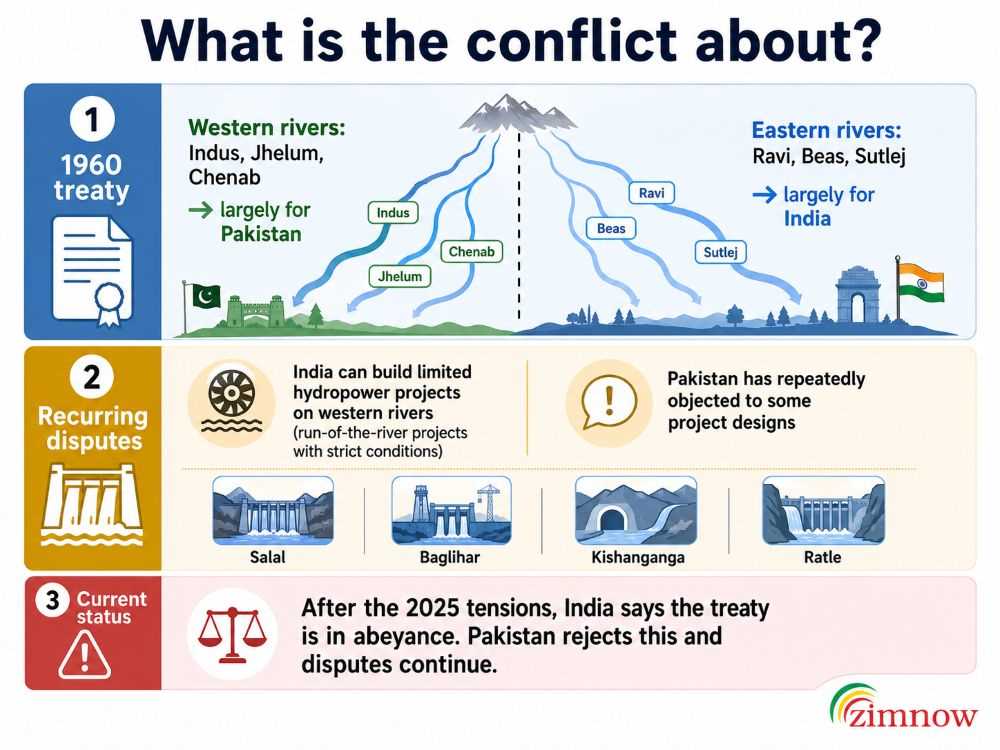
The Indus Waters Treaty gave Pakistan control over the western rivers, namely the Indus, Jhelum and Chenab, while India retained rights over the eastern rivers, the Ravi, Beas and Sutlej. However, the treaty also allows India limited use of the western rivers for purposes such as run-of-river hydroelectric power generation, domestic use and some agricultural activity, provided those uses comply with treaty provisions.
India argues that Pakistan has repeatedly treated even treaty-compliant Indian projects as strategic threats. According to this view, technical objections have often been turned into political disputes, delaying projects that could support development in Jammu and Kashmir without reducing Pakistan’s share of water.
This pattern, India says, began early. Soon after the treaty came into force, India supplied information on small hydroelectric plants intended to serve remote communities upstream of the international border. One such project was only 200 kilowatts and involved no consumptive use of water. Yet Pakistan objected. Similar objections followed over other projects, creating prolonged discussions over developments that India considered modest and legitimate.
Related Stories
Over the years, larger projects became even more contentious. The Salal Hydroelectric Project, for example, became the subject of Pakistani objections in the 1970s. India eventually agreed to design changes, including reducing pondage and modifying low-level outlets. Indian critics of those concessions argue that they were not required by the treaty and later undermined the dam’s sediment-management capacity, affecting its long-term efficiency.
The Tulbul Navigation Project in the Kashmir Valley followed a similar path. India suspended work in 1987 after Pakistani objections, hoping for an amicable settlement. The project remains unresolved decades later. India’s argument is that what could have been a mutually useful navigation and water-regulation project became another casualty of political mistrust.
The Baglihar Hydroelectric Project also became a major dispute. Pakistan raised objections and eventually took the matter to a Neutral Expert under the treaty framework. The final decision largely upheld India’s right to proceed, subject to some technical modifications. For India, the outcome weakened Pakistan’s broader claim that such projects posed an existential water threat.
The Kishanganga Project produced another prolonged battle. Pakistan objected to India’s plan to divert water from the Kishanganga/Neelum River for power generation before returning it into the Jhelum system. The matter went to arbitration, and the Court of Arbitration upheld India’s right to divert the waters, while also setting conditions to protect minimum downstream flows. Even after that ruling, the project continued to attract objections and uncertainty.
The more recent Kishanganga and Ratle disputes have further strained the treaty framework. India has objected to Pakistan pursuing parallel processes involving both a Neutral Expert and a Court of Arbitration. New Delhi argues that this undermines the agreed dispute-resolution mechanism and creates legal confusion. Pakistan maintains that it is using available treaty channels to protect its water interests.
This is where the core disagreement becomes clear. Pakistan sees its objections as defensive measures in a highly water-stressed country dependent on the Indus system. India sees them as a pattern of obstruction that has gone far beyond legitimate technical scrutiny.
There is no doubt that Pakistan faces serious water pressures. Its agriculture, food security and economy are deeply tied to the Indus basin. Any perceived threat to these waters is therefore politically explosive. This explains why Indian dams and hydroelectric projects have often triggered alarm in Pakistan’s media and political discourse.
But India’s counterargument is that Pakistan’s water crisis cannot honestly be blamed on Indian projects alone. Pakistan’s own policy documents and public statements by some of its leaders have acknowledged deep internal weaknesses in water management. These include low storage capacity, canal losses, inefficient irrigation, poor maintenance, wasteful cropping patterns and inter-provincial disputes.
In 2010, Pakistan’s then Foreign Minister Shah Mahmood Qureshi publicly challenged the claim that India was responsible for Pakistan’s water shortages. He pointed to large volumes of water being lost through mismanagement and urged Pakistanis not to blame India for failures within their own system. That admission remains important because it complicates the popular narrative that Pakistan’s water stress is mainly the result of Indian action.
Pakistan’s 2018 national water policy also recognised major inefficiencies. Large volumes of water diverted into the canal system do not reach farms. Significant flows also drain into the Arabian Sea without being fully utilised. These are major administrative issues that point to internal structural problems.

India argues that Pakistan cannot expect normal cooperation under a major strategic treaty while allowing or supporting forces that destabilise Jammu and Kashmir. Pakistan rejects that accusation and insists that the treaty is a separate legal instrument that should not be linked to broader political disputes. Yet, in practice, no major agreement exists in a vacuum. When violence, distrust and hostile rhetoric dominate the wider relationship, technical cooperation becomes harder to protect.
The Indus Waters Treaty survived for more than six decades because both countries, despite conflict, saw value in keeping water cooperation insulated from war and politics. That insulation is now under severe pressure.
For India, placing the treaty in abeyance is a signal that patience has limits and that cooperation cannot be one-sided. For Pakistan, the move is alarming because the Indus system is central to its national survival. For the international community, the dispute is a warning about the fragility of even long-standing agreements when political trust collapses.









Leave Comments