








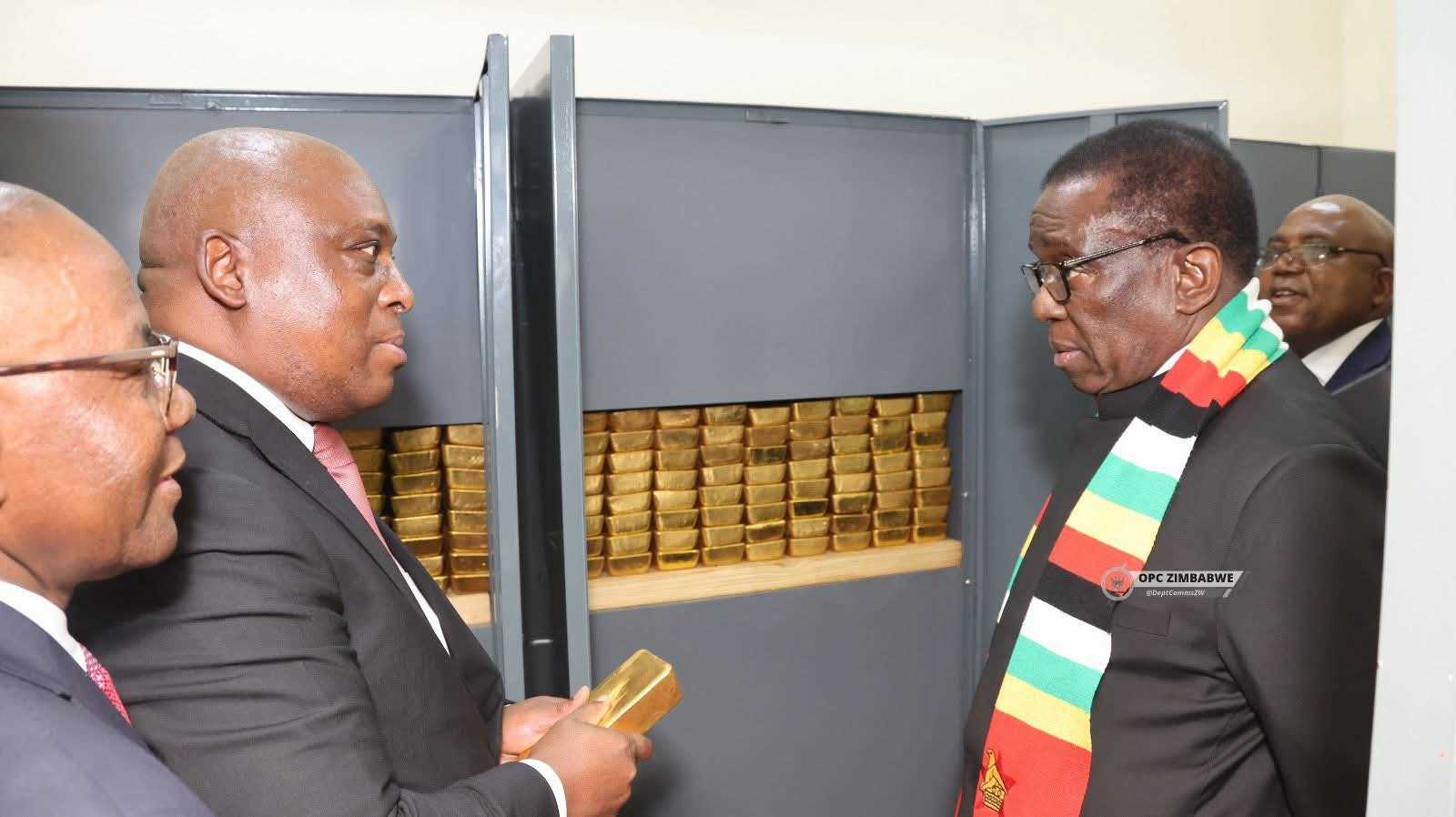
Caption: President Mnangagwa tours RBZ to inspect vaults that are holding national reserves as backing for the Zig, currency
Zimbabwe's gold sector has reached record production levels, but a new US$15 million investment threshold for foreign participation in small and medium-scale gold mining could undermine future growth by discouraging the exploration capital needed to discover the next generation of large mines, a new policy analysis has warned.
A report prepared by Fincent Advisory for the Ministry of Mines and Mining Development, the Ministry of Finance, Economic Development and Investment Promotion, the Zimbabwe Investment and Development Agency (ZIDA) and the Chamber of Mines argues Zimbabwe’s challenge is no longer current production, but ensuring the country maintains a pipeline of future large-scale mines.
Zimbabwe produced a record 46.7 tonnes of gold in 2025, a 28 percent increase from the previous year, with artisanal and small-scale miners (ASM) accounting for approximately 75 percent of output, or 34.9 tonnes. Large-scale operations, where most foreign investment and exploration activity occurs, contributed only about 11.8 tonnes and have remained largely stagnant.
The report notes that while the government’s new gold policy seeks to promote citizen participation, formalise small-scale mining, improve environmental compliance and curb speculative holding of mining claims, its investment thresholds could have unintended consequences.
Under the policy announced in May 2026, small and medium-scale gold operations producing 20 kilograms or less per month or requiring capital of US$15 million or less are reserved for Zimbabwean citizens. Foreign operators below that threshold are expected to scale up, enter alternative arrangements, or exit the segment, while all operators must re-register by January 1, 2027.
However, Fincent argues that the US$15 million investment threshold does not reflect the realities of mineral exploration, which is typically financed through smaller, staged funding rounds.
The study says most early exploration programmes globally require between US$1 million and US$5 million, while only 43 companies worldwide had gold exploration budgets exceeding US$10 million in 2024. As a result, the new threshold is considered significantly higher than what most junior explorers can commit.
Related Stories
"A US$15 million entry floor therefore exceeds the budget of the overwhelming majority of the world's gold explorers.The grassroots share of global budgets is at a record low (~19%), so the early-stage capital Zimbabwe needs is already globally scarce; a high threshold competes against, rather than attracts, it," the report notes.
"Treating exploration like development is the policy’s central calibration error,” the report states. It argues that the restriction could limit the flow of risk capital needed to discover future mines.
According to the analysis, uncertainty around ownership rules, title security and capital repatriation could increase investment costs, reducing project values by an estimated 25 to 40 percent and extending the time required to secure financing.
The report warns that if the policy is implemented without adjustments, exploration spending could decline by 30 to 50 percent, potentially resulting in the loss of 4 to 6 tonnes of annual large-scale gold production by the early 2030s.
"In plain terms: under strict implementation, an exploration-spend fall of 30–50% could forgo an estimated 4–6 tonnes per year of potential new large-scale output by the early 2030s — roughly US$0.4–0.6 billion per year in export earnings and US$20–30 million per year in royalties at a 5% rate, before corporate tax.
"The investor-friendly path does the opposite, adding 8–10 t/yr and close to US$1 billion in annual exports. This is the production pipeline the threshold puts at stake," the report further states.
The findings also raise questions over alignment with the National Development Strategy 2 (NDS 2), which targets mining growth from 5.7 percent in 2026 to 6.9 percent by 2030 and places emphasis on attracting responsible investment and expanding early-stage exploration.
Fincent maintains that the policy’s objectives of empowerment and formalisation can still be achieved but recommends replacing the blanket US$15 million threshold with stage-based investment commitments, protecting existing investor rights and creating a transparent ZIDA exception mechanism for strategic projects.







Leave Comments